
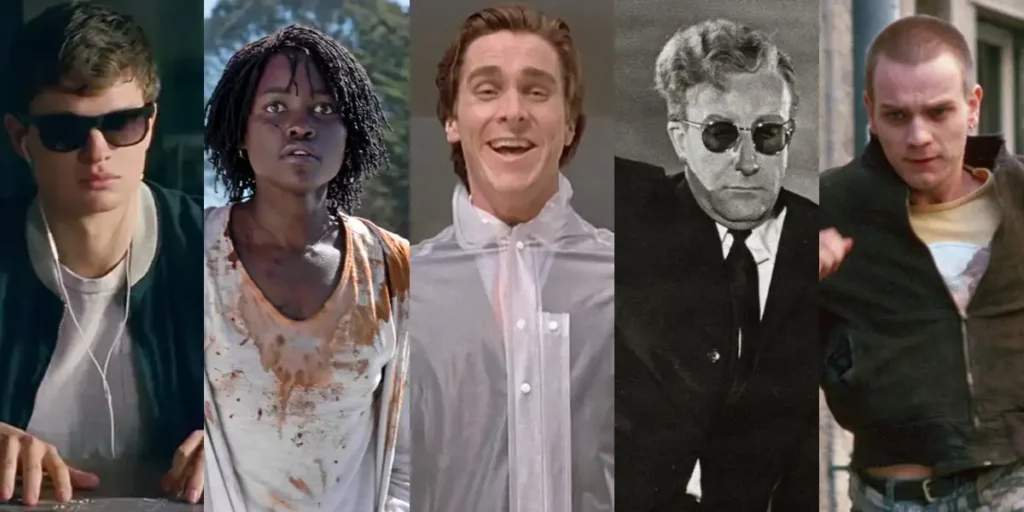
Magic can happen when music and film are brought together. Let’s look at the top 25 best needle drops, or uses of songs, in movies!
Non-original songs have been put into films about as long as the cinema itself has been around. But the use of pre-existing songs in movies, or “needle drops,” didn’t become a standard practice until the 1960s and especially the 70s. Since then, needle drops have become so common that most people usually don’t think twice about them. But most people also don’t spend their free time writing about movies on the internet, so here I am to ask the question: what are the best needle drops to ever be put in movies?
But first, some qualifiers. We’re not including songs that were originally written for the film in question, although new covers of premade songs are allowed. I’m also regrettably excluding the use of century-old classical music because, to be blunt, those are so widespread that I’d never be able to wrangle them together and preserve my sanity. Lastly, no songs that are played in biopics of their respective musicians, because then I’d say things like, “Y’know, that Rocketman has some really good Elton John needle drops!”
As a final warning, full spoilers are on the table for all of these movies. And even with my exclusions, I’m certain some great needle drops have slipped my mind or eluded me, so feel free to share your own favorites! With that said, these are what I consider the top 25 best needle drops in movies.
25. “Where Is My Mind?” by Pixies – Fight Club
Here’s a tune almost everyone remembers when they think of needle drops, and for good reason. An unnamed Narrator (Edward Norton, of The Invite) is brought into a fight club by the enigmatic Tyler Durden (Brad Pitt, of F1). The club becomes a terrorist group out of his control, and it turns out Tyler is the Narrator’s other personality freeing him from an unsatisfying life. The two fight until the Narrator shoots himself in the face, killing Tyler but leaving him alive. He and his love interest (Helena Bonham Carter, of Enola Holmes) then look out at the skyline and hold hands while the club blows up skyscrapers, with the Pixies song playing them out.
“Where Is My Mind?” already has an industrial, ghostly sound to its main riff and loose vocals, so it’s perfect for a movie as unhinged as Fight Club. Even when the Narrator seemingly regains control of his mind, the consequences of the harsh things he’s done in an even harsher world are literally exploding around him, and all he can do is watch to the beat of a wailing song about the floating, spinning mind he’s escaped. The song is almost impossible for most people to hear without thinking of this unforgettable imagery, and it became Pixies’ most well-known track largely for that reason.
24. “A Change is Gonna Come” by Sam Cooke – Malcolm X
Sam Cooke’s American standard has always been rooted in the racial tensions of his and Malcolm X’s time, so it’s a no-brainer to include in a film about the titular Black activist (Denzel Washington, of Highest 2 Lowest). But what makes it stand out here is where it’s used and how much more bittersweet it becomes. Near the end of the film, after taking a more independent stance on his worldly outlook compared to his Islam allies, Malcolm X is on his way to give what would be his final speech before his assassination. In his car, “A Change is Gonna Come,” plays as he ponders over his family and the violent opposition likely following him.
We know he’s about to be killed, we know he knows it’s a possibility, and we know it’s largely because of the change he’s trying to create. Which gives the song – usually meant as a symbol of pure hope – an undercurrent of darkness as we’re reminded that all necessary steps forward will be met with hostility, and things will get worse before they get better. After all the ugliness Malcolm X has seen and even inadvertently contributed to, this final needle drop has us thinking of both the song and his legacy a bit differently. The cost of change may be worth it, but it still can hurt all the same.
23. “Raindrops Keep Fallin’ on My Head” by B.J. Tomas – Spider-Man 2
Since this song’s use in the film it was made for – Butch Cassidy and the Sundance Kid – doesn’t count, the next best thing is its reinvention in Spider-Man 2. This superhero sequel sees Peter Parker (Tobey Maguire) struggling with his fading powers after a series of personal crises. When the powers stop working entirely, he forgoes his responsibility as Spider-Man, leading to an upbeat montage of him living a carefree life to the beat of the song. He’s succeeding in school, he’s walking comedically joyfully through the city, and he even casually munches on a hot dog while watching a police chase he would’ve once joined in on.
Sam Raimi’s Spider-Man movies are already goofy, but it’s a bold move to follow up the brooding retirement of a hero with a sequence this campy, and then insert such a breezy jaunt of a tune to boot. But it stands out as one of the film’s most memorable bits. After Peter’s been beaten down the whole movie, just hearing that ukulele kick in puts you in his cheery headspace, while reminding you deep down that there are still problems – raindrops – around him. It’s a feat to take a song already heavily associated with its intended movie, and have it be so immediately tied to another totally different movie decades later.
22. “I Got 5 on It” by Luniz – Us
Apparently, Jordan Peele wasn’t satisfied with making scissors, rabbits, and the time 11:11 creepy. He asked composer Michael Abels to turn a hip-hop song about drugs into a horror track. In Us, a family are traveling to their vacation home and grooving to this track, with Adelaide (Lupita Nyong’o, of The Odyssey) getting her young son in rhythm to the tune. The family are later attacked by doppelgangers of themselves, culminating in a fight between Adelaide and her copy to a slower, eerier orchestration of the song’s hook. Firstly, the song on its own now sounds way spookier than it was probably ever meant to be, so good job there.
Secondly, Adelaide snaps her fingers to the track on the down beat, which subtly hints at her not being totally in sync with how most “normal” people would process something. Some people pieced together from this alone that she’s the original doppelganger who swapped with her other version years ago. As for why this song specifically was picked, the subject matter of people splitting the cost of weed darkly, humorously parallels the fact that each doppelganger mirrors the actions of their counterparts. Except in this case, it’s against their will. Bottom line, I’ve never been so happy to have a song ruined like this.
21. “My Hero” by Foo Fighters – The Other Guys
This is one of those needle drops where you just kinda had to be there at the time. Underdog detectives Gamble (Will Ferrell, of Barbie) and Hoitz (Mark Wahlberg, of Flight Risk) envy the glory and attention of the far more decorated, celebrated, and badass Detectives Danson (Dwayne Johnson, of The Smashing Machine) and Highsmith (Samuel L. Jackson, of Argylle). These two head out, chasing criminals on rooftops in an epic race that brings in the jamming Foo Fighters hit. When they need to make a quick descent, the action heroes confidently jump down, the song blasts louder… and they pathetically hit the ground and die.
After seeing these two be built up as pompous rock stars, played by two very famous actors, I’d expected them to gradually fall from grace over the course of the film. Not literally fall out of the picture in one sudden act of stupidity within the first twenty minutes. And I really don’t think this punchline would have worked nearly as well had the buildup not been accompanied by such a triumphant and, well, heroic song. Especially when that song immediately cuts out when they hit the ground. It’s a short but sweet gag that practically defines the movie, and “My Hero” deserves a lot of credit for helping it land… unlike these guys.
20. “Mele Kalikimaka” by Bing Crosby and the Andrews Sisters – National Lampoon’s Christmas Vacation
Probably not the first needle drop you think of when this holiday comedy is brought up. But whenever I hear the song around Christmastime, I can never again go without thinking of Chevy Chase perving out. With Christmas approaching and his whole family chaotically gathered in his house, Clark Griswold (Chase, of John Candy: I Like Me) is awaiting his holiday bonus so he can put in a swimming pool. He stares out the window and envisions the pool fully installed in the summer, with everyone having wholesome fun… until a store employee he’s hot for starts invading the fantasy and giving him a “show.”
In a film that banks heavily on winter and holiday memories, it’s already nice to get a more tropical brand of nostalgia with this scene, especially if you live somewhere that never gets snow in December. (Which is what the song is about in the first place.) But then that wholesomeness is ruined by Clark’s shameless lusting, with Chase’s eager performance driving the joke home. Even the big trumpet section suddenly sounds like music from a sleezy porno! The absurdities mix like a margarita you’d drink at this very pool party, and in a holiday as atmospheric as Christmas, you’re given another reason to smile when hearing this jingle.
19. “Tubular Bells – Pt. 1” by Mike Oldfield – The Exorcist
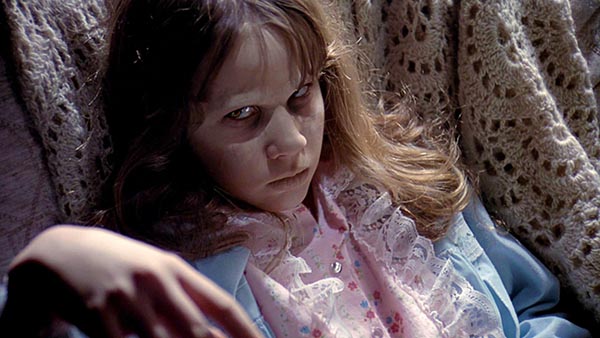
Believe it or not, the “theme” to 1973’s The Exorcist had already existed from Oldfield’s instrumental rock album earlier that year. But its appearance in the film, though brief, is so fitting that it’s impossible to separate the two. It’s not even part of some major scene. Film actress Chris MacNeil (Ellen Burstyn, of Requiem for a Dream) is simply walking home to her home and daughter (Linda Blair). Nothing particularly bad has happened yet; she’s just strolling down the street during a bustling Halloween season, only stopping when she briefly overhears a conversation involving Dr. Damien Karras (Jason Miller).
With how sinister the opening piano and titular tubular bells sound in the original song, it’s no shock that someone quickly saw their potential as the theme for a horror movie as grounded yet freaky as The Exorcist. It’s used purely to build the sense of something dark looming over everyone that hasn’t fully arrived yet. Chris has no reason to worry about anything at this point, but this song playing over a crisp, blustery Halloween day tells us she should be worried. And on that note (no pun intended), the scene as a whole just gets you in the mood for Halloween, which is when most people probably rewatch this movie anyway.
18. “Everybody’s Talkin’” by Harry Nilsson – Midnight Cowboy
Harry Nilsson didn’t do the original version of the song – that was Fred Neil – but he might as well have given its iconic use in this 1969 drama. The Midnight Cowboy in question is Joe Buck (Jon Voight, of Megalopolis), who leaves his Texas home behind to become a male prostitute in New York City. “Everybody’s Talkin’” starts playing as he wanders through his town, ready to leave it. It appears several more times as the film’s main theme, including near the end as Joe ditches his cowboy outfit on his way to Florida with his hustler friend Rico (Dustin Hoffman, of Tuner).
At first, the lightly sweeping, plucky tune seems to set the mood for a hopeful man voyaging to a new horizon. But when you know how dark the circumstances that brought him here are, and how utterly lost he is in his trauma, this exact same piece suddenly sounds much more somber and sadder. And that’s not even addressing how it’s about getting away from a big, bustling city with hollow faces, yet it’s played as a character is trying to integrate himself into it, foreshadowing how much Joe doesn’t belong there. Much like the movie itself, the song gets you feeling down in a deep, quiet way.
17. “We’ll Meet Again” by Vera Lynn – Dr. Strangelove
Here we have another soft tune to a tragic ending… at least, it would be tragic had it not been so funny. Stanley Kubrick’s Dr. Strangelove mocked the then-contemporary Cold War with the story of a preemptive nuclear strike on the Soviet Union, ordered by the paranoid commander Jack D. Ripper (Sterling Hayden, of The Godfather). The rest of the movie is one farce after another in an attempt to stop the strike, which would activate the Soviets’ doomsday machine and destroy the world. One missile gets through – complete with a cowboy riding it down – and we end on nuclear Armageddon to the lovely sound of Vera Lynn’s singing.
It’s pretty obvious to tell what makes this such a great needle drop. A hopeful song about loved ones being reunited someday is put against the literal end of the world that ensures no one will see their families again. Unless you want the interpretation of everyone meeting each other in the afterlife. Regardless, that is the ultimate sick, twisted punchline in a movie filled with jabs at the brainless poisons of Cold War-era politics… and no other politics, especially not today’s. It’s even funnier since song had been used to provide comfort to the British public in an age of nuclear paranoia. So, nice job shattering that bliss, Kubrick.
16. “Mad World” by Michael Andrews and Gary Jules – Donnie Darko
This cover of the Tears for Fears original is so famous that a lot of people don’t even know it’s a cover. It plays at the end of this strange psychological thriller with Jake Gyllenhaal (Spider-Man: Far From Home) as the troubled teen Donnie, who sees and receives orders from a strange figure in a rabbit suit named Frank (James Duval, of Independence Day). He subsequently complicates the lives of everyone around him, until a vortex sends a plane back in time to an alternate reality in which it kills Donnie, letting everyone else move on without the troubles he brings… I think. I’m honestly still not sure if that’s the idea.
But half the reason I give into it at all is because this song comes in to add an extra layer of depressing. The bottom line is essentially that Donnie’s very existence, something he’s struggled to find the purpose of, has no place in the world anymore. Or, if it does, it’s reduced to a bad dream for the people he left behind in this new timeline. It’s hard to tell whether their lives are better without him, worse, or if it doesn’t matter. Because, as the song says, they’re all going nowhere with no tomorrow anyway. It’s the fact that this stripped-back version of is used – rather than the rock-driven original – that makes everything even more hopeless.
15. “Dark & Long – Dark Train” by Underworld – Trainspotting
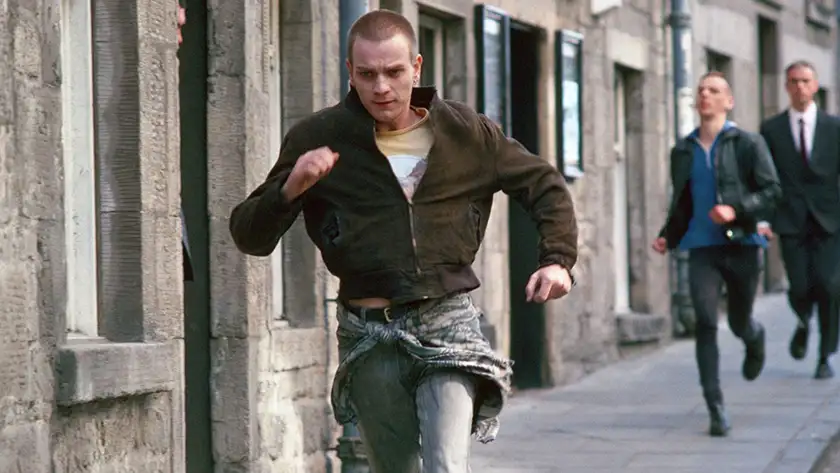
Trainspotting is one of those films where each song selection is a great choice, but this one leaves by far the biggest mark. A group of heroin addicts is struggling to get sober, with Mark Renton (Ewan McGregor, of Star Wars: Revenge of the Sith) going through withdrawals in his bedroom. The result is a series of sweating, screaming, and hallucinations involving HIV tests on game shows, stretching rooms, and a baby crawling on the ceiling. And, of course, Underworld’s remixed song is there to keep the pulse up the entire way through.
It goes without saying that withdrawal is an immensely difficult thing for recovering addicts to face, but this sequence hammers into your skull that it can be absolute hell. The sins of the past caused by Renton’s addiction and the fears of the time in which he lives are fused with a thumping dance track that, in isolation, is very catchy and fun. But the repetitive beat and utterance of “ride the train” become maddening when they never let up throughout the ordeal. Listening to it again just keeps bringing me back to that scene. Instead of grooving like it wants me to, I’m feeling my heart race a bit.
14. “You’re My World” by Cilia Black – Last Night in Soho
This criminally underrated film from Edgar Wright has a handful of great needle drops to choose from. But my personal favorite is the double use of “You’re My World.” The first happens when teenager Ellie (Thomasin McKenzie, of Eileen) is transported to the 1960s of which she fantasizes, seeing the glamorous life of club singer Sandie (Anya Taylor-Joy, of Furiosa) and even Cilia Black herself. But through her supernatural gift, Ellie learns that Sandie murdered the men who abused her. The song returns as an elderly Sandie (Diana Rigg) tries to kill her to cover up her crimes, switching between old and young Sandie in Ellie’s mind.
The old-timey glitz and sophistication that Ellie sees in the 60s come out through this swaying track as she enters a gorgeously lit theater in the glossy streets, with Black’s booming voice amplifying these sensations. But with the sharp strings at the start, slow beat, and lyrics that put all the singer’s worth into one person, the song works equally well as the anthem for a woman driven mad by abuse and revenge. The song doesn’t sound all too uplifting anymore, does it? Which all serves the point of the film: even the eras we idolize have dark, terrible underbellies beneath their flashy surfaces.
13. “Hip to Be Square” by Huey Lewis and the News – American Psycho
A lot of people probably think of the song “Stuck in the Middle with You” in Reservoir Dogs when murdering someone to a catchy song enters their minds… which hopefully doesn’t happen often. But for me, American Psycho takes the cake in that oddly specific department. Patrick Bateman (Christian Bale, of The Bride!) is an investment banker desperate to thrive in his high-class life while moonlighting as a killer. He becomes jealous over the greater success of his coworker, Paul (Jared Leto, of Tron: Ares), invites him to his apartment, and murders him with an axe after playing and explaining the song in question.
Bateman’s delusional pretentiousness, chewing of scenery, and violent… um, quirks, all coalesce right here. Of course he’d preach about the deeper meaning of a band and song he claims to be an expert on, completely missing that its celebration of conformity is meant in irony. Of course he’d find it necessary to tell this to the person he’s about to brutally slaughter. And of course he’d just wipe himself down and settle back to calmness with the loud pop song still blaring. The buildup is great, Bale’s cheery performance is infectious, and you get to see the best Batman kill the worst Joker. What else do you need?
12. “I’ve Told Every Little Star” by Linda Scott – Mulholland Drive
The enigmatic Mulholland Drive is seemingly about a mysterious woman named Rita (Laura Harring, of Inland Empire) on the run, taken in by aspiring actress Betty (Naomi Watts, of The Ring). The two develop an intense attraction for each other, during which time Betty also sees Camilla Rhodes (Melissa George, of Dark City) auditioning for a role with a lip sync of “I’ve Told Every Little Star.” Where things get head-scratching is when we shift to Diane Selwyn – who resembles Betty exactly – and her ex-girlfriend, the apparently real Camilla who resembles Rita. From my interpretation, this movie takes Diane’s abstract fantasies and internal angers and brings them to physical reality.
So, the “fake” Camilla singing about a longing she’s yet to confess is possibly a sign of many things. Is Diane projecting? Does she think the real Camilla still has hidden feelings for her? Is the fact she’s lip-syncing Diane’s way of imagining her as a fraud? Plus, when you aren’t entirely sure what’s going on, you get something that sounds so cheery and innocent being fake-sung by an actress who barely looks like she knows what she’s doing, in a sterilely colored set, and it visibly puts Betty on edge. As a result, the song sounds so off, as it should. It’s given a new dreamlike quality that’s on par with the rest of the movie.
11. “The Number of the Beast” by Iron Maiden – 28 Years Later: The Bone Temple
This movie is less than a year old, but I’m already calling its climactic needle drop one of the best of all time. After the events of 28 Years Later, Satanist cult leader Sir Jimmy (Jack O’Connell, of Sinners) finds the kind and reclusive Dr. Ian Kelson (Ralph Fiennes, of Conclave), who has built a bone temple to honor victims of the Rage Virus. Jimmy questions whether Kelson is Satan and therefore his father. To convince Jimmy and save his own life, Kelson dons makeup and puts on a performance of dance, fire, and Iron Maiden blasting through his speakers.
Fiennes goes to freaking town with some of his best acting ever, fully embodying the deranged, animalistic lunatic of Satan himself. The already striking bone temple is vividly lit aflame in a stunningly gorgeous display of pyrotechnics and hallucinatory blurs. It’s utterly f**king ridiculous, but everything about the story backs it up. At that point, it’s just a matter of choosing the right song to go with this hellish imagery and idea, and do I need to explain why a heavy metal track about experiencing the Devil is the best choice? Jimmy and his cult seem suckered in by the display. Why shouldn’t we be?
10. “Day-O (The Banana Boat Song)” by Harry Belafonte – Beetlejuice
This is certainly one of the strangest needle drops of all time, but that helps imprint it in our minds and link the song and film even more closely together. Beetlejuice, a supernatural comedy about ghosts whose home is sold to a vain family, couldn’t be any more different from this Jamaican folk song. When the ghosts (Geena Davis and Alec Baldwin) try to scare the new family out of the house, one of their ideas is to possess the group during dinner and make them sing and dance to Belafonte’s rendition of “Day-O.”
This family isn’t outright despicable or anything, but they’re clearly shallow and pretentious enough to where this kind of “scare” is satisfying to watch. The method matches how the rest of the movie operates: terrifying in concept, randomly bizarre, but just grounded enough to keep one toe in reality. As for why this song specifically was used, maybe it just sounds simple and quirky enough for what the scene is attempting? I’m okay with not knowing. Like several old-school Tim Burton movies, the randomness somehow clicks. Where else would you get this combo? Aside from Beetlejuice Beetlejuice, but why settle for sloppy seconds?
9. “Harlem Shuffle” by Bob & Earl – Baby Driver
Edgar Wright never misses with his needle drops. I can already hear the dismay at me leaving Shaun of the Dead off this list. But his crowning achievement of music in film is Baby Driver. “Baby” (Ansel Elgort, of West Side Story) is a youth stuck as a getaway driver for a gang he’s indebted to, but one of the ways he copes with stress is his thorough love of music. The film brilliantly times many sequences to whatever song he’s listening to, including the revving engines and gunfire. It’s unclear whether this is all a pure coincidence or, as I like to believe, we’re seeing inside Baby’s mind as he times everything subconsciously.
For all the elaborate examples, my personal favorite is relatively simple. It’s over the opening credits when Baby is on a coffee run while listening to “Harlem Shuffle.” This is your first good look at who Baby is: someone clearly in a troubled space but still powering through with style thanks to, as clichéd as it sounds, the power of music. The walking paces of everyone around him, the ringing of bells, and even his “yeahs” when choosing an order all sync up to fully hit you what exactly the movie is doing. Other moments are more impressive, but this one stands tall by only relying on the personality of this character and world.
8. “Wise Up” by Aimee Mann – Magnolia
In this three-hour odyssey of strangeness and dysfunction, we follow a sexist motivational speaker, a game show host, his estranged daughter, a hapless cop, a gold-digging wife, her husband’s nurse, a child prodigy, a former child prodigy, and eventually frogs fall from the sky. When I lay everything out, the idea of them all independently, separately singing along to a non-diegetic song originally meant for Jerry Maguire doesn’t seem so strange. That’s exactly what happens when most of the characters are at their lowest points, buried by their anxieties, egos, traumas, and denials of fault.
After two hours of emotional chaos, this singalong to a slow ballad of reflection is a much-needed moment of peace and clarity. It’s the most human you’ve seen these people at this point, and because the entire movie has been so surreally assembled in typical Paul Thomas Anderson fashion, it works magnificently. It’s the only time in which everyone seems to be on the same page without even knowing it, like this is the one chance for them all to spiritually cross paths before facing the fallout of previous events. It’s the film’s most tender sequence and hits like a ton of bricks – or a storm of frogs – exactly when it needs to.
7. “Still” by Geto Boys – Office Space
I literally start laughing every time I reach this section in the writing process. Office Space takes tons of shots at the tedious idiocy of workplace life, focusing on a group of friends who begin fighting back against their callous company. Though they come up with schemes that are designed to be practical and impactful, they go for pure catharsis by taking a constantly jamming, problematic printer into a field and beating the everloving s**t out of it. The Geto Boys back them up and vault this scene into legendary territory.
I’m pretty sure we’ve all wanted to take out our rage on the most uncooperative nonliving object of our workspace. But by adding this aggressive, white-knuckled rap track, Office Space makes it look like the single most legendary thing a human being could possibly do. It even boosts the mimicry of street life pain when one of the traumatized workers has to be pulled away from the wreckage. Everyone’s remarked on how the blocking and editing play their part in the hilarity as well. But a song shouting “Die, motherf***ers, die!” being redirected at a printer? That’s the biggest source of laughter for me.
6. “The Chain” by Fleetwood Mac – Guardians of the Galaxy Vol. 2
Let’s be real; a quarter of James Gunn’s needle drops could’ve made the list, but it would be overkill to include them all. The second Guardians film finds Peter Quill (Chris Pratt, of Mercy) reunited with his god father Ego (Kurt Russell, of The Thing). The team splits off, and “The Chain plays under the weight of their emotional rifts. As Peter is tempted by the life of a god, it seems like the titular chain – the bonds uniting this family – may truly be broken. But when Ego’s evil nature is revealed and his victory seems final, Peter reaffirms his bond with his friends and fights back with the tune playing again.
It’s rare that a song can convey two starkly different tones at two different points within the same movie. The first is dour and moody, causing the line “You’ll never love me again” to dominate. The second is firmly triumphant, causing the line “You would never break the chain” to stand tall. That dichotomy has always been the nature of the song itself, but it’s fantastically put to use at two of the film’s most pivotal moments. As a bonus, the song’s second appearance is one of very few non-diegetic needle drops in the trilogy. It’s purely coming from Peter’s soul. Cheesy? Yes. Totally belonging in a Guardians movie? Hell yes.
5. “California Dreamin’” by The Mamas and the Papas – Chungking Express
This is probably the least “mainstream” film on the list, but it squeezes everything it can out of an all-time great track. Chungking Express features a cashier named Faye (Faye Wong) in Central, Hong Kong. As she goes through a humdrum yet busy life and falls for a recently dumped police officer (Tony Leung Chiu-wai), Faye imagines herself in the paradise of California, USA. This song of the same sentiment plays frequently throughout her story, including blaring on her restaurant’s radio, while she secretly cleans her crush’s apartment (not creepy at all), and at the end by the cop when he greets her as she returns from California.
The song’s harmonic, melancholic arrangement makes it a masterpiece to begin with, meaning you could throw it into any situation and convey a sense of distant longing. So, see what happens when it’s the anthem for a young woman on the opposite side of the world from California, trying to power through a city filled with noise and strangers, repeating over and over like shouts echoing through a cave of emptiness. It’s the sheer persistence of its many appearances that makes this such an all-timer of a needle drop. The film is at its best when it relies solely on sensory atmosphere, so it’s at its absolute best whenever this song plays.
4. “Holding Out for a Hero” by Jennifer Saunders – Shrek 2
Rest in peace to Bonnie Tyler, the song’s original singer. As great as her rendition is, though, it will forever be the Shrek 2 climax song for me and almost every other 2000s kid. Newlywed ogres Shrek (Mike Myers, of Michael) and Fiona (Cameron Diaz, of Back in Action) travel to Fiona’s home to meet her parents, only to receive pushback from both them and Fiona’s Fairy Godmother (Jennifer Saunders, of Death on the Nile). A plot is set to force Fiona to fall in love with Prince Charming (Rupert Everett, of Napoleon), culminating with the two dancing to the Godmother’s performance of the song while Shrek and his friends storm the castle.
With a brawl against guards, a break-in with a giant Gingerbread Man, and a race against time, it’s obvious how this fist-pumping anthem would add to the excitement. But the fact that the Godmother herself is singing it, thinking of her version of a happy ending while her foe is fighting for his, is what tips the climax into being one of the best in any animated movie. Not to mention the orchestral rearrangement that’s better suited for a fantasy action sequence. Every time this song’s been used for a movie afterwards, the main reaction I’ve heard is, “Cool, but it’s no Shrek 2.” No attempts will top this, period.
3. “The End” by The Doors – Apocalypse Now
Fade in on a desolate jungle. One of the most ominous Doors songs ever starts playing as the jungle is set ablaze and shrouded in suffocating smoke. Fade to Vietnam War soldier Benjamin L. Willard (Martin Sheen, of Judas and the Black Messiah) staring at a slow ceiling fan, reminded of helicopter propellers. His slowly spinning face is superimposed over continued footage of war’s destruction while The Doors keep singing about an enigmatic farewell. That is how this movie opens. And it keeps going from there as Willard is sent on a mission in South Vietnam to assassinate the crazed Colonel Kurtz (Marlon Brando, of Last Tango in Paris).
If ever there was a song that I’d bet money was written for a movie and yet wasn’t, this is it. Both the song and sequence are filled with an indescribable sense of gloom. Both invoke a muted acceptance of the cold, cruel unknown that leaves us shadows of who we were. And both take you to a realm that you’re not fully sure is our own or even ever was. Even when I listen to “The End” divorced from the film, its mystical lyricism of riding snakes westward and Roman children awaiting rain bring me back to a film that itself transforms a jungle landscape into a mythical hell. Nothing can separate them again, and I know I’m not alone there.
2. “On the Nature of Daylight” by Max Richter – Arrival
Old classical songs may be off the table, but I said nothing about contemporary ones like this 2004 piece. In Arrival, aliens land on Earth with unknown motives, so linguist Louise Banks (Amy Adams, of Nightbitch) is brought in to study and learn their language. She seemingly had a child die of illness, which we flash to throughout the movie. It turns out the nature of the alien language allows its users to perceive time nonlinearly, leading to a final reveal: Louise has been seeing the child she will have, who will die. Yet, as Richter’s piece begins, she still chooses to be with her eventual husband and father of the child (Jeremy Renner, of Wake Up Dead Man).
The soothing cellos and violin invoke a sense of something tranquil and beautiful coming after darkness, like daylight after night. That emotion is magnified 100-fold when put to an ending sequence that shows a woman who, knowing full well all the pain she’ll face, still sees the beauty in everything that will lead to her losses. We don’t end the film with her child’s death, after all; we see the happy memories like her spelling her name and playing.
“On the Nature of Daylight” has been used in other films, including Shutter Island and Hamnet (for which Richter also did the full score). But none of them have felt more achingly aligned with the song’s uplifting yet tragic spirituality than this masterpiece of an ending to a masterpiece of a film.
1. “The Sound of Silence” by Simon and Garfunkel – The Graduate
“The Sound of Silence” is one of the most famous songs of all time. So, it’s remarkable that I still associate it with this coming-of-age classic. It’s first played when college graduate Benjamin Braddock (Dustin Hoffman) is returning home. Next is when he’s floating in his pool and then continues his affair with Mrs. Robinson (Anne Bancroft, of The Elephant Man). At the end of the film, Benjamin and Mrs. Robinson’s daughter Elaine (Katharine Ross) run away together on a bus to escape their parents, who have forbidden their love. “The Sound of Silence” plays one more time as their triumphant smiles slowly fade to blankness, closing the movie out.
“The Sound of Silence” looms over the entire film like a dark specter, crooning of lingering emptiness that spreads like cancer, untreated by others with the same affliction. This is a needle drop that doesn’t just heighten how you process a film, but actively changes it. Without it, The Graduate could be interpreted as a feel-good romance with a bit of an artistic flair. Benjamin is constantly looking for the next step in his life after graduation, which makes his future look optimistically wide-open at a glance. But thanks to the use of Simon and Garfunkel’s song, we instead feel how none of his options entice him, leaving him aimless and lost.
It’s made impossible to not see that sadness in both eventual lovers, especially in an ending that most films would treat as a victory. But as soon as you hear the song play one more time, your stomach sinks as you realize their recklessness has still left them nowhere. It’s one thing to see their faces fall; it’s another to have the same track from the opening confirm that this has all been one big cycle. Though the ending has been hotly debated, I fall on the side of it being tragic. And the “Sound of Silence” needle drop is the most prominent reason as to why.