
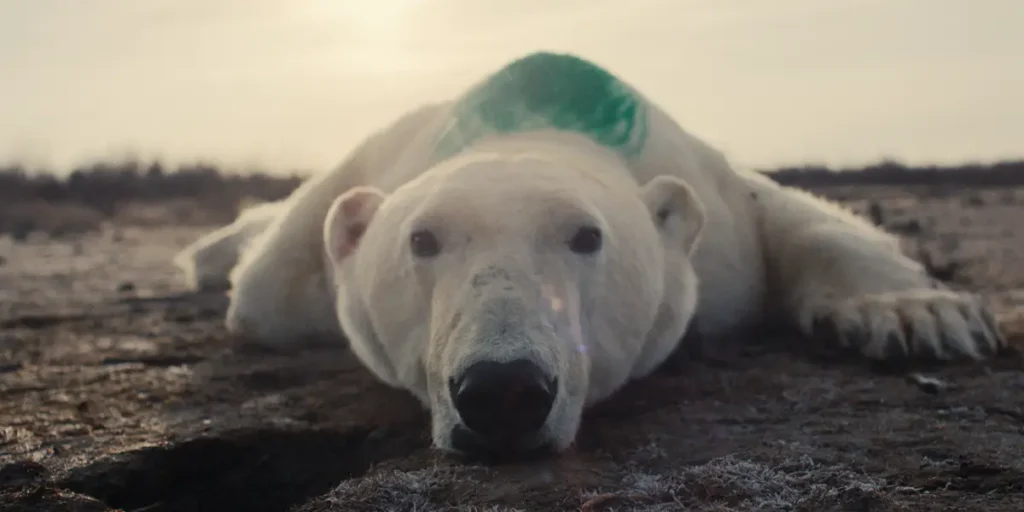
Nature documentary Nuisance Bear is a fascinating, at times poetic documentary about the fraught coexistence between the human and natural worlds.
Directors: Gabriela Osio Vanden & Jack Weisman
Genre: Nature Documentary
Run Time: 90′
Limited Theatrical Release: November 6, 2026 (Los Angeles)
Wider Theatrical Release: December 4, 2026 in New York, Canada, U.K. and Ireland, and additional markets
MUBI Release: TBA
Where does nature truly belong in the modern world? Has our relationship with it changed fundamentally, and how? What happens when the distance between humans and nature starts to shrink? A film that poses those questions and more, Nuisance Bear is a documentary from Gabriela Osio Vanden and Jack Weisman. A feature-length expansion of their 2021 short (and winner of the Documentary Grand Jury Prize at this year’s Sundance), it sees the pair return to the Canadian town of Churchill, Manitoba, as they examine the changing relationship between humans and polar bears, as well as the ecological impact.
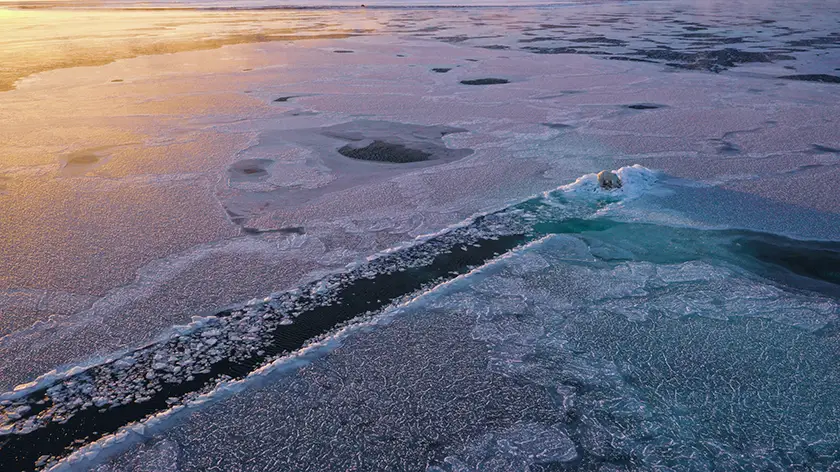
For thousands of years, these bears have travelled across the Hudson Bay in northern Canada. Usually, they spend time on land looking for food, surviving until the water freezes. However, because of climate change, a major problem has emerged. The ice doesn’t form until much later, so the bears stay on land for longer, meaning they become acclimatised to the presence of humans – and become more dangerous. What’s more, their migration path is right in the middle of Churchill, dubbed ‘The Polar Bear Capital of the World.’ Consequently, polar bears have to increasingly contend with our modern world as they fend for themselves.
One example comes from Churchill’s bear-based tourism industry. Every year, groups flock to the town on Lazy Bear Expeditions, hoping to catch a glimpse of this endangered species. Meanwhile, whether through traps, ‘Bear Jails’, or firing weapons at them, Churchill seeks some sort of control over what they deem ‘nuisance bears’. The Inuktitut term is avinnaarjuk, which leads to the film’s other crucial perspective as Vanden and Weisman spend time in the next town to the north, Arviat. The Inuit community living there have to contend with more bears than ever before (and claims that numbers are actually increasing). That has led to human loss, as Inuit elder Mike Tunalaaq Gibbons (who passed away in 2025) tragically attests to in his narration.
Vanden and Weisman have stated in an interview with IDA that they wanted “to juxtapose two communities through the bears they share.” That is successfully achieved in Nuisance Bear, which partly acts as a comment on colonialism. It is a story that is full of intrusion, not just with the bear on the towns and vice versa, but with outsiders intruding onto Indigenous communities. You wonder whether Churchill has pushed these bears onto someone else, and how that has changed how the Inuit view what Gibbons describes as “an ancient understanding that bears and humans are equals.”
This altered relationship reflects broader changes that have taken place within this shared environment. Traces of mechanisation can be found everywhere, from giant-wheeled trucks to ATVs. There is even a helicopter airlifting a bear in one staggering set-piece.
Vanden and Weisman started their careers as cinematographers. They work here alongside a team who specialise in wildlife photography to capture these bears with intimacy and scale. Those sound like opposing forces for a film, but not in the nature documentary, where animals are just as important as habitats. Here, long lenses and wide shots are used in equal measure. We can get close to the bears, sometimes with really tight close-ups. But there are also landscape shots that show the Arctic tundras, rocky terrains and factory-dominated horizons they occupy.
However, the most important and purposeful bit of camerawork is how Nuisance Bear uses the gaze. The film is told primarily through the journey of one particular polar bear, and we side with his POV frequently, following him as he ventures on his migratory journey. That is typical for a nature documentary. Yet the film pairs our observation of this bear with the tourists, the hunters, the Polar Bear Alert Team and others. All of them are watching over these bears, following their every move for different purposes. Elsewhere, some visual flair is given through a couple of experimental techniques and quick-cut montages, and there is an ethereal score from Cristobal Tapia de Veer (The White Lotus).
Nuisance Bear could have had a little bit more substance with the themes it interrogates, particularly around climate change (which it touches on rather than makes an explicit factor). Nevertheless, it is still a well-shot, deeply complex documentary that stands out because of how Vanden and Weisman tackle their themes. It displays humanity and animals as interconnected whilst highlighting the numerous ways the former has encroached on the latter. “The bear is a visitor from the past navigating a maze of the present,” Gibbons says in one of his passages. Said maze is the modern world, the towns and people placing themselves within an environment to make their own, regardless of who is already there.
In that way, Nuisance Bear becomes a film about the fraught, precarious coexistence between the human and natural worlds. And it makes for a fascinating, at times poetic watch.
Nuisance Bear (2026): Movie Plot & Recap
Synopsis:
In Canada, a polar bear’s traditional migration path is disrupted by climate change. That leads to the bear drifting into two towns – the Inuit community of Arviat and Churchill, known as ‘The Polar Bear Capital of the World’.
Pros:
- Vanden and Weisman’s documentary is full of fascinating themes touching on colonialism, climate change and the precarious balance between the human and natural worlds.
- It is also poetic at times, helped by narration from the late Inuit elder Mike Tunalaaq Gibbons.
- The imagery is remarkable and purposeful, from the bear’s eye view of the animal’s journey to some experimental touches.
Cons:
- It just needed a little bit more substance.
Nuisance Bear will be released in theaters in Los Angeles on November 6, 2026, and in ew York, Canada, U.K. and Ireland, and additional markets on December 4, 2026.
Header credit: Gabriela Osio Vanden