
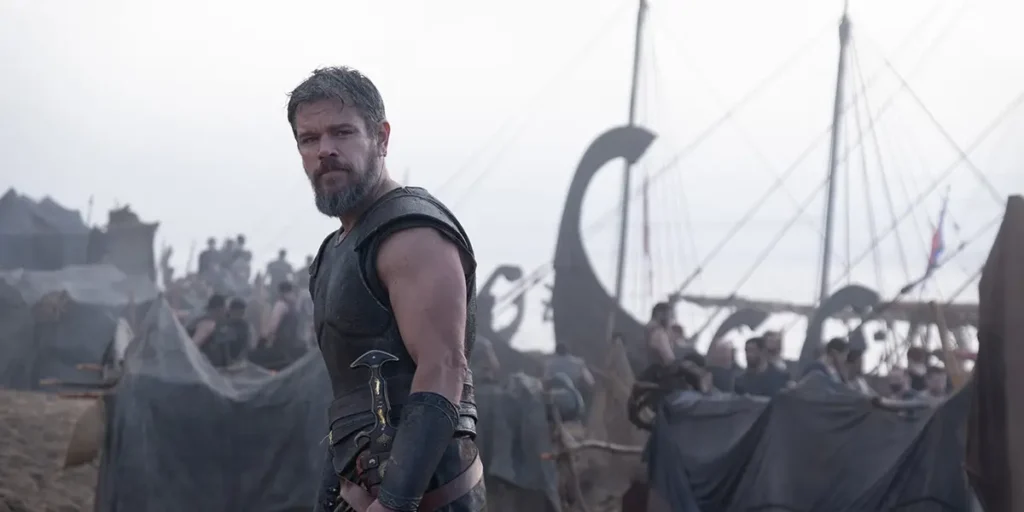
Despite oversimplifying story beats of Odysseus’ voyage home, Christopher Nolan’s The Odyssey manages to capture a world of treachery and wonder on a massive scale.
Director: Christopher Nolan
Genre: Action, Adventure, Fantasy, Epic, Drama
Run Time: 172′
Rated: R
Release Date: July 17, 2026
Where to Watch: Globally in theatres
Whatever Christopher Nolan’s next project would be after the success of Oppenheimer – which nearly earned a billion dollars at the box office and won seven Oscars at the 96th Academy Awards – it was always going to face unrealistic expectations. To make matters “worse,” the film that followed his atomic-bomb biopic turned out to be The Odyssey, an adaptation of Homer’s literary classic.
Beyond my admiration for Nolan’s work and what he’s done to preserve the theatrical experience through his partnership with IMAX, my excitement for his latest goes deeper: I adore the swords-and-sandals grand-adventure epic. From dramas like Gladiator to goofy spins like Monty Python and the Holy Grail, I grew up on the genre that used to rule Hollywood with productions such as Ben-Hur, which has simply ceased to exist. So, the idea that one of our finest directors would use his blank-check movie, post-Oscar win, to make the definitive adaptation of The Odyssey was, frankly, a match made in heaven.
Having served ten years in the Greeks’ war against the city of Troy, King Odysseus (Matt Damon, of The Rip) sets sail for his homeland of Ithaca. Eager to reunite with his beloved wife, Penelope (Anne Hathaway, of The Devil Wears Prada 2), and son, Telemachus (Tom Holland, of Spider-Man: No Way Home), he finds his journey far more treacherous than the battlefield. While his family must deal with scheming suitors vying for Penelope’s hand in marriage and the title of Ithaca’s new King, Odysseus faces deadly monsters and vengeful gods, only to be repeatedly set back after each encounter.
As part of self-imposed homework in preparation to cover The Odyssey, I took on the task of rereading the original poem. Not even halfway through Homer’s classic, I quickly realized that I was far more invested in the political intrigue in Ithaca with Penelope, Telemachus, and Antinous (Robert Pattinson, of The Drama) than in reading about Odysseus’ encounters with gods and monsters. When it came to Nolan’s adaptation, given his obsession with keeping things practical and grounded in reality, it wasn’t much of a surprise to learn that he might’ve felt the same.
“A time of apparent magic” is the title card that opens the film, seemingly prioritizing the human condition over magical spectacle. Nolan’s interest in exploring men’s legacy is nothing new. It is a theme throughout The Dark Knight trilogy and the core thesis of Oppenheimer. Amidst monsters and large battles, The Odyssey’s script is at its best when focused on Odysseus’ creeping sense of dread as he reckons with the lasting impact of the trick he played on Troy with the wooden horse. How will gods and man view this violation of a peace treaty? Was it worth having his men assault and murder thousands of innocents so he could finally be freed and sail home? Will it inspire others to commit such violence? What consequences will those closest to his heart suffer over his ambitions?
To call The Odyssey epic would be underselling the filmmaking challenge the cast and crew undertook. Most of the film’s massive scale is thanks to Hoyte van Hoytema’s cinematography. One of the many selling points of The Odyssey is that it is the first movie ever shot entirely on IMAX film cameras. Each frame is expanded to that beautiful, tall 1.43:1 aspect ratio (depending on the format you see the movie in), capturing a world long lost to us.
Each land our characters set foot on – whether for conquest, guidance, or supplies – feels alien, casting them out into dangerous waters. The ocean is depicted with such beauty and horror, offering both escape and imprisonment. Ruth De Jong’s production design conveys the impending doom our roster of characters faces. With Odysseus, you can sense in your bones the toll it’s taking on his men as they hold the oars to row their heavy ships against the ocean waves of the sea god Poseidon.
In Penelope and Telemachus’ case, their castle feels less like a warm, welcoming home and more as a prison. A piece of set decoration that stands out in Ithaca is the jail-cell-like doors that shield Penelope’s private quarters from the suitors in the main hall, juxtaposing her physical and mental insecurity. The lighting, or lack thereof, inside the castle smartly sets the tone that Ithaca’s brightest days might be behind it if Odysseus indeed does not return.
I walked away from The Odyssey delighted by most of the scenes set in Ithaca. Much of that has to do with the actors occupying this space, though some have more to do than others. Anne Hathaway ended up being one of the biggest highlights for me. She perfectly encapsulates Penelope’s loyalty to her husband, her tenderness towards her subjects, and her pain of not knowing if she should grieve a dead man or one who abandoned her. Hathaway also injects a much-needed fierceness into the character, making Penelope’s interactions with the suitors, especially Antinous, gripping to watch.
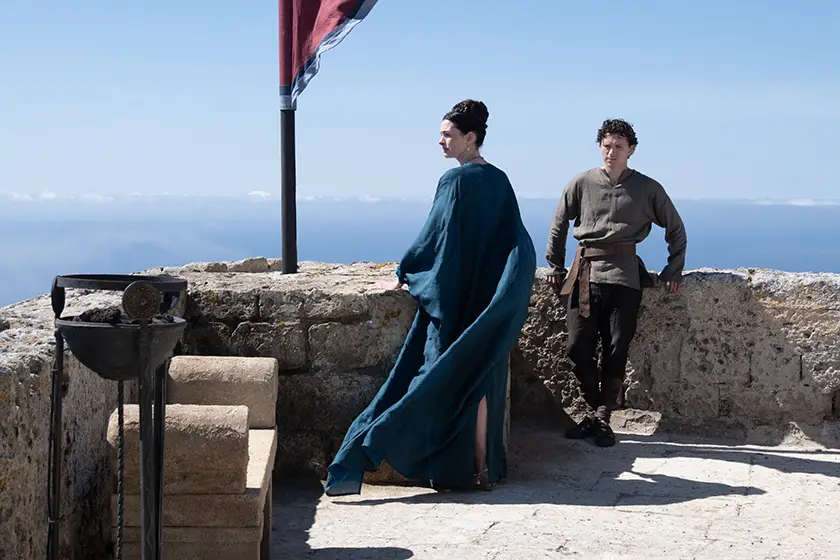
Tom Holland has shown promise since he was a young actor. He’s a charming Spider-Man, but outside of Marvel, no production has given him the chance to flex his talents. Nolan uses audiences’ perception of Holland – we sometimes still see him as a kid – against them. Telemachus is in a position very similar to Holland’s: the people around him treat him as a child pretending to be a competent adult. Whether it’s because of personal experience or the way it’s written on the page, Holland masterfully conveys Telemachus’ frustration on an emotional level we haven’t quite seen from him before.
It helps that Holland has such versatile performers to act alongside. Being the suitors’ ringleader of sorts, Antinous is cocky, deceitful, falsely complimentary, and Robert Pattinson, as usual, commits to the bit he’s doing. This allows Holland to develop a believable on-screen rivalry with Pattinson, making it easy to want to see Telemachus come out the victor. John Leguizamo’s (Violent Night) Eumaeus offers Holland the opposite: a fatherly figure who is encouraging and thoughtful, yet won’t hesitate to give Telemachus a clout in the ear if he needs one. It’s Jon Bernthal’s (The Accountant 2) Menelaus who brings out some of Holland’s most emotional work as he recounts the story of the wooden horse, tearing up at the legend of his father.
However, Matt Damon quite possibly had the toughest job of all. The Odyssey, as a narrative, rests entirely on Damon’s ability to navigate the many contradictions of the man whom some would call a hero and others an anti-hero. Odysseus’ decision-making can be admirable and brave, just as it can be cruel and selfish.
Elliot Page’s (The Umbrella Academy) Sinon might be the one character who best illuminates how great Damon is at portraying Odysseus’ complexity. He’s the crux who questions our hero’s morals, initiating the inner turmoil that haunts him on his voyage. Himesh Patel (Enola Holmes 3) picks up the baton as Eurylochus, and, in brotherly fashion, confronts Odysseus when he has no trouble putting everyone in danger if it means scratching his ego. Damon deserves all the praise, which makes it odd that the aspect of The Odyssey that worked the least for me is his journey home.
Any problems that anyone might have with The Odyssey don’t have to do with its craftsmanship or performances. It has everything to do with Nolan’s inability to fully embrace the mythos of Homer’s poem. For comparison, The Dark Knight trilogy is an excellent offshoot. As celebrated as those movies may be, even its biggest fans could contest that Nolan gives the impression of being embarrassed by the source material he adapted. Gotham doesn’t carry that gothic energy associated with the character; it’s just Chicago, or any other American city. The Joker can’t be permanently disfigured and have white skin as a result of a chemical incident; it has to be clown makeup. Bane isn’t allowed to use the super-steroid venom from the comics to make him strong; he’s just strong.
The Odyssey suffers from a similar lack of commitment that might be more appalling based on who you ask. In the original text, the deities driving the events forward include Aeolus, Hermes, Poseidon, Zeus, and others. These gods are actual characters with unique personalities, and while they are mentioned in Nolan’s adaptation, that’s all you really get: occasional mentions. By removing these huge personas, story beats suffer. Odysseus’ encounter with the Cyclops Polyphemus (Bill Irwin, of Interstellar) goes from a game of cat and mouse that enrages Poseidon, the father of the Cyclops, to a simple monster to overcome.
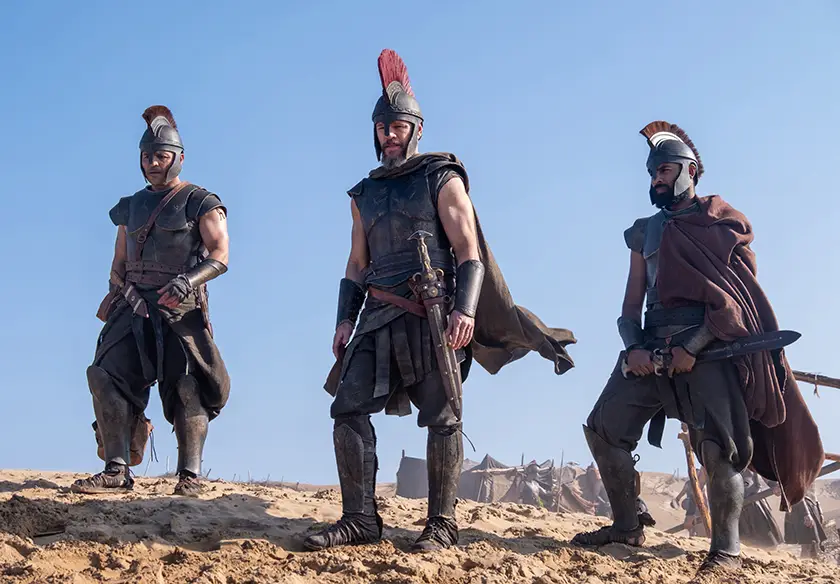
It’s not like there aren’t good set pieces with the godlike figures we do see. Samantha Morton (Anemone) as Circe gives Nolan the chance to dip his toes into the realm of horror as Odysseus’ loyalty to his men is tested. The sequence with the sirens is haunting, as Damon delivers a heartbreaking monologue about his fear of reuniting with his family. Even the goddess Athena (Zendaya, of The Drama) is enough of an emotional anchor for Odysseus that you forgive the movie for giving her less than five minutes of screen time. The issue here is that the odyssey component of The Odyssey feels incomplete or rushed because it is reluctant to embrace its fantasy roots.
Adaptational quibbles aside, it’s hard to look at The Odyssey and not be impressed by the work of the crew Christopher Nolan assembled to bring his vision to life. Accompanied by another excellent Ludwig Göransson score that feels like equal parts Mad Max: Fury Road, Hereditary, and The Princess Bride, The Odyssey is a welcome new translation of Homer’s poem, presented in visual form. This kind of filmmaking is hard to come by these days. We’re likely never going to see a swords-and-sandals epic on this scale ever again, and certainly not anytime soon. I, for one, can’t wait to rewatch this religiously throughout the summer on the largest possible screens I can find.
The Odyssey (2026): Movie Plot & Recap
Synopsis:
Odysseus sails home after successfully bringing on the fall of Troy. His voyage proves more dangerous, encountering vengeful gods and monsters.
Pros:
- Nolan’s use of IMAX continues to be as immersive as ever.
- The art departments elevate the film’s sense of scale.
- If you like political intrigue à la Game of Thrones, the storyline in Ithaca will not disappoint.
- The cast is committed to Nolan’s vision, with Hathaway being a major highlight.
- Göransson adds weight with a score that feels grand and intimate
Cons:
- The odyssey part of The Odyssey lacks a sense of commitment to Homer’s fantastical elements.
- Some viewers might have an issue with the short screen time some actors have, such as Zendaya.
The Odyssey will be released in U.S. theaters, in U.K. and Irish cinemas, and globally in theatres on July 17, 2026.