
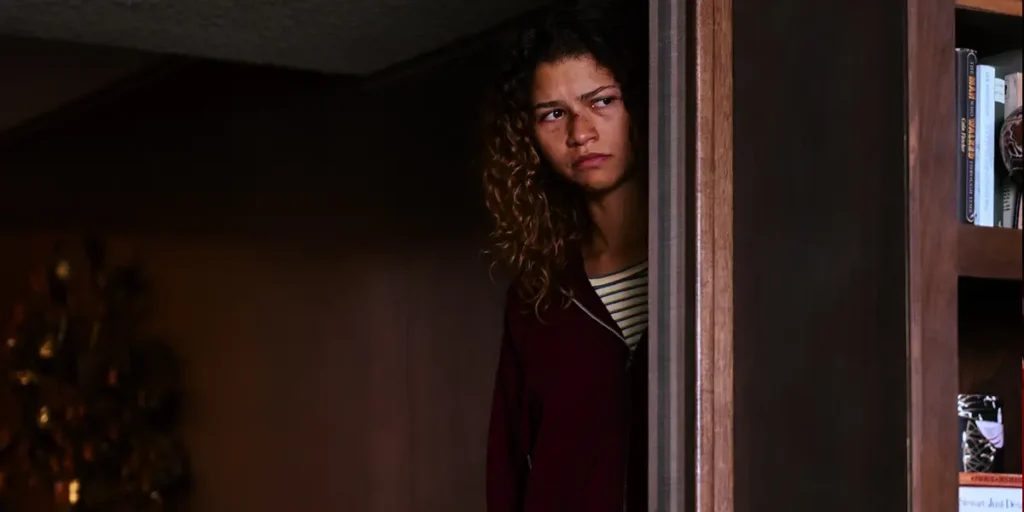
Neon excess fades into grit in Euphoria Season 3 as Zendaya leads a colder, measured yet uneven reinvention of the series.
Showrunner: Sam Levinson
Genre: Teen Drama, Coming of Age, Psychological Thriller
No. of Episodes in Season 3: 8
Release Date: April 12-May 31, 2026 on HBO Max
Euphoria returns for a third season that feels less like a continuation and more like a reinvention. In Season 3, HBO’s once neon-drenched teen drama doesn’t quietly re-enter the cultural conversation so much as detonate back into it: it’s louder, harsher, and more volatile, replacing glitter with grit.
Rue Bennett, played with unnerving precision by Zendaya (The Drama), remains the show’s central figure: a young woman trying to outrun her addiction while, however faintly, holding onto the hope of stability. Set several years after the events of season 2, this season finds Rue entangled in the consequences of her past, including a mounting debt tied to a lost suitcase of drugs. The rest of her former classmates have fractured into an uneasy adulthood, including Nate Jacobs (Jacob Elordi, of Wuthering Heights), now locked into a volatile marriage with Cassie Howard (Sydney Sweeney, of The Housemaid), Maddy (Alexa Demie, of Mainstream), a talent assistant forever on the back foot, and Jules (Hunter Schafer, of Cuckoo), who drifts at the margins of the narrative. The shift is immediate: this is no longer a show about adolescence as spectacle, but about what comes after.
The opening of season 3 sends Rue smuggling drugs across the Mexican border. The sequence sets the tone: less music video, more Breaking Bad, with a western edge. For all its controversy, Euphoria’s defining quality has always been its atmosphere. Creator Sam Levinson built a visual language that exists somewhere between realism and hallucination, where teenage parties unfold in shimmer and grief arrives in slow motion. The style is not decoration; it is part of the narrative. It aligns with the show’s subjectivity. Addiction and adolescence are both states defined by distortion of time, perception, and emotional proportion. Season 3 abandons much of that approach. The camera is more restrained, the palette more muted.
The first two seasons of Euphoria often felt as though they were being shaped from the inside out. Season 3, by contrast, frequently feels observational: events are presented rather than experienced. The result is a show that is clearer, perhaps, but less immersive.
That change is most pronounced in the soundtrack. Labrinth’s music blended electronic, soul, and gospel influences, swelling in step with the characters’ inner turmoil. His absence is felt here. Hans Zimmer’s score is polished, but lacks the intimacy and volatility that defined Labrinth’s contribution. Unsurprisingly, viewers responded by layering Labrinth’s tracks over new scenes on social media, underscoring the shift.
A change in style isn’t necessarily a bad thing, though. What Euphoria is attempting here is growth, shedding its adolescent aesthetic in favour of something more “adult”, which broadly works with the narrative. What stands out is that the main ensemble still feels like teenagers; the difference is that their consequences are no longer softened or protected.
Nate’s arc this season centres on collapse. Once the show’s dominant high school jock – all control and intimidation – he’s now left with the fallout of failed business dealings and mounting financial pressures, finding himself in deep with a loan shark named Naz (Jack Topalian), spending much of the season trying to claw back leverage and pay off what he owes. The situation is further complicated by Cassie’s success on OnlyFans, which brings in significant money while simultaneously humiliating Nate and deepening their already fragile relationship. By the end of the season, Nate is pushed to physical and psychological extremes by Naz, culminating in perhaps the show’s most brutal conclusion.
Elordi and Sweeney’s chemistry remains inert, the pair playing more like two wooden posts than a believable couple in combustion. Elordi, in particular, feels noticeably detached this season. His performance is muted, almost provisional, as if he had already mentally checked out. Besides Zendaya, he’s the only core cast member to have carved out a notable post-Euphoria career, recently marked by an Oscar nomination for Frankenstein. There’s a sense that Nate runs on momentum rather than investment, with Elordi’s performance increasingly untethered from the character.
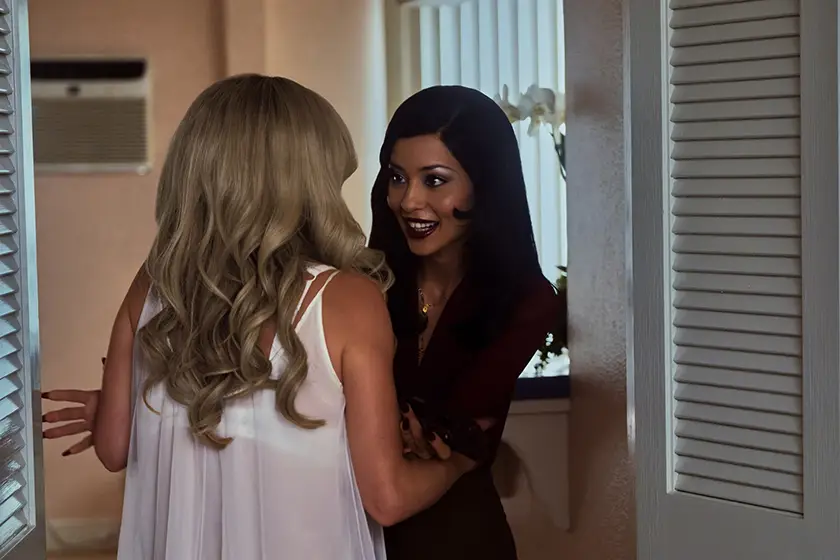
Maddy becomes Cassie’s manager, and the story gradually shifts away from Cassie and Nate’s romance. In its place, it surfaces a quieter thread: the lingering complexity of Cassie and Maddy’s friendship, and the uneasy form of girlhood that persists between them despite everything that’s come before.
Zendaya remains the series’ most reliable instrument. Her performance anchors most of its more uneven stretches. Even the smallest flicker of expression holds attention as she shifts between deadpan humour and emotional collapse, whether Rue is at her lowest – buried up to her neck in the desert – or locked in dialogue-heavy push-and-pull with other characters. The show sharpens whenever it returns to her. Her storyline is the most compelling of the season. Now working under the soft-spoken drug lord Laurie (Martha Kelly, of Common Side Effects), Rue also finds herself drawn into the orbit of Alamo Brown (Adewale Akinnuoye-Agbaje, of Suicide Squad), a ruthless, gun-toting southern crime boss. He becomes a distorted, dangerous mentor figure as Rue is pulled into the crossfire of Laurie and Alamo’s escalating rivalry.
Rue is a character we’ve spent three seasons waiting to see float rather than thrash just to keep her head above water. Now sober-adjacent, her desire is no longer chaos but escape from it. “I just want good old-fashioned American problems,” she tells Jules in one of the season’s defining conversations. Rue is chasing normality: marriage, routine, boredom, stability. This season really tests that desire, pulling it away from Rue just as she begins to find a sense of calm. It’s a structural tension that keeps the season consistently engaging.
Rue’s ending is almost too bittersweet to fully absorb. It feels faithful to the season’s unsparing worldview, one that privileges realism over wish fulfilment. But in doing so, it withholds a measure of emotional release. There is something quietly devastating about watching a character so beloved arrive at an ending that feels less like closure than acceptance.
This season is misshapen. It doesn’t quite know what to do with many of its characters, who wander in and out of the narrative without much sense of direction or impact. The second half of season 3 does find a stronger rhythm: individual storylines converge more effectively, and the pacing tightens. There are moments – like a club robbery – that briefly reinvigorate the series, but they remain intermittent rather than cumulative. By the end, season 3 still feels assembled rather than composed: a collection of strong parts that never fully resolve into a unified vision.
The final episode is equal parts melancholy and justice. It swings for the fences and largely connects. As an ending to Euphoria, it feels worthy; as a season, however, season 3 often feels caught in transition, never quite finding firm footing.
EUPHORIA SEASON 3 (HBO) SERIES Plot & Recap
Synopsis:
Rue Bennett and her peers navigate love, identity, trauma, and addiction in an unstable world as the consequences of their past continue to resurface.
Pros:
- Zendaya delivers a compellingly nuanced performance
- Stronger focus on adult consequences and personal growth
- Rue’s storyline provides the season’s emotional core
- Ambitious crime-drama elements that raise the stakes
Cons:
- Lack of narrative cohesion
- Several supporting characters feel underdeveloped
- Loses some of the immersive style that defined earlier seasons
Season 3 of Euphoria is now available to watch on HBO Max.