
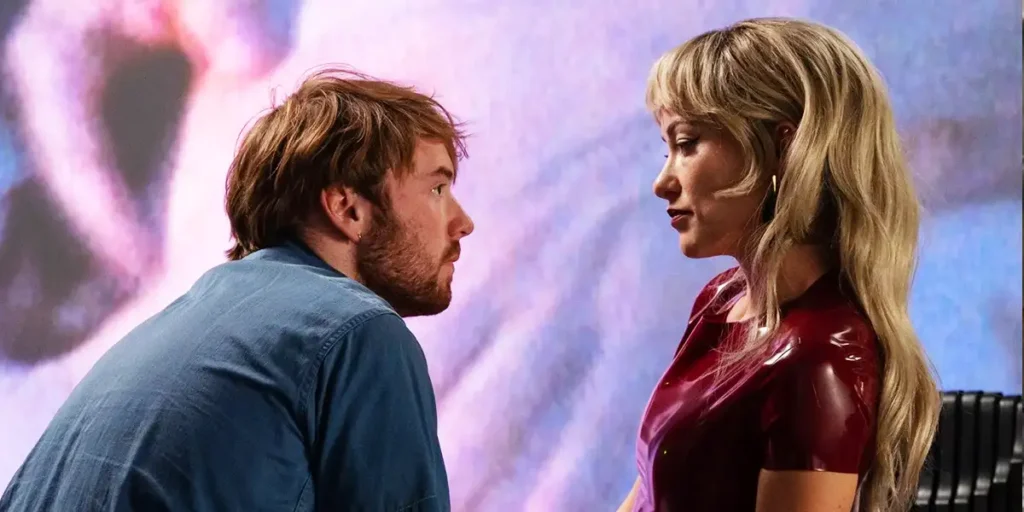
With I Want Your Sex, Gregg Araki vibrantly dissects the Gen Z sex recession while making an elegant argument for being open to the world as it comes to you.
Director: Gregg Araki
Genre: Rom-Com, Drama, Thriller
Run Time: 90′
Rated: R
U.S. Release: July 31, 2026 in theaters
U.K. Release: August 28, 2026 in selected cinemas
Statistics in recent years have shown that Gen Z is reportedly having far less sex than other generations that have come before them. With the COVID pandemic setting prime developmental/experimental years back and the heightened pressure of curating and cultivating a balanced digital presence, it seems this generation has regressed in their ability to develop sexual relationships without the fear of judgment clouding their every move.
For many Gen Zers, who have access to the world at their fingertips at all times, there seems to be more anxiety creeping into every corner of their peripheral that is actively holding them back from opening themselves up to new sexual experiences. In his latest feature, I Want Your Sex, Gregg Araki seeks to understand the motivations behind Gen Z’s relationship to sex, how it differs from those in older generations and how it potentially has held an entire cohort of people back from understanding themselves on a more intimate level.
I Want Your Sex opens on Elliot (Cooper Hoffman, of The Long Walk), a seemingly directionless albeit optimistic young man recently hired to work for world-renowned artist Erika Tracy (Olivia Wilde, of The Invite). Erika has gained her status through her provocative and hyper sexual art shows that both push and blur the boundaries between eroticism and exploitation. Shortly after Erika hires Elliot, she approaches him with an offer to turn their working professional relationship into a sexually intimate one.
Elliot is completely taken aback by Erika’s offer. While he has a girlfriend, who appears to genuinely not care if he lives or dies based on the apathetic attitude she constantly greets him with, he doesn’t see how he can say no to this opportunity. Elliot ultimately decides to enter into the sexually promiscuous, yet entirely consensual, relationship with Erika with a completely open mind.
Due to their sexual romance, Elliot begins to question his desires, boundaries, goals and relationships with the people around him. While the experience has opened Elliot up to an entirely new world, it’s also begun to make it impossible to ever go back to the way his life was before he met Erika, both for better and for worse.
It’s clear that Araki intends for the characters of Erika and Elliot to represent their respective generational cohorts, the millennials and Gen Zers. Millennials grew up in an entirely post-sexual revolution world and have borne witness to the evolution of women’s rights and growth in support of the LGBTQIA+ community, all without being entirely enmeshed in the omnipresent, hyper-surveillance digital ecosystem Gen Z has never truly lived without.
The film argues that Gen Z has never had the advantage of exploring oneself without the fear of repercussions that come in the form of TikTok date recaps, Instagram rejection videos, or podcast episodes that air out disastrous sexual encounters. I Want Your Sex dissects how the younger generation has become so anxious about experiences where they have to be vulnerable due to an intense and persistent fear of judgement, but the film also underlines how embracing vulnerability is the only way to discover who you truly are.
Araki’s analysis of Gen Z’s fearful approach to being vulnerable in their most intimate moments delicately deconstructs the consequences of growing up in the digital age while highlighting the freedom that comes from pushing yourself to find out what you’re made of. Notably, Araki does not leave millennials unscathed, but rather shows the way in which their more casual approach to sex doesn’t necessarily mean they are more emotionally evolved, as creating such a harsh divide between sexual and emotional intimacy is another form of avoiding being vulnerable.
Araki’s bold signature visual style elegantly contextualizes the taboo surrounding the topic of sex as it pertains to the younger generation. His psychedelic framework, hyper-pigmented color palette and masterful use of costuming set the perfect scene for his ambitious script attempting to understand why Gen Z seems to have such a complicated relationship with sex.
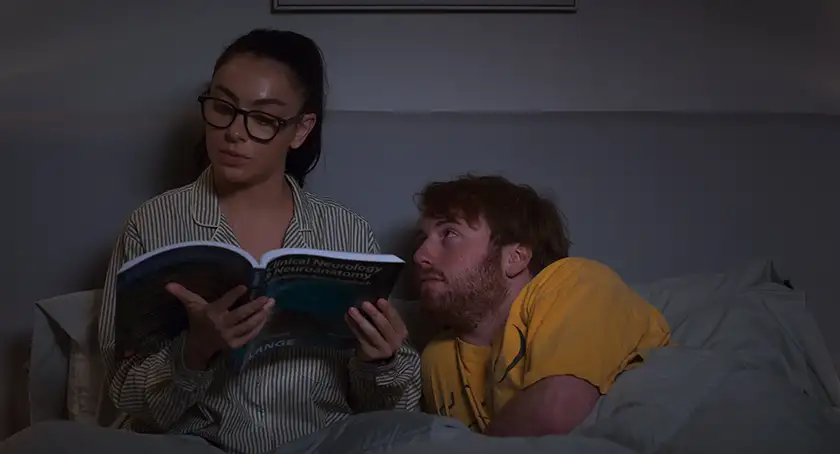
Through his performance as Elliot, Cooper Hoffman cements himself as one of the most dynamic rising actors to watch. He has a natural magnetism to him that makes watching his performance almost hypnotic. Olivia Wilde gives one of the best performances of her career as the erratic yet enticing Erika Tracy. It truly is a role only she could execute with the level of precision needed to build a character so unpredictable yet completely calculated.
I Want Your Sex is not a condemnation of Gen Z for their seeming lack of sexual curiosity and proclivities but rather a genuine attempt to understand the decline this generation has faced in terms of sexual experiences. Araki pointedly shows both the good and the bad of how Elliot’s life evolves once he begins to embrace his sexuality as a way of saying having sex isn’t necessarily going to make your life better, but being open to experiences as they come to you and approaching them with curiosity rather than a fear of judgment just might be the thing that changes your life for the better.
I Want Your Sex (2026): Movie Plot & Recap
Synopsis:
When a young man enters into a sexual relationship with his new boss, his entire world flips upside down.
Pros:
- Cooper Hoffman and Olivia Wilde are absolutely mesmerizing.
- Araki’s analysis of the impact of sex in a young person’s life is eloquently balanced and deeply nuanced.
- Araki’s signature psychedelic style soars.
Cons:
- Some of the ensemble performances feel a bit isolated from the film as a whole.
I Want Your Sex will be released in US theaters on July 31, 2026 and in selected UK cinemas on August 28, 2026.