
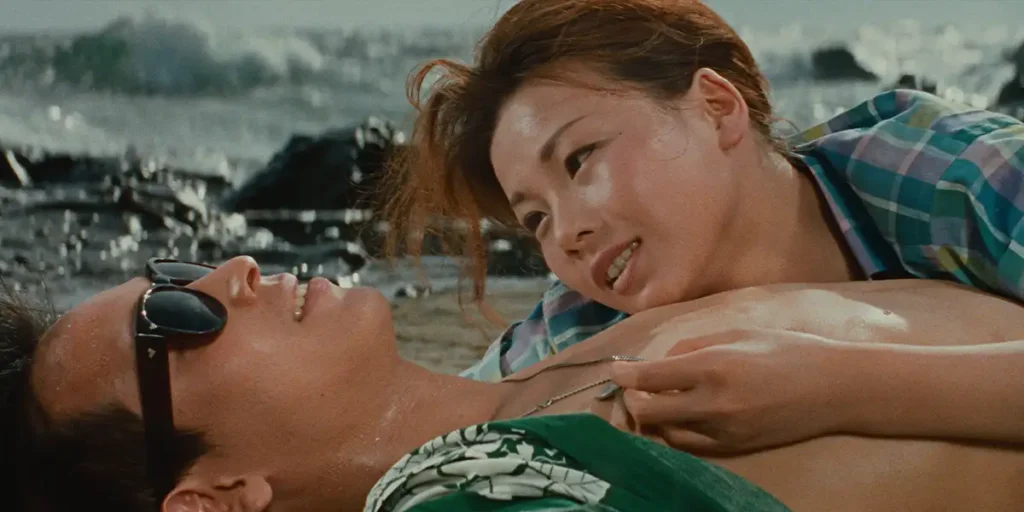
Nagisa Ōshima’s Cruel Story of Youth is a brutal yet honest portrait of the post-war Japan generation stripped of their youth.
Director: Nagisa Ōshima
Original Title: Seishun Zankoku Monogatari (青春残酷物語)
Genre: Crime Drama
Run Time: 96′
Rated: Not Rated
Original Release: July 9, 1961 (U.S.); February 25, 2008 (U.K.)
4K UHD + Blu-Ray ‘Criterion’ Release: July 21, 2026
Although he’s unsung worldwide, Nagisa Ōshima is one of Japan’s most important filmmakers, alongside the likes of Akira Kurosawa and Kenji Mizoguchi. The three changed the country’s cinematic landscape not only through their profound realism, but also through their honest social critiques. Kurosawa (High and Low, Stray Dog) and Mizoguchi (Osaka Elegy, Street of Shame) weren’t afraid to take jabs at Japan’s patriarchal society and the post-war struggles many endured.
Ōshima took things further; he didn’t do a mere jab, but a full-frontal attack on the Japanese social, political, and cultural institutions of the 50s and 60s. He used innovative and provocative means, like sexuality and youth rebellion, to explore the fracture of the economic recovery and postwar class hypocrisies–containing a more ferocious vision than his contemporaries dared to implement. Ōshima’s activist storytelling can’t be better captured than in his excellent sophomore feature from 1960, Cruel Story of Youth (青春残酷物語).
Framed against the Anpo demonstrations in Japan, where many protested against the U.S-Japan Security Treaty, the film begins with a scene that defines the entire picture, where Ōshima demonstrates how money and sexuality are treated in this time and place. The dynamic between the two drives the narrative into the cold, harsh realities of post-war Japan for the young undergoing such societal and economic turmoil. We meet a young woman named Makoto (Miyuki Kuwano, of Yasujirō Ozu’s Late Autumn), indulging in drinks at a local Tokyo bar. She seems to be a regular visitor, as the other customers seem to have seen a familiar face. When Makoto wants to head out, a man asks if he can give her a ride home. Just by his look and hesitation, we already sense that he has bad intentions.
The drunken man doesn’t want to drop Makoto off at her house. Instead, he wants her to stay with him at a hotel, forcing Makoto to do as he pleases while waving money in her face as a “payment” for her time. Right before the man could put her hands on her, a stranger named Kiyoshi (Yūsuke Kawazu, of Masaki Kobayashi’s The Human Condition Part II and III) separates the two and beats up the assaulter, demanding the same money he was waving at Makoto to give it to him for his malicious actions. After the incident, Makoto and Kiyoshi go their separate ways, yet this won’t be the first and last time they encounter each other in the crowded yet lonely streets of Tokyo.
While you may think that Kiyoshi is a knight in shining armor for saving Makoto from her attempted rape, the events following this introductory scene will reveal quite the opposite. Ōshima soon paints the portrait of lost souls abandoned by society who crave devotion and search for meaning at a time when Japan’s post-war prosperity has failed to provide them with any real sense of purpose.
On their second encounter, Makoto accompanies Kiyoshi to a river. Everything is going swell, right until Kiyoshi comes onto her, which causes Makoto to slap him in the face as hard as she can. His response is to push her into the water aggressively. Kiyoshi’s angst and desperation are felt; his reaction, although a disturbing act of violence, exposes the deep resentment simmering beneath the rebel facade he adopts. Ōshima strips away the romantic heroism of his character introduction to reveal a frustrated man drifting through moral decay.
Instead of ignoring him after he pushed her, Makoto’s intrigue of Kiyoshi grows; anger and curiosity create an illusion for a quick escape from the mundane, brutal life she currently has. But this “escape” isn’t going to fix any of her problems; it will draw her deeper into a destructive cycle fueled by emotional dependency and recklessness. Kiyoshi forces Makoto to turn their first encounter–him saving her from an assault–into a money scheme. She would lure middle-aged men into submissive scenarios, unguarded, so that Kiyoshi would rescue her and rid them of their money.
Cinematographer Takashi Kawamata’s camera is often close to the characters, making the viewer witness every impulsive decision and violent outburst without the comfort of distance. While men are extorted of their money for being pigs who feel they can take advantage of a young woman, Ōshima does not present this scheme as a morally satisfying act of justice.
Ōshima expresses that both the assaulters and the young couple are trapped within a corrupt social order where exploitation has become the norm and resistance is tainted by manipulation and violence. Cruel Story of Youth will sometimes remind you of other films that revolve around the abandoned youth and post-war struggles, like Jean-Luc Godard’s Breathless (À bout de souffle) and Nicholas Ray’s Rebel Without a Cause.
Both films have characters who try to live up to romanticized, dangerous ideals to mask their vulnerability and isolation. James Dean’s Jim Stark and Jean-Paul Belmondo’s Michel Poiccard reject traditional authority and embark on reckless antics. They are slick, but always feel as if they are wearing a mask that hides their true personas. It adds to their character and fits the portrayal of the respective directors’ works, which is one of the many reasons they have become classic cinema characters after all this time.
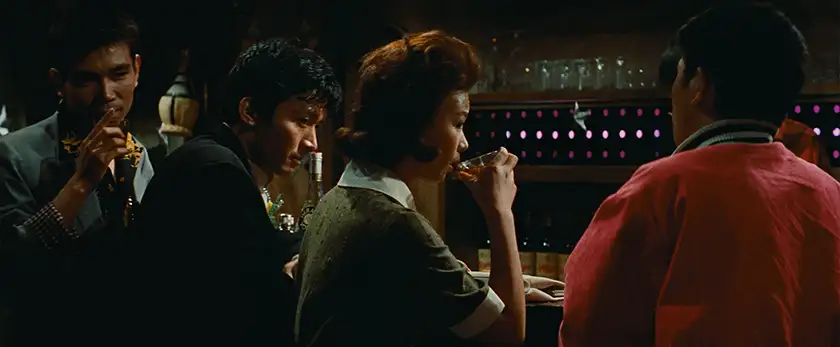
Regarding Kiyoshi, his swagger is quickly exposed, and Makoto’s fascination with him comes from her yearning to escape rather than a romantic longing. Ōshima never lets Kiyoshi contain that mythic presence that Stark and Poiccard have; his unruly persona is not romanticized. Ōshima strips rebellion of its cinematic glamour and exposes it as something self-destructive, which is why he portrays Makoto and Kiyoshi as victims of a consuming evil: an uncaring society and its manipulative leaders. This is what makes each scene the leading pair are far colder and more brutal than those in the aforementioned. It is the false promise of freedom. The adults who endured the effects of the war firsthand suffered to get their heads up and start from zero. Their children, who take on the second-hand tolls, are absorbed by their own failures and their grievances.
Ōshima’s restlessness is smeared across each scene, his camera capturing a generation that drifts through emotional ruin and moral disorientation. He depicts their lives as genuinely as possible, even if it means showing the ugliness that many would like to ignore–exploitation, desperation, violence, and all. Even through the quick bursts of visual flair and vivid color that are placed in the Cruel Story of Youth, there is a persistent sense of unease that refuses to let the viewer become intoxicated by its beauty. Beneath the film’s flashiness lies a bleak portrait of rebellion stripped of allure. It is a tale that, much like its title suggests, shows how things will inevitably collapse under the weight of violence and ignorance in society. History is always bound to repeat itself, and considering the world leaders in charge, pondering what lies ahead makes Cruel Story of Youth even more striking.
Cruel Story of Youth (1960): Movie Plot & Recap
Synopsis:
A man takes advantage of a young woman’s trauma and longing for an escape to rob middle-aged men of their cash during the economic and societal struggles of post-war Japan.
Pros:
- Great lead pairing of Yūsuke Kawazu and Miyuki Kuwano, who deliver subtle yet complex performances.
- Ōshima expresses his thoughts and grievances on the false promises given to the post-war generation with remarkable and heartbreaking honesty.
- The tension never fully dissipates, preventing the viewer from feeling comfortable.
- The vivid colors and flashy stylistic bursts create a compelling contrast with the brutality of the story.
Cons:
- None.
Cruel Story of Youth was released in a Criterion Collection 4K UHD and BLU-RAY Special Edition on July 21, 2026.