
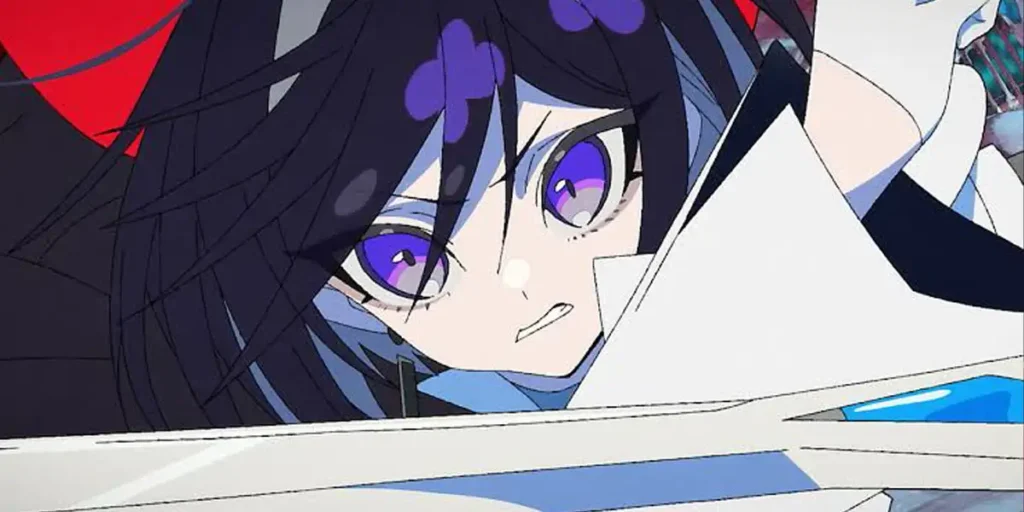
The Ribbon Hero adapts Tezuka’s Princess Knight with real intelligence, abandoning animation for something braver in its final minutes.
Author: Daichi Ogi
Director: Yūki Igarashi
Genre: Anime, Animation, Action, Adventure, Fantasy
Run Time: 109′
Release Date: August 8, 2026
Where to Watch: Netflix
“You must not resist.” These are the first words we hear in The Ribbon Hero. A dying mother, poisoned by a disaster called Nergal, tells her daughter to survive rather than fight. It’s a devastating opening, and it’s also the question the film will spend the next 108 minutes trying to answer.
Igarashi Yuki’s The Ribbon Hero, which lands on Netflix on August 8, is a genuinely ambitious piece of work. It’s a daring reimagining of Tezuka Osamu’s beloved manga “Princess Knight”, telling the story of Sapphire, princess of the fallen kingdom of Silverland, who loses everything to a mysterious disaster called Nergal and washes up in Goldland, where she builds a new life. Sapphire is voiced by Saaya, of the Japanese comedy duo Lalande, in her first feature-length voice role. She gives the character a bruised, uncertain resolve that carries the film.
The plot itself, though, is not the film’s most interesting feature. What matters is what The Ribbon Hero does with disaster — and, eventually, what it admits animation cannot do. Nergal takes its name from a Mesopotamian underworld god, but here it becomes something more abstract: a force that devours souls. And souls, in this film, are literal hearts: cartoon shapes that can be held, taken, or lost. When Sapphire flees Silverland by ship and collapses on the deck, the image cannot help but evoke refugees, migrants, and the displaced. But the politics of that image, the economics, and the actual conditions of a world in collapse remain mostly off-screen. What we see, instead, is the visual language of the heart being stolen, the soul being consumed.
With this choice, the film aims for something universal and fable-like, and as an allegory, it works. By turning displacement into a fairy-tale image, The Ribbon Hero makes the reality of loss accessible to young viewers who might not yet have the words for it. Yet, at the same time, this is also where the film runs into trouble. A disaster, in the real sense of the word, is about who gets hurt, who survives, and who is sacrificed. When the film turns that sacrifice into a stylized ritual and abstracts the loss into a heart-shaped object you can hold, it makes the disaster easier to look at than it should be. And when a disaster becomes easy to look at, the questions of cause and consequence recede; the film gives us the shape of grief without quite letting us feel its weight.
The Ribbon Hero is built around seven “Acts,” complete with curtains that rise and fall and a structure that suggests a curtain call. The image often has the depth of a stage, and characters are arranged like actors performing before an audience. This makes sense given Tezuka’s history. He conceived “Princess Knight” under the strong influence of the Takarazuka Revue — the all-female musical theater company based in the city of Takarazuka since 1913, whose gender-crossing performances shaped the manga’s iconic image of a princess raised as a prince.
Watching the film, you feel this inheritance in a very physical way: the camera treats each scene as if it were staged, and the emotional beats land like the peaks of a musical number rather than the turns of a screenplay. For a viewer, this means the film feels less like a story unfolding and more like a performance we’ve been invited to witness — which is either the film’s greatest strength or its greatest limitation, depending on how much you want a film to move on its own terms.
The film also uses a fragmented, non-linear montage. Sapphire’s memories of losing her parents keep intruding on the present, so that grief is never a past event but a continuous condition. In this respect, the film’s sense of time is genuinely absorbing. Disaster, here, is not something that ended; it’s something that keeps happening.
For audiences familiar with the past decade of Japanese animation, especially works in the lineage of Puella Magi Madoka Magica, much of The Ribbon Hero‘s visual language will feel very familiar. The theatricality, the cut-out editing, the recursive flashbacks, the myth of the girl carrying the burden of the world on her shoulders — all of it has become familiar territory. It’s no coincidence that Gekidan Inu Curry — the collage-and-cutout art collective that created the surreal witch worlds in Madoka Magica — is back doing significant animation work here. The film handles these devices with care and craft, but never quite escapes their gravity to arrive at something of its own.
Everything shifts in the film’s final gesture. After the last battle, without warning, The Ribbon Hero ceases to be an animation. The image cuts to live-action footage shot on Kodak film. What we see is not Sapphire, not Nergal, not the world of the story at all. We see the actual printed volume of Tezuka’s manga, sitting on a table. We see the Takarazuka Grand Theater and its surrounding streets: the station, housing, buildings, and the people who live there. The film has left its own world behind and turned its camera toward the real place where “Princess Knight” was born.
Here’s what makes this so pointed. Despite the enormous influence the Takarazuka Revue had on Tezuka’s Princess Knight, the Revue Company never officially staged it. Tezuka himself once described the prospect as a kind of “self-poisoning,” as if the story would have fed back into its own source. The film doesn’t try to fill that strange absence, nor does it show us the stage. Instead, it shows us the city that produced the stage.
This is where the film’s real theory of adaptation comes into focus. It aims neither for faithful reproduction nor for radical modernization, but for something more restrained: turning the camera back toward the actual ground from which the story came and reaching for its origin.
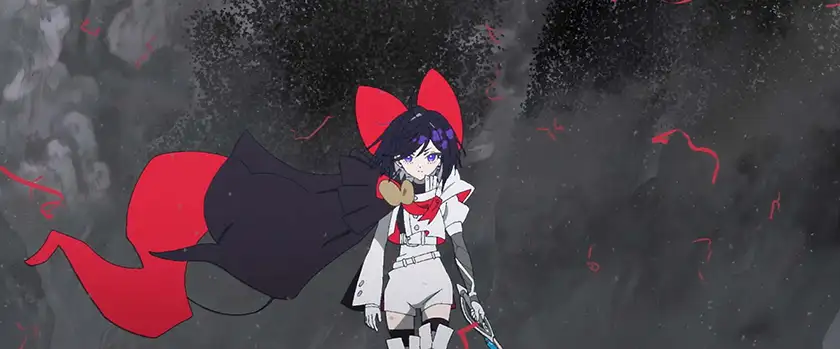
The angels, the souls, Nergal, the ribbons of light — everything The Ribbon Hero draws belongs to the world of the ideal. That’s why those final live-action streets feel so different. Nothing miraculous happens there — just people moving through a station, trees, roads, the plain fact of a place that exists. And yet those streets are the reality from which the imagination of “Princess Knight” first emerged.
At the beginning, Sapphire’s mother told her not to resist. Sapphire refused, and picked up her sword, but the film’s final answer isn’t the victory of struggle. The disaster hasn’t gone anywhere, and what was lost hasn’t returned, yet the ground where the story was born remains — and with it, the memory pressed into that ground. What the film ultimately tries to save is neither a hero nor a kingdom nor a soul, but that ground itself.
Animation is capable of rendering any world at all, yet that freedom carries an inherent risk: it can drift so far from reality that it loses touch with it entirely. The Ribbon Hero is a film that seems aware of this danger, and its final gesture is the closest it comes to genuine honesty. By taking its own limits seriously, the film treats “Princess Knight” with a kind of respect that few adaptations bother to offer.
I wish the film had gone further with the political weight inherent in its images — the exodus, the refugees, the class relations quietly threaded through Goldland — and had found a visual language that wasn’t quite as Madoka Magica-shaped. But that final turn — to Kodak film, to real streets, to a manga volume you can hold in your hand — is the gesture that has stayed with me long after the credits.
The Ribbon Hero (Netflix): Movie Plot & Recap
Synopsis:
Sapphire, princess of the lost kingdom of Silverland, is stripped of everything by the disaster known as Nergal and washes up in Goldland, where she takes up her sword to defend the community she has just begun to build.
Pros:
- Abandons animation for live-action Kodak footage, filming the printed manga, the Takarazuka Grand Theater and the surrounding city — the material ground from which Princess Knight came — and admits what its own medium cannot reach.
- A montage that refuses linear time, letting Sapphire’s grief keep encroaching on the present, so that the disaster reads as an ongoing condition rather than a finished event.
- Saaya’s voice work carries the weight of the role in what is her first feature-length performance.
Cons:
- Much of the visual vocabulary will feel familiar to anyone at home in post-Puella Magi Madoka Magica animation, and the film never breaks through that repetition.
- The disaster is abstracted onto an ideal plane: souls rendered as hearts, sacrifice stylized into ritual offering, with the political and economic conditions behind the exodus barely put on screen.
- The theatrical structure promises an engagement with the work’s Takarazuka origins that the film only redeems in its closing minutes.
The Ribbon Hero will be available to stream globally on Netflix on August 8, 2026.
Daichi Ogi (小城大知) is a film researcher and PhD candidate at the University of Osaka, a journalist and critic based in Japan, and a member of the Japanese Film Pen Club (the country’s FIPRESCI chapter). His writings can be found at eiga.com, INTRO, or Senses of Cinema.