
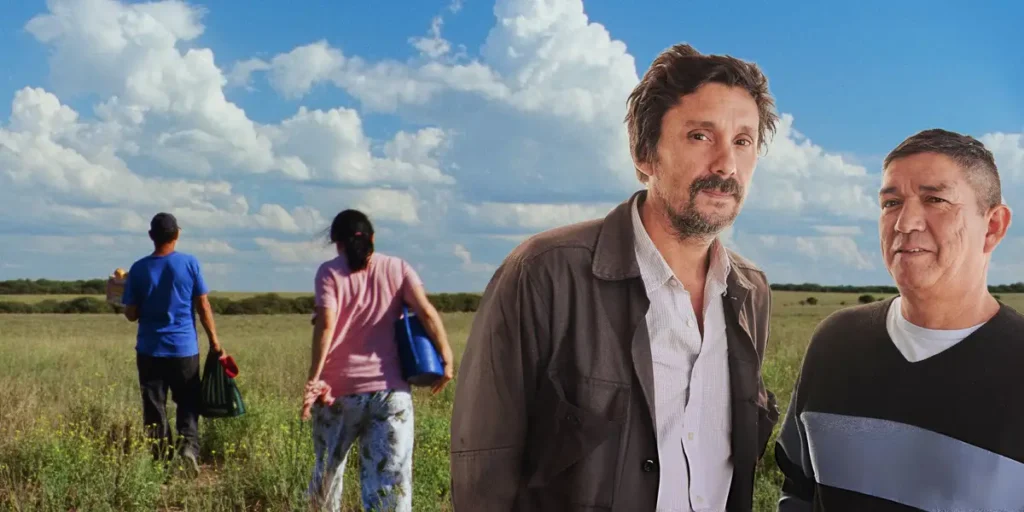
We interview writer-director Lisandro Alonso and actor Misael Saavedra about their new film Double Freedom (La Libertad Doble) at the Cannes Film Festival.
It’s been 25 years since Lisandro Alonso was nominated for the Un Certain Regard award at the Cannes Film Festival for his feature debut La Libertad (Freedom). A quarter of a century later we interview him at Cannes, where he’s returned with the unlikely sequel, Double Freedom (La Libertad Doble). Alonso’s work has made the Argentinian director a poster boy for contemplative cinema, better known as ‘slow’ cinema. La Libertad saw rural woodcutter Misael (Misael Saavedra) engage in a regular day’s work on his employer’s ranch, chopping errant branches and cleaning scrub, punctuated by breaks to eat and relax in his makeshift shack. The film revels in images of a man doing what he knows best.
Going all the way back to Jeanne Dielman, slow cinema recognizes that watching people engaging in familiar tasks is hypnotic and reassuring, and Alonso has generated a film buff fanbase by sticking to that maxim in his films since. In Double Freedom, we meet Misael right where we left him all those years ago. Very little has changed, but Misael’s life is about to take a different turn when the care home where his mentally disabled sister Micaela (Catalina Saavedra, no relation) is being shut down. Despite introducing a more solid narrative than found in La Libertad, its sequel has proven a hit with fans of Alonso’s patient and observant world-building.
We met Lisandro Alonso and Misael Saavedra after the film’s bow in the Director’s Fortnight strand of the 79th Cannes Film Festival. Read the interview to find out what they told us about sequels, remakes, simple shoots, and much more.
Lisandro Alonso and Misael Saavedra on returning to the world of La Libertad in Double Freedom
What drew you back to the world of La Libertad after all this time. Why did you want to revisit that story?
Lisandro Alonso: I think that after experiencing different ways of making films, with professional actors in international places, I really wanted to feel like I did when I started making films just after film school. I thought that going back to where I started would be a great chance for me to experience and to work with the same people that I worked with years ago, and it feels great. You have demands in life when you’re 25 years old, but you keep going in life, and suddenly you have another set of issues, and so you need to follow up.
Was it difficult to get as many of the cast and crew as you could back together after all that time?
L.A. We added new people, like Catalina Saavedra, who plays Misael’s sister. Part of the crew that was involved in the first film doesn’t work in the film industry anymore. They were doing different things for different reasons, but I just called them – exactly the same group of people – to ask them to be there.
Misael, what did you think when Lisandro asked you to come back and play your role again?
Misael Saavedra: When Lisandro first asked me to come back, I doubted for a bit. I wasn’t sure about it, but then I asked my mother and my family, and they told me, “It’s your friend Lisandro, so maybe you should go and try it again!”
Lisandro Alonso and Misael Saavedra on the making of Double Freedom
Viggo Mortensen has said what he enjoyed the most about working with you was just how simple the shoot was. What does that kind of minimalist kind of filmmaking mean for you?
Lisandro Alonso: First of all, it brings the chance to use cinema just as an excuse for me to meet people and to enjoy two or three months together. Without cinema, I wouldn’t be able to do that, so I use it as an excuse and tell everybody, “Let’s make a film!” I’m just discovering nowadays that I often make movies this way so I can find a group of people with whom to share a common experience, and to feel some appreciation and love.
Then you go back to your normal life, paying the bills. However, for that moment, it brings me a lot of fuel to just keep doing what I have to do every day. We didn’t shoot every day, so I’m not the kind of filmmaker that really puts pressure on anyone, even if I know how I really want to do things. My bigger job is to find the right people to enjoy the shoot, and if the film is not good enough, it’s not gonna kill anyone.
Tell us about the shoot itself. Where is this woodland that Misael’s character has been tending all these years?
L.A. We shot on my father’s farm back in Argentina. The back garden of my home! Misael really knows his way around there. We were just enjoying the time, eating meat every day, drinking some wine, going for walks, and then I’d say, “Okay, let’s shoot something!”. It was great, and I really enjoyed that kind of ride, without having to explain to different people what I was doing.
Did that freewheeling approach apply to the script as well? Was much improvised?
L.A. It seems like I don’t have a script, but I do, even if it’s only a few pages. Paper is not a film, so a script is just a guide for me to share with the crew, to see how and where we are going to shoot, and how much daylight we need, or how many microphones. Every time that I started a film or a project, I just showed the crew what I want to shoot. They don’t need a script, because now we’re like friends and family. There was a script, like 30 pages, in order to explain that this is not like the first film. It’s going to have some other elements. Misael will have a situation that he is not used to, and that’s the main conflict. By shooting the film, we would discover if it will work out or not.
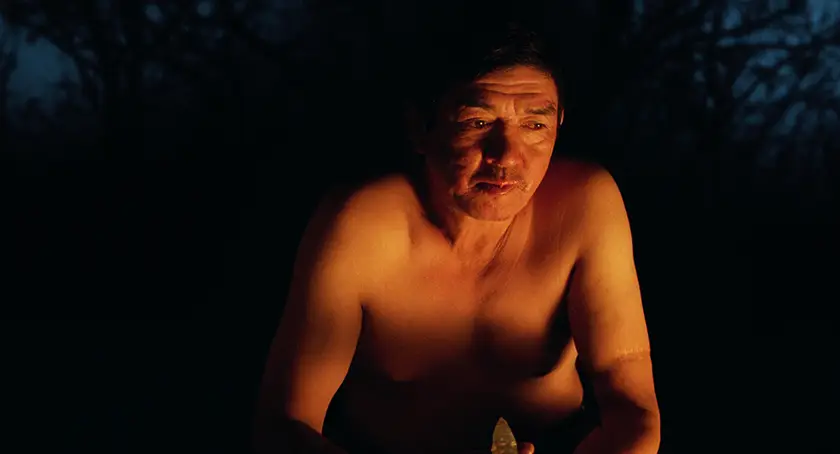
Misael, your chemistry with Catalina was terrific, very believable as a brother and sister. Did you do much preparation together to establish the characters?
Misael Saavedra: We didn’t have time to get to know each other before we started shooting, just one or two days. Fortunately, we just got along very easily. We were kind of nervous to see how we would manage that kind of relationship in front of the camera, but fortunately it worked well.
Lisandro Alonso on Cannes and the changing world of filmmaking
It’s been 25 years since you were at the Cannes Film Festival with La Libertad. What do you think are the main differences in coming to a festival like Cannes and showing a film between then and now?
Lisandro Alonso: Even after 25 years, I think it’s still extremely important for me nowadays, as a filmmaker from South America, to have this platform, to show the film, and receive the stamp of approval from the festival. It’s very important for me to keep proving that I can show films in a festival like this, and that I’m not crazy!
But it has changed a lot. What happens with the film afterwards is probably going to be very different from 25 years ago, where I travelled in order to show the film in commercial places. I mean, there were very limited kinds of cinemas, but nevertheless, there were screens for these kinds of films. Nowadays, I will probably show this film just in festivals, or universities, and mental hospitals! I feel very lucky to be here, especially showing this film. It’s the first time Misael and I traveled together, and the first time he’s taken a plane, so really, we are very happy to be here.
Is there a sense that the upheaval in the characters’ lives in Double Freedom reflects the upheaval in the world that we’re seeing at the moment? 2001 was a very different world.
L.A.: Yeah, I think everything changed so much. When we started shooting La Libertad, we even used phones in a very different way. The way we show films has changed radically, through platforms and different devices. In the case of Misael, even if he exists only in the film, and in a very humble way, and he didn’t ask the world too much; the possibilities of having a better life are changing for the worse. He needs to take care of things that he can’t take care of, and that other people should take care of, like his sister’s mental issues. He doesn’t have the tools. ItIn a metaphorical way, I think that is happening worldwide.
The rights we all have, and the possibilities we all have, are changing. I see that among my friends and other people: it’s getting very difficult for them to decide to have kids, or choose to send them to university, or buy an apartment, or travel, or get a good job. I think it’s getting harder and harder, and that’s without talking about the wars happening today.
Filmmaking seems to be changing more and more. Do you worry that it’s going to get more difficult to make films on the scale that you like to make them?
L.A. That seems like a natural question for me to ask myself, but I discovered that by doing this kind of film, I get the chance to work with people that naturally would not respond to me as a filmmaker. I just finished a film two weeks ago, a remake of Kiarostami’s Taste of Cherry, in Brazil, with Wagner Moura. Nowadays, it seems that being honest with yourself is not the natural way for you to get bigger, but somehow, it works for me. I feel very lucky [that I’m able to be honest].
Once I finish in Cannes, I will start editing the film. Next year is the 30th anniversary of Taste of Cherry, so I will be happy to put Kiarostami’s work out there and talk about it. That kind of cinematography influenced me very much, and I think it’s good to talk about these kinds of films nowadays, when images are moving so fast and I don’t know what I’m watching.
This interview was edited for length and clarity.
Double Freedom (La Libertad Doble) premiered at the Cannes Film Festival, in the Quinzaine des Cinéastes, on May 16, 2026.
Header credits: Lisandro Alonso and Misael Saavedra, of the film Double Freedom (La Libertad Doble), pose for a portrait shoot during the 79th Cannes Film Festival on May 16, 2026 in Cannes, France. (Sebastien Dubois-Didcock, Contour by Getty Images) / A still from the movie (Luxbox, Cannes Film Festival)