
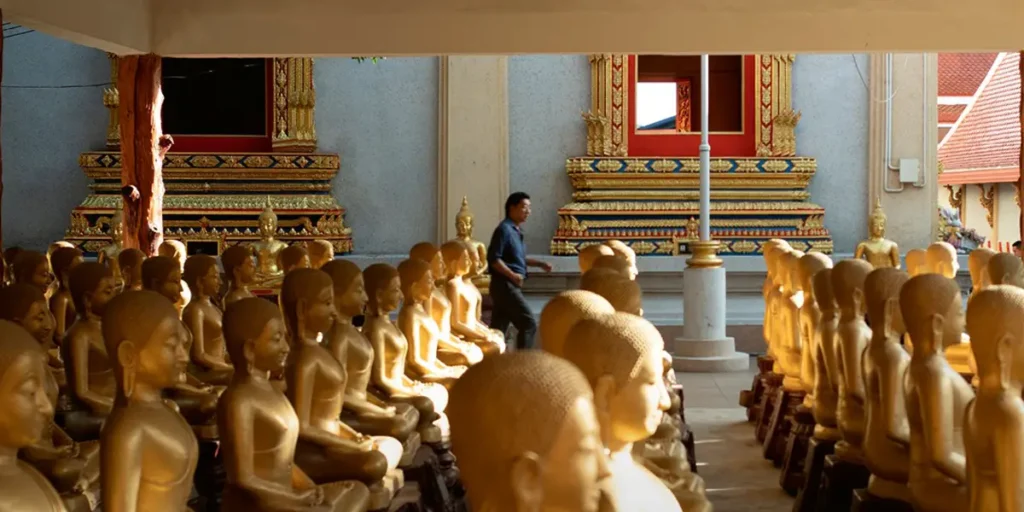
9 Temples to Heaven, the feature film directorial debut from Sompot Chidgasornpongse, is a carefully paced rumination on death and spiritualism.
Director: Sompot Chidgasornpongse
Genre: Drama
Run Time: 140′
Cannes Premiere: May 19, 2026 (Quinzaine des Cinéastes)
U.S. Release Date: TBA
U.K. Release Date: TBA
Considering his long working association with Apichatpong Weerasethakul (Tropical Malady, Memoria), it seems fitting that Sompot Chidgasornpongse’s first feature film as a director is a languid, gentle look at religion and spiritualism in Thailand. 9 Temples to Heaven is one of the most patiently paced films you will find this year, with its generous 140-minute runtime unfurling with no rush or definitive end goal in sight.
Like his countryman, with whom he has worked on four features, Chidgasornpongse recognises that the journey is just as important as the final destination, if not more so. This consideration lends 9 Temples to Heaven with a wandering quality that sometimes teeters into aimlessness, but for the most part sinks into an invigorating hypnosis.
63-year-old Sakol (Surachai Ningsanond, of The Promise) is informed by a fortune teller that his elderly mother (Amara Ramnarong) might die soon, thus setting up the journey of 9 Temples to Heaven. Along with his mother, wife, brother, sister, and children, Sakol embarks on a trip to, as the title suggests, nine different temples around Thailand. It is frequently referred to as a merit-making trip, a pilgrimage where at each temple rituals and ceremonies are carried out with various monks. Chidgasornpongse doesn’t give any great fanfare to each arrival at the temples nor the ceremonies themselves, but the understated, observational nature of his filmmaking is the only way that this story could have been told.
His work as First or Second Assistant Director on notable Weerasethakul films such as Tropical Malady (2004) and Syndromes and a Century (2006) clearly influence 9 Temples to Heaven—Weerasethakul’s involvement, along with Kissada Kamyoung, as a producer is also notable. Scenes unfurl naturalistically, the camera like an additional family member observing this family’s journey. At one point, a character looks at and knocks on a window, which feels as if he is doing it to the camera lens itself. Long shots—mostaly static, some tracking—allow these scenes to glacially coast along, but most notable is how the camera will often drift in the middle of scenes, capturing the surrounding environment and Thai architecture whilst dialogue continues.
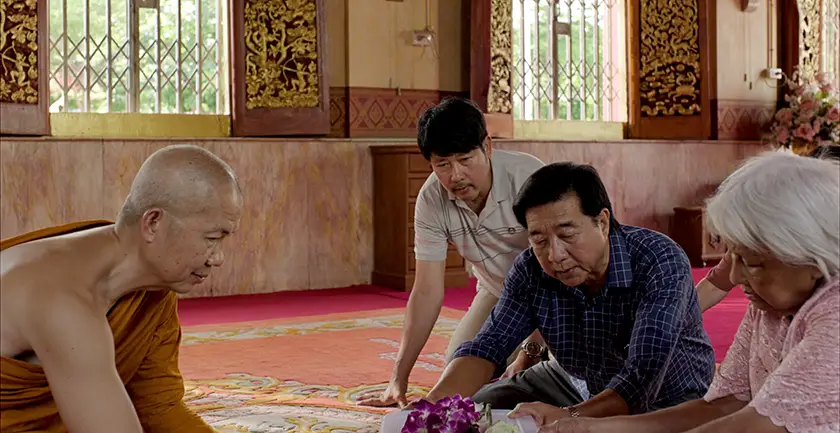
This is not to say that 9 Temples to Heaven is a carbon copy of any of Weerasethakul’s works. Chidgasornpongse is definitely less focussed on magical realism than the legendary filmmaker is; instead, he rarely moves outside of the realms of realism, only occasionally dipping into some otherworldly, spiritual places. These moments stand out amidst the naturalism, and often accompany characters’ interesting musings on death and the afterlife. The environment is also a character not just visually, but aurally too, with ambient noise—the buzz of insects, the passing of cars or planes, the shouts of children—often drowning out standard dialogue.
It is a fascinating exercise in filmmaking that constantly makes the viewer aware that they’re watching a whole world in action, and not just a group of people. This causes some of the characters to become lost from a traditional narrative point-of-view, as well as the various family tensions that come to light, but 9 Temples to Heaven is too irresistibly unique to have those shortcomings become big issues. Legendary filmmaker Tsai Ming-liang (Days, Abiding Nowhere) embraces the fact that many of his films could cause viewers to fall asleep, such is the fine line they skirt between being awake and dreaming. In 9 Temples to Heaven, during one ritual, a monk notes that the family’s minds are drifting, inviting them to reflect on whether they are truly aware of their surroundings. It is a curious invitation that extends to Chidasgornpongse’s film as a whole, and in turn to us as the audience.
9 Temples to Heaven (Cannes 2026): Movie Plot & Recap
Synopsis:
After being informed by a fortune teller that his elderly mother doesn’t have long to live, Sakol and his family embark on a pilgrimage around Thailand. Along their journey, they visit nine temples in one day, observing religious rituals amidst their familial differences.
Pros:
- Many fascinating reflections on death
- Superbly realised observational cinema
- An ambient atmosphere that envelops the viewer
Cons:
- Difficult to connect with any of the characters
- Occasionally too drifting and meandering, causing attention to wain
9 Temples to Heaven premiered at the Cannes Film Festival, in the Quinzaine des Cinéastes, on May 19, 2026.