
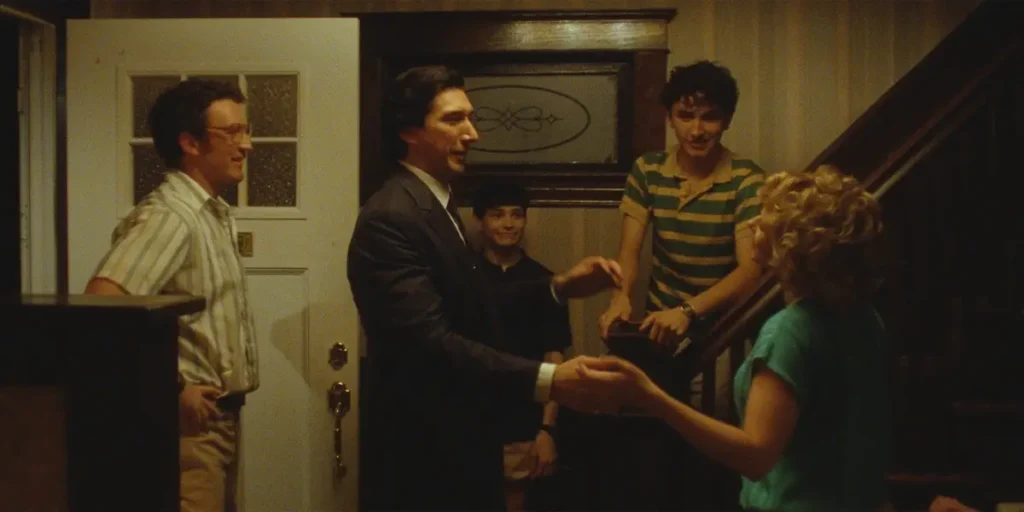
Solid performances and filmmaking can’t shake the feeling of déjà-vu from Paper Tiger, James Gray’s latest New York-set crime thriller.
Writer-Director: James Gray
Genre: Crime Drama, Thriller
Rated: R
Run Time: 115′
Cannes World Premiere: May 16, 2026 (In Competition)
U.S. Release: November 2026
U.K. Release: TBA
Howard Hawks once said “A good movie is three good scenes, and no bad scenes.” A James Gray joint usually concentrates all that goodness into one great scene, and the rest comes and goes just fine. In Paper Tiger, we are spoiled with two great scenes, but surrounded by a raft of mostly middling ones. It balances out to a typically solid film from Gray, albeit his most forgettable.
For all his evocation of classic Hollywood filmmakers, Gray is a more challenging writer-director than people realize. In many of his films (his crime thrillers especially), he throws us in with ragtag bunches of everymen who could lead perfectly happy lives if they’d just stop making stupid decisions. The protagonists of We Own The Night, The Yards and Little Odessa need to put as much distance between them and any combination of dirty cops, corrupt contractors and Russian mafiosos as possible. Paper Tiger is another variation on the themes and narrative outcomes of those films, offering no surprises in its tale of a tight-knit family fighting forces with whom they’ve unwisely opted to do business.
Miles Teller makes his biggest stab at actorly credibility in years as Irving Pearl, an engineer living in the New York borough of Queens in 1986 with his wife Hester (Scarlett Johansson, of The Phoenician Scheme) and their teenage sons Scott (Gavin Goudey) and Ben (Roman Engel). Theirs is a comfortable but unremarkable life. We learn this from a series of opening scenes that explain their situation with little subtlety. They’re toying with leaving the city. Scott is going to college soon. Gray’s script is populated by the same types in the same locales that we’ve seen in his and so many other director’s films that we can expect a lot of the plot beats before they slide into view. Conflict and tragedy are inevitable; it’s just a matter of who introduces it.
We get our answer in the Brylcreemed, besuited form of Adam Driver as Irving’s brother Gary, an ex-cop turned investor and contractor, whose impending divorce isn’t enough to take the wind out of his sales. Driver gives his best performance to date as Gary, his animated gestures and slick style offering a sharp contrast to the cramped and hazily-lit interiors Irving and his family call home. Most every element of the film, from the production design to Joaquín Baca-Asay’s cinematography, is determined to remind us that Paper Tiger hails from (and is set in) an analog age, where cellphones don’t exist and money is ready to be made around every corner. Unfortunately, the Pearls have chosen a dark corner to turn.
Gary comes to Irving with a proposal that sounds like a bad idea from the off. He wants to offer consultancy to the Russian owners of a waterfront that’s polluted by oil that will need cleaning up to comply with new environmental regulations. From the first moment we actually glimpse the Russians who run the waterfront (led by Victor Ptak’s Bogoyavich), it’s clear these guys aren’t concerned about their carbon footprint. When Irving and his boys run afoul of the Russians’ henchmen while innocently surveying their prospective jobsite, it’s only then that they and Gary realize what they’ve got themselves into, while viewers will slap their heads at the blinkered worldview that led them here.
Paper Tiger feels like a smaller version of the conflicts of which Gray’s crime thrillers usually consist. It’s Gary and Irving against the Russians, but other possible allies and adversaries are lacking. Gary’s former colleagues in the force actually try to help, as their surveillance shows the Pearls are ripe for plucking by their would-be partners in environmental preservation. What we get instead is a health scare for Hester that sits awkwardly alongside the crime shenanigans, not influencing matters as much as it really should. If it resonates at all, it’s due to Johansson’s performance, investing Hester with vulnerability beneath her Noo Yawk bluster. Next to her, Teller does fine as Irving, even if he can’t muster the same emotionality as Johansson, or keep attention on him when Driver acts everyone else off the screen.
Most of Paper Tiger rattles along in functional ’A-to-B’ expository beats, punctured by those saving grace moments of great filmmaking. Irving wakes up one night to hear footsteps downstairs, and Gray pins us with him as he threatens the intruders with a BB gun. We never see the intruders in the darkness, only hearing their raspy voice as they deliver an icy threat. The other moment comes in the climax, with Driver’s Gary setting things right once and for all. Spoiling it might diminish the artistry, but it’s always worth sitting through the familiar beats of Gray’s films to find those grace notes. However, it’d do the writer-director a world of good to branch out a little further than New York next time. I hear Jersey’s lovely this time of year.
Paper Tiger (Cannes 2026): Movie Plot & Recap
Synopsis:
Two brothers start doing business with Russian mobsters, and try to extricate themselves when things inevitably go awry.
Pros:
- Three great leads. Adam Driver delivers his best performance yet
- Elegant filmmaking from Gray, with moments of palpable tension
Cons:
- Gray’s milieu of New York mobs, cops and corrupt officials doesn’t feel as compelling as it has in previous films.
Paper Tiger premiered at the Cannes Film Festival in Competition on May 16, 2026. Read our reviews of James Gray’s Ad Astra and Armageddon Time.