
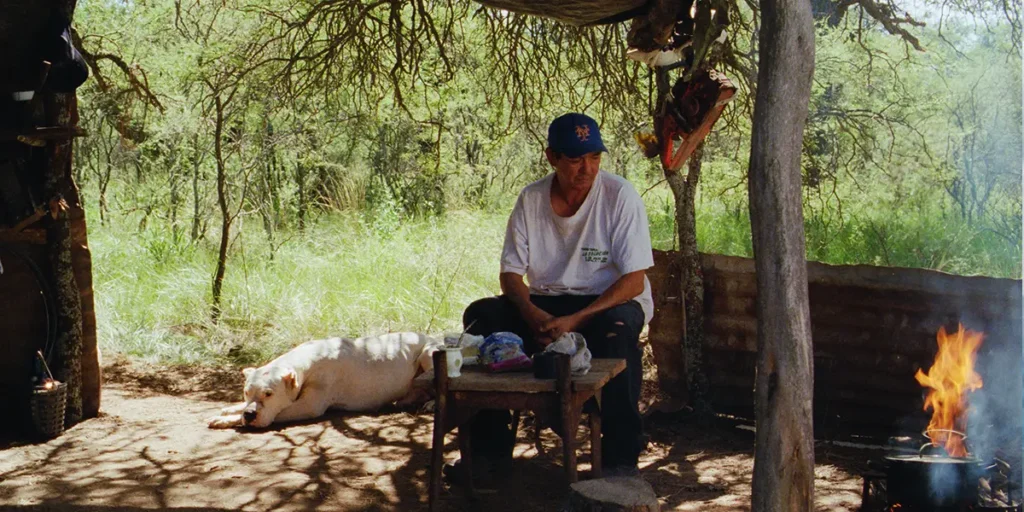
In Double Freedom, Lisandro Alonso reminds us of what a sequel should do, revisiting his earliest triumph while taking it in new directions.
Director: Lisandro Alonso
Original title: La Libertad Doble
Genre: Drama
Run Time: 100′
Cannes Premiere: May 16, 2026 (Quinzaine des Cinéastes)
U.S. Release Date: TBA
U.K. Release Date: TBA
Double Freedom (La Libertad Doble) opens right where its predecessor, 2001’s La Libertad, left off, with humble woodcutter Misael (Misael Saavedra) peeling cooked meat of an unidentified animal before a campfire. Writer-director Lisandro Alonso welcomes the viewer back to the world of his first feature with a familiar setup, but the world is not the same place it was in 2001, and even someone living as simple a life as Misael’s is not invulnerable to the winds of change.
Alonso’s methods have not changed much, but the Argentine filmmaker should be reassured that audiences are invested enough to see what will happen to his protagonist when he might be in some kind of trouble. As Misael chomps on a meaty limb, the black skies behind him light up with flashes of lightning. Dark clouds, both literal and metaphorical, are rolling in.
Change doesn’t come all at once, least of all in the realm of ‘slow’ cinema. The first half of Double Freedom operates much in the same vein as its predecessor. The camera observes Misael, still going about his daily business as he did 25 years ago. He washes himself from a tub, he scrapes bark off a branch before cutting it from the tree, he stops to urinate, he goes back to work. There’s a reassurance in the consistency of Misael’s life, that some corners of the world can avoid the turmoil that seems to plague the headlines and social feeds. Misael exists outside technology, and that works just fine for him. As before, Saavedra’s stoic face never betrays any emotional surcharge; we get close to him, but his secrets will be guarded forever.
For a while, it looks like Double Freedom will carry on in the same patient, potentially frustrating way as before. The first line of dialogue comes after 20 minutes (and that’s spoken to a dog), but Alonso finds beauty in the quietude of rural Argentina. Returning cinematographer Cobi Migliora lets the greenery reflect the near-constant sunshine, helping his director find fascinating tableaux in the leafy landscape. A wide shot of Misael’s dogs encountering a lost calf recalls Johann Heinrich Roos’ animal scenes. There is beauty anywhere you look, but the calm this environment brings is about to be tested. Double Freedom shocks with a sudden move into narrative that was never invited into Misael’s world before now.
Misael hears from neighbours that his sister Micaela (Catalina Saavedra, of Problemista) has been wandering outside the care facility where she resides. He drives to see her, but even this simple act ruptures the relationship we’ve built with Misael to this point. The quiet radicality of Alonso’s films lies in his ability to subvert narrative and emotional expectation on a whim, and Double Freedom delivers that subversion in spades. Misael is told the care home is closing down, and that he will have to take over Micaela’s care. Though her severe autism-like condition is never definitively identified, she is clearly in need of 24/7 assistance. She can talk, but has no conception of doing everyday tasks for herself.
In the role of Micaela, Catalina Saavedra is sweetly endearing, a busy childlike contrast to Misael’s continued calm. His emotions never break, but the heartbreak lies in imagining what must be going through his head. It probably can’t be good. Alonso doesn’t get explicitly ‘big-P political’, but Misael’s predicament nods to the severe social cuts of the Milei government. Such decisions impact every corner, no matter how remote or peaceful.
As Misael’s world becomes more populated (by his sister, and the people he encounters in the process of bringing her home), he seems to shrink within the frames Lisandro puts in his way. Where once he roamed his green working grounds freely, he now finds himself hemmed in by the sickly peeling walls of the care facility, and has less of the frame to occupy at home now that there’s another body there.
Double Freedom is a film about freedom being halved. Anyone who cares for a sick family member will tell you that your walls retract inwards, and the tragedy of the film is wondering how poor Misael will cope. We have to trust the process, but Lisandro doesn’t want to lie to his viewer. As Micaela goes for a wander on the scrubland, she shrinks in the landscape. Where the animals were a tableau, she is a dab of paint in a Turner landscape, threatening to be lost if we don’t watch out for it. If we revisit in another 25 years, we might be scared of what we find, but Double Freedom’s success lies in making us care enough for these characters that we will want to check in on them again.
Double Freedom (La Libertad Doble): Movie Plot & Recap
Synopsis:
We revisit rural woodcutter Misael, still living a simple life, but changes in family circumstance are about to change all that.
Pros:
- Alonso masterfully evokes the spirit of La Libertad, before subverting expectations with a new narrative angle
- The performances and filmmaking are quietly powerful in their mesmeric power
Cons:
- By default, Alonso’s ‘slow’ cinema style will not appeal to all viewers
Double Freedom (La Libertad Doble) premiered at the Cannes Film Festival, in the Quinzaine des Cinéastes, on May 16, 2026.