
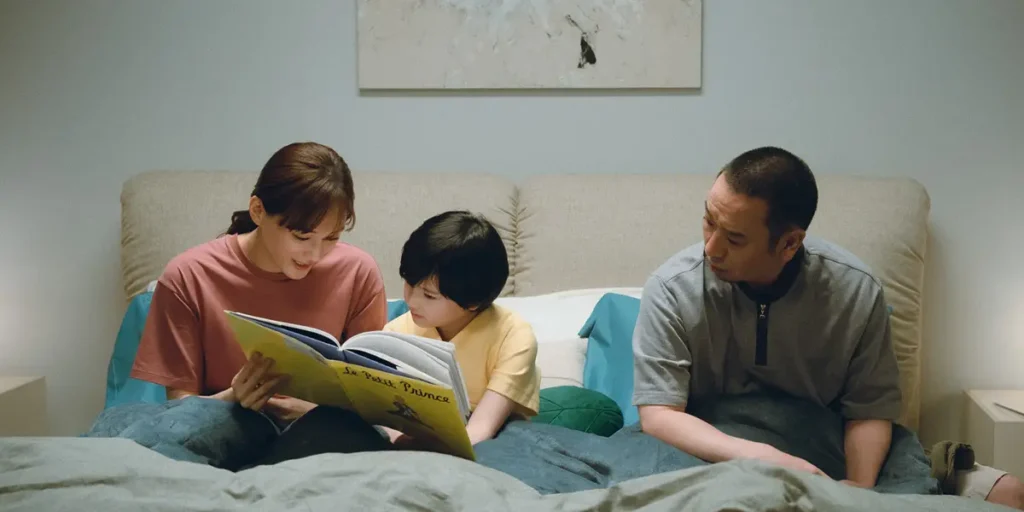
In Sheep in the Box, science fiction meets family drama in an emotional and touching portrayal of the not-so-distant future.
Director: Hirokazu Kore-eda
Original title: 『箱の中の羊』 (Hako No Naka No Hitsuji)
Genre: Drama, Fantasy, Sci-Fi
Run Time: 126′
Cannes Premiere: May 16, 2026 (In Competition)
U.S. Release Date: TBA
U.K. Release Date: TBA
Sheep in the Box (Hako No Naka No Hitsuji) begins with an intertitle telling the audience that this story is taking place in “the not-too-distant future” and an establishing shot of Japan where the characters live. From the opening scene, Hirokazu Kore-eda introduces the audience to the setting of the movie and to its genre. The near future timeline immediately conveys that this is a science fiction movie but, as we learn more about the characters and their relationships with each other, it becomes increasingly clear that this is more than that: a film that also delves into grief and complicated family dynamics.
In this near future , Otone Komoto (Haruka Ayase) is an architect, and her husband Kensuke (Daigo Yamamoto) works for a construction company. After losing their son Kakeru two years prior in an accident, they receive an invite from REBirth, a company that specialises in creating AI-based humanoid robots that look and act like a lost loved one. The couple decides to try this out and welcome a robot, the life-like Kaleru (Rimu Kuwaki), into their home.
The film is at its best when it explores the family dynamic between the characters, which are complicated, to say the least, and very much real in their imperfection. Other family members also make an appearance from time to time; Cousins, sisters, and overbearing mothers are all key elements to Sheep in the Box and the way the characters interact with each other, as we see how much Otone’s broken relationship with her own mother affects the relationship she is trying to build with Kakeru.
Similarly, Sheep in the Box is very effective in its portrayal of grief. Otone and Kensuke are both still coming to terms with the tragic accident that took away their son, but in different ways. Their recollection of the events varies slightly, as does the way they are trying to come to terms with it. While their grief may manifest in different ways, neither of them is ready to let go, and this is where Kakeru and the entire REBirth project come in. But is replacing their lost son really an effective way to face their grief? This is something that the main couple will have to ask themselves and eventually find an answer to.
The near future is portrayed in an uncanny and somewhat familiar way. Not so distant from our own and yet different enough for us to understand that it is not the present, the world we see portrayed in Sheep in the Box feels highly realistic and almost obtainable. However, the film lacks worldbuilding from a science fiction point of view. We do not know much about the humanoid robots at all, if not for what the main couple hears in the somewhat expositionary video at the beginning of the film.
This inevitably feels like a missed opportunity. There is a lot that Sheep in the Box could have explored further when it comes to the character of Kakeru and his role in the film. Does he learn how to think for himself, and is he programmed for that in the first place? And how does free will work in these beings without a soul? The question of consciousness and agency of humanoid robots has always been a pivotal topic in science fiction, Blade Runner is just one of the many examples of this, and Kore-eda’s movie could have revisited this in a new light in the world of accessible generative AI.
Ultimately, Sheep in the Box raises more questions than it answers. While relevant to its time and to today’s technology and artificial intelligence conversation, the film has very little to add to the latter. In fact, it does not really take a firm stand on it, choosing to focus on the elements of character and family dynamics. But if that was what the director was interested in all along, I could not help but wonder why he chose to use the science fiction genre at all, given how little of this is actually present in the final product.
Sheep in the Box (Cannes 2026): Movie Plot & Recap
Synopsis:
Two years after the tragic death of their son, a couple decides to take in a humanoid robot whose AI technology replicates their lost son.
Pros:
- The family dynamics are compelling and feel very honest and real.
- The portrayal of grief is heartbreaking and moving, but also very authentic.
Cons:
- The film does not focus on the science fiction elements enough, leaving part of its world-building incomplete.
- Kakeru could have been explored a lot more as a character as his existence raises a lot of ethical and philosophical questions.
Sheep in the Box (箱の中の羊 – Hako No Naka No Hitsuji) premiered in competition at the Cannes Film Festival on May 16, 2026. Read our reviews of Family Romance LLC, Rental Family, A.I. Artificial Intelligence, and Kore-eda’s Monster.