
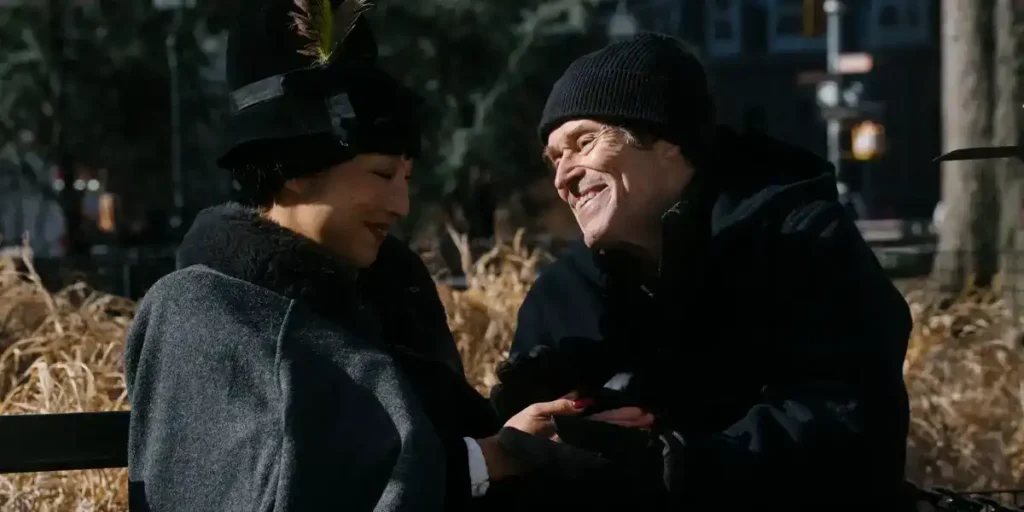
With Late Fame, Kent Jones delivers a quiet, funny, and intimate film about New York City, pretentious hipsters, and the pursuit of artistic creation in 2026.
Director: Kent Jones
Genre: Comedy, Drama
Run Time: 96′
Rated: NR
U.S. Release: August 7, 2026 in theaters
U.K. & Ireland Release: August 28, 2026 in cinemas
What does it even mean to be an artist today? There’s no money in it, unless you’re already rich. There are limited ways to get people to look up from their phones and read your latest work. And yet, people keep making art, for a million different reasons, and whether noble or narcissistic, this pursuit is undeniably human. Late Fame is an extremely well-made film that explores this question, exposing the ridiculous precarity of art, success, and spiritual fulfillment.
Willem Dafoe (Poor Things) stars as Ed Saxberger, a mild-mannered man who represents a version of New York that’s been lost to time. He arrived in the city as a teenager with nothing but a wad of cash in his pocket and fell into the downtown arts scene, ultimately achieving a burst of fame through the publication of a poetry book. But when the film opens in the present day, Saxberger is working at the post office and living a serene but somewhat lonely life, the spotlight forty years behind him.
A chance encounter introduces Saxberger to Meyers (Edmund Donovan, of Civil War), a tightly-wound, overly earnest fan who insists upon expressing his admiration and introducing Saxberger to his friends. Saxberger is initially hesitant, but upon meeting the group, he finds himself as compelled by them as they are by him. He becomes steadily more enmeshed in their world as the group works towards hosting a public reading of their work. But though the reading drives the film’s narrative, Late Fame is more a character piece than anything else, interrogating the generational divide between Saxberger and Meyers, and the various others caught in their orbit.
Meyers and his friends fancy themselves true artists in a world overtaken by cell phones, instant gratification, and spiritual emptiness. The group, which dubs itself the Enthusiasm Society, is made up of wannabe essayists and poets who speak reverently of the New York from Saxberger’s artist days. But despite their luddite aspirations, the group is not exempt from the perils, personal blindspots, and uncomfortable financial realities of the modern day.
The Enthusiasm Society worships artists who struggled for their work, but Meyers is an NYU grad student living in an apartment his parents pay for. His perpetually tweed-jacketed friends see themselves as tortured geniuses, but in reality they spend a lot of time getting drunk and not actually writing. They look down at a group of influencers who frequent the same bar as them, but they are equally fame-obsessed, frequently asking Saxberger whether he knew various literary celebrities, and dimming when he awkwardly admits he did not.
The film is able to offer sharp observations about class by shining a light on these contradictions, but the tone consistently remains light and humorous, as well as deeply kind. Despite their neuroses and hipster affectations, these characters come across as trying sincerely to navigate modern times and come out okay, even contribute to society somehow. Late Fame is laugh-out-loud funny at times, but it never crosses the line into excessive satire—a difficult balancing act—nor does it judge its own characters too harshly.
The young artists feel like the most authentic characters, but Dafoe turns in a great, understated performance, giving viewers a sense of what it’s like watching the world change and pass you by. In only a few decades, downtown Manhattan has gone from a grungy part of the city where artists congregated to one of its most expensive and desirable locations. Dafoe portrays Saxberger as someone who just takes it all in.
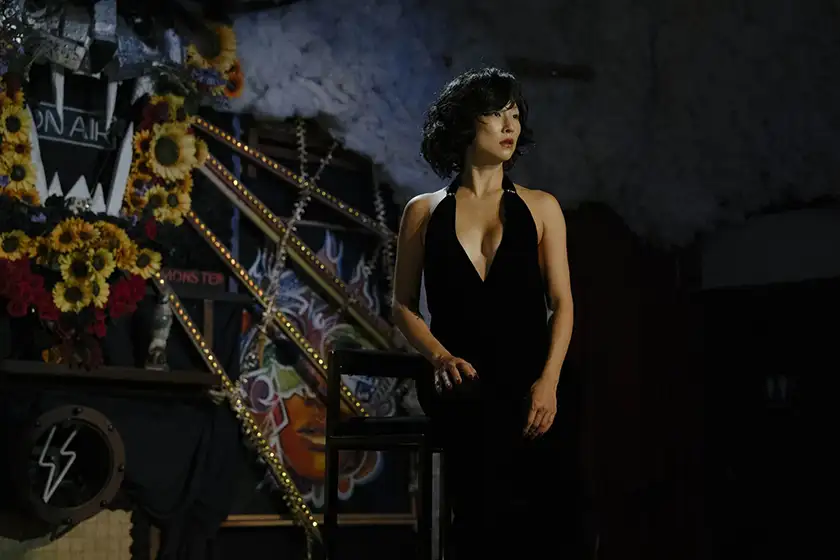
Dafoe’s Saxberger is juxtaposed against Greta Lee’s Gloria, who embodies the real plight of the contemporary artist. Gloria is the only woman in the Enthusiasm Society, flitting in and out shattering male egos and hearts. Lee portrays Gloria as an over-the-top starlet, with a comedic grandiosity that calls to mind more the diva version of herself she played in The Studio than the subtly earth-shattering performances that made her an indie darling in films like Past Lives. Gloria feels simultaneously like the femme fatale from a 1940s noir and an inarguably 2020s woman, natural at performing the self—not just on stage, but all the time. Lee puts her all into the role—which requires both singing and cabaret-style dancing—selling Gloria as a character to whom performing is as essential as oxygen.
Gloria shows that the scrappy, struggling artist still exists, and being one is not as romantic as Meyers likes to believe. She commands the attention of the audience and the men around her, but she’s also the least developed character. We’re told she likes to present herself as “mysterious,” but this renders her mysterious to the audience as well, to a fault: our relationship to her feels uneven in comparison to everyone else. While Meyers’ hypocrisies and mannerisms are laid bare and Saxberger’s mundane routines are depicted in detail, Gloria remains largely unknowable. Certain moments point to compelling (and concerning) things about her life, but they go largely unexplored, which strikes an odd note in a story this dedicated to character.
But perhaps this is par for the course in a film that loves New York City itself more than any character. In a script full of tightly written interactions, the scene I keep coming back to follows Saxberger walking the streets alone, reciting one line of an old poem over and over. There’s grief over how much has changed, curiosity about what’s new, and that distinct New York imagery—it’s one of my favorite scenes of the year so far.
I love the familiar ways New York City gets captured in film: soaring establishment shots over the Brooklyn Bridge, action scenes in an eerily deserted Times Square, rom-com heroines flagging down yellow cabs. Late Fame’s approach might be one of the most subdued yet intimate: every viewer, no matter where they are, will feel the energy of the city in every frame.
This loving attention undoubtedly comes from director Kent Jones, himself a mainstay of the NYC arts scene as a filmmaker, critic, programmer, and previous director of the New York Film Festival. But Late Fame has other creative forces behind it as well. The script was penned by Samy Burch, the Oscar nominated writer of May December, and adapted from an 1890s novella by Arthur Schnitzler, whose work also served as the basis for Kubrick’s Eyes Wide Shut. The process of adapting and modernizing a text that Jones and Burch took on reflects the essence of the film. Transitioning the setting from Vienna in the 1800s to New York in the 2020s is quite a change, but the differences between Saxberger’s past and present are presented as similarly drastic.
Late Fame captures an iconic place and a moment in time while creating a memorable cast of characters. It’s a difficult time to be an artist, a vocation that requires pure passion with no entitlement to monetary success or status. While the members of the Enthusiasm Society have yet to fully learn this lesson, it’s one the film embodies.
Late Fame (2026): Movie Plot & Recap
Synopsis:
An aging artist joins a group of young aspiring writers, prompting reflections on life, time, and the pursuit of creation.
Pros:
- Balances humor and cultural critique with genuineness and heart
- Great performances, especially from relative newcomer Edmund Donovan
- Captures New York City in loving detail
Cons:
- The film’s only female character is oddly underdeveloped
Late Fame will be released in US theaters on August 7, 2026 and in UK & Irish cinemas on August 28, 2026.