
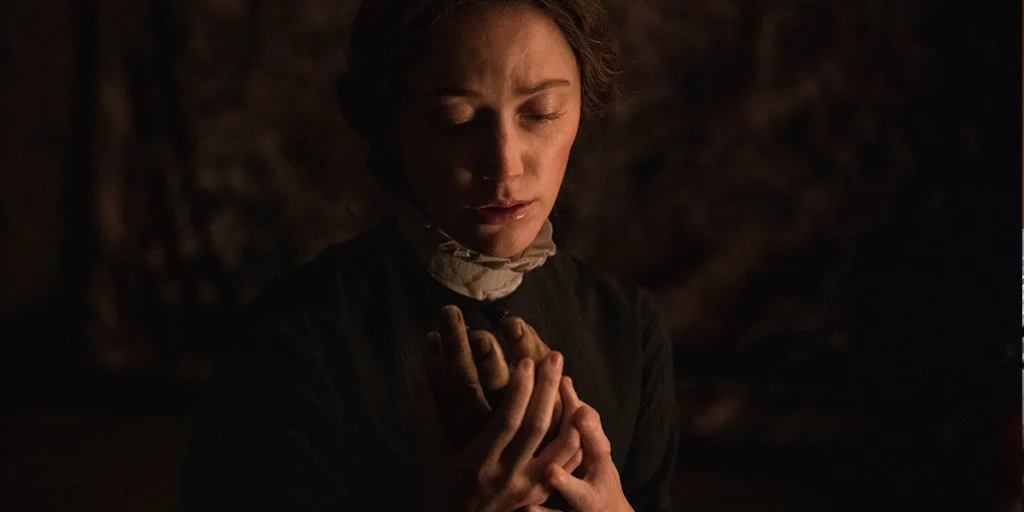
Maika Monroe has a blast in Victorian Psycho, a bloody, frenzied romp about a psychopathic governess that is undermined by a simplistic script.
Director: Zachary Wigon
Genre: Horror, Slasher, Thriller, Psychological Thriller
Run Time: 102′
Rated: R
U.S. Release: November 13, 2026
U.K. Release: 2026 (date TBA)
Where to watch: In U.S. & Canadian theaters
Part primordial “eat the rich” film and part girlboss feminist “good for her” movie, Victorian Psycho doesn’t live up to either of these genre buzzwords.
Winifred Notty (Maika Monroe, of Longlegs) is “the sanest person she’s ever met,” and her stalwart conviction persists even as the bodies stack up. At the opening of the film, in 1858, Winifred has just arrived at the esteemed Ensor House to assume a position as the governess to two children. The family, unsurprisingly, represents the monstrous glut of the uberwealthy, a topic numerous recent films have satirized.
The household patriarch, Mr. Pounds (Jason Isaacs, who also had fun skewering the upper class in The White Lotus’ third season), is fussy and controlling in a way that yields to true darkness. Mrs. Pounds (Ruth Wilson, of A Very Royal Scandal) stalks through the house in extravagant gowns and frets over the quality of her son Andrew’s education (Jacobi Jupe, of Hamnet) while making it clear she doesn’t care whether her daughter, Drisilla (Evie Templeton, of Wednesday) even wakes up in the morning.
The family is initially too caught up in themselves to notice that Winifred has a dark past, though there are pointed references from household staff about the string of missing or dead children from her last several posts. (Despite this morbidness, the film retains a fairly inoffensive, darkly comedic tone throughout.) But audiences know everything early on thanks to Winifred’s narration, which is amusing because of her passionate belief that all of her actions are justified. The film is not a mystery, it’s a gleeful characterization of a female psychopath.
On her first night at Ensor House, Winifred finds an ear in her bedroom and relishes in eating it whole. Early on in her tenure, a skeezy gardener threatens to reveal her secrets, and gets an ax through the skull without a second thought. She terrifies her only friend, a skittish housemaid (Tomasin McKenzie, of Last Night in Soho), scandalizes the Pounds, and kills a deer in front of the children to teach them a lesson about death.
Winifred believes she has a demon inside her – and maybe she really does; the film plays with reality and truth – whom she nicknames “Fred,” and she has come intent on unleashing horror upon the family while clawing her way into the aristocracy. Victorian Psycho rapidly proceeds through an array of outlandish, dreamlike sequences in which every actor is clearly having a blast with their melodramatic characters.
Maika Monroe continues to live up to her role as a bonafide horror star, in a performance less nuanced than her breakout, the cult classic It Follows, but more demanding than the smash hit Longlegs. Her maniacal grins and nervous tics give us a character wholly aware of their own wrongdoing yet unstoppable in their pursuit of mayhem—it’s a pleasure to watch Monroe work.
Similarly, Jason Isaacs balances menacing gravitas and absurd eccentricism to create a memorable performance. On the verge of parody, he stands out within the class satire genre, which is crowded with similarly obnoxious characters.
Exaggerated acting choices are highlighted by frequent fisheye closeups, just one of the camera techniques director Zachary Wigon (Sanctuary) experiments with to show how unhinged the house becomes. These cinematic choices work in harmony with the over-the-top set design: rooms upon lavish rooms, slightly too tall ceilings, and lurid colors show us the enviable yet grotesque spaces the aristocracy creates for themselves.
These techniques can break viewer immersion at times, promoting reflections on what feels like the aimless inevitability of the narrative. But they’re placed strategically enough to augment the film’s tone, which is frenzied romp. Winifred’s rapid deterioration makes for a whirlwind, just over 90-minute viewing experience.
This inevitability comes from the simplicity of the script: from the beginning, we know Winifred is a psychopathic killer, and the film gives us little to think about as she slices and dices her way through Ensor House. The film could have truly thrived if it leaned into its B-movie campiness—some genres, like slashers, are successful precisely because of the fun and frights they offer while sticking to a predictable formula. Victorian Psycho is most enjoyable when it’s dumping buckets of blood all over the set and getting Winifred and the Pounds family in the same room for theatrical confrontations.

It stumbles when it tries to go deeper than that, weighing itself down with trite third-wave feminist analysis designed to justify Winifred’s insanity. The film periodically nods to the repressive structure of Victorian life, especially for women. Insanity, then, becomes an escape from normative, patriarchal society.
This has been understood by a vast number of creatives; our most seminal Victorian authors explored the gender dynamics of what was then contemporary culture, and this is part of why their work has retained such power. In Charlotte Brontë’s “Jane Eyre”, should we not see Jane as a woman attempting to claim her autonomy, and Mr. Rochester’s imprisoned, allegedly insane first wife, Bertha, as a sympathetic victim of her time? Recent subversive takes on the era have found endless room to analyze the transgression, threat, and power of female rage, even female violence.
The film’s connection to such socially critical works is perhaps most obvious when considering its title, a reference to American Psycho. Another book-to-screen adaptation (Victorian Psycho is based on a novel by Virginia Feito, who then wrote the screenplay), American Psycho also depicts a remorseless serial killer convinced of their own sanity. But Patrick Bateman’s psychopathy allows the narrative to interrogate masculinity in relation to neoliberal capitalism and Reagan-era politics; the murders themselves are not the point of the story. Conversely, Victorian Psycho devotes the majority of its runtime to Winifred committing and then covering up the murders, and leaves its commentary at the surface level.
The film joins a rich political tradition it unfortunately cannot measure up to. And embracing its slasher-esque roots more would have set it apart in today’s media landscape, which is full of class satires and “elevated” horror fare. But despite a script that needed a bit more meat on its bones for audiences to chew on—as Winifred does some poor servant’s ear—Victorian Psycho’s blood-soaked escapades are worth a watch.
Victorian Psycho (2026): Movie Plot & Recap
Synopsis:
In Victorian England, a gleefully psychopathic governess assumes a new post and unleashes horror upon the family.
Pros:
- Fun performances from actors clearly reveling in the film’s absurd tone.
- The film’s narrative is bloody, entertaining, and satisfying.
- Cinematic choices, set design, and costuming will hold audience attention.
Cons:
- A simple script weighs down the film’s intended messaging and limits its potential.
Victorian Psycho will be released in theaters in the U.S. and Canada on November 13, 2026. In the U.K. and Ireland, the film will be distributed by True Brit Entertainment.