

Siân Heder’s Being Heumann is a moving and well-acted drama based on true events that couldn’t feel any more relevant nowadays.
Director: Siân Heder
Genre: Docudrama, Historical
Run Time: 127′
Rated: R
Theatrical Release: November 6, 2026 (limited)
Digital Release: November 13, 2026 on Apple TV
Even though at times it does feel like a predictable and traditional (and maybe even Oscar-baitey) dramedy, Being Heumann ultimately works due to how relevant and emotional it ends up being. Led by an excellent Ruth Madaley, Siân Heder’s latest film manages to fictionalise a true story in such a way that it balances its message with its characterisations, making it clear that main character Judy Heumann’s work was both deeply personal for her and something she was doing for the good of pretty much everyone in the United States.
I was moved by Being Heumann but, at the risk of sounding a bit clichéd, I was also inspired to be better, to do something to make a difference for disabled people and minorities in general.
Being Heumann is set in 1977 and mainly takes place in San Francisco, California. As the story begins, we learn that five years before, Congress passed a law that included Section 504, which made discrimination based on disability prohibited in programs and activities receiving federal funding. This means that, if signed and confirmed, this law would require thousands and thousands of buildings to change and include objects such as ramps or elevators to make them accessible to disabled people. And why isn’t Section 504 being signed? Because United States Secretary of Health and Human Services Joseph A. Califano Jr. (Mark Ruffalo) considers its implementation to be senseless and prohibitively expensive; so much so, in fact, that if he were to sign the document, he would probably get fired.
Judy obviously doesn’t care about budget problems in the government or the fact that two congressmen added Section 504 to the law almost at the last minute. She fights against discrimination, and alongside her friends and peers, she wants the document to be signed. Thus, she decides to occupy the San Francisco federal building as a form of protest. Initially, she says she and her group of protesters will stay inside only for one night, but as Califano keeps ignoring both her phone calls and her public pleas, she decides to stay put. Thankfully, she’s accompanied by a loyal group of people, including other disabled folk in wheelchairs; Black Panther member Chuck Jackson (Ray Fisher, of Zack Snyder’s Justice League); lesbian activist Joni Breves (Roberta Colindrez); and even Evan White (Dylan O’Brien, of Send Help), a local TV journalist and reporter who’s sympathetic to the cause.
Structurally, Being Heumann gets to the point quite quickly, wasting no time in sending its characters to protest outside the federal building and, eventually, inside it. There’s no need to include a whole backstory or even flashbacks to Judy’s past. Everything we learn about her, we do through her actions, her interactions with her fellow protesters, and her persistence. As another character puts it: she’s “an a*hole, but the a*hole we needed”. She’s a great leader precisely because she won’t rest until she’s heard, and because she finds problems nobody seems to care about. At times, she can make her work a bit too personal, but she always comes around and realises why she truly is protesting.
And that’s the secret of Being Heumann: it’s both about the message and about Judy as a person. The script never loses sight of its protagonist as, well, a human, but it also manages to convey the importance of her work and everything she and her peers have gone through. Let’s remember that the film takes place in 1977, in a United States without ramps at street corners and without accessibility options in most buildings. In fact, the film ends in such a way that it makes it clear Judy’s work didn’t end in the late seventies, and ties it all up with archival footage of disability protestors outside the Capitol in 1990. Being Heumann is inspirational, but it’s not naive; it never tries to tell us that what transpired in the late seventies was enough.
Now, you do have to consider that Being Heumann is a rather traditional motion picture, meaning it ends up being quite the crowdpleaser. It touches upon complex issues and tries to make them digestible, not only for the viewer to empathise with its characters and their struggles, but also to make it feel relevant nowadays. In that sense, I do understand why some people might see it as a very light and very Oscar-baitey movie; in fact, there are few surprises in Being Heumann, and some aspects of its climax even feel a bit anticlimactic. But at the same time, I do feel that making Being Heumann as accessible as possible makes a lot of sense, not only from a commercial standpoint, but also for its story to reach and touch as many people as possible.
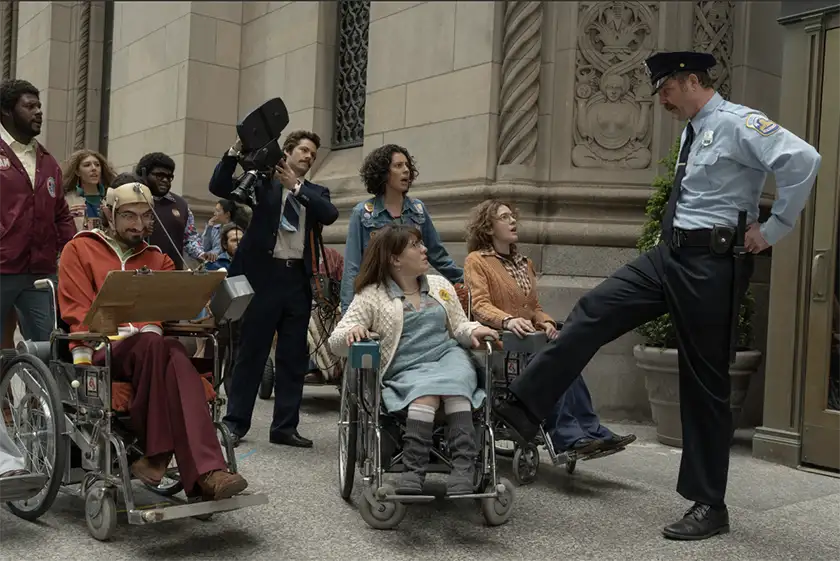
Moreover, I never got the sense that the film was trying to manipulate me emotionally or that it was being dishonest. Pretty much all the dramatic beats work, and I ended up crying three or four times mainly because I felt connected to Judy and her struggles on a deeply human level. This group of protestors aren’t presented as victims to be pitied, but as regular folk with desires, interests and flaws who, as they occupy the building, party and eat and drink and smoke weed and have sex and make mistakes. Appropriately enough, the film manages to humanise these characters in the same way any other fictional figure has to be humanised in any movie, and, of course, Ruth Madeley’s strong performance is the standout.
Being Heumann tells an extraordinary story of ordinary people fighting to have the same rights as anybody else. Judy herself might have a very specific disability, having to use a wheelchair and depending on an assistant to get out of bed or go to the bathroom, but as she puts it, she’s fighting for the rights of every disabled person in the States: the blind, the deaf, the sick, the little people. In that sense, her fight is a universal one, and one that ends up affecting everyone in the country (positively, of course). Being Heumann is the right film to honour Judy and her work, and, hopefully, it should move people into doing something, anything, to make our world better for everyone and anyone.
Being Heumann: Movie Plot & Recap
Synopsis:
A disability rights activist leads the 26-day occupation of the San Francisco federal building to convince the Secretary of Health and Human services to sign the first U.S. federal civil rights protection for people with disabilities.
Pros:
- Excellent performances.
- Moving and deeply human.
- Feels honest and relevant.
- Moves at a quick pace.
Cons:
- A bit on the traditional side.
Beyond the Review
Where did Being Heumann premiere?
Being Heumann had its World Premiere at the Toronto International Film Festival on September 10, 2026. It was then screened at many festivals globally, including AFI Fest and the BFI London Film Festival.
Which disability did Judy Heumann have?
Judy Heumann had polio, which she contracted at 18-months-old in Brooklyn, New York, where she began to use a wheelchair for mobility. You can find Judy Heumann’s biography on her official site.
Is Being Heumann likely to win any awards?
Yes, Being Heumann is a strong contender for many major awards. Siân Heder previously won an Oscar for Coda, and there is critical buzz for this film too. But the awards discourse is mainly around star Ruth Madeley, who might win a Best Actress prize at the Oscars, Golden Globes or SAG.

Being Heumann had a limited theatrical release on November 6, 2026 and will be available to watch on Apple TV from November 13, 2026.