
A sparse story of death, The Summer Book finds middling results when three generations of a grieving family keep too much on the inside.
Director: Charlie McDowell
Genre: Drama
Run Time: 90′
U.K. & Ireland Release: August 7, 2026 in cinemas
U.S. Release: September 19, 2025 in theaters; October 21, 2025 on digital platforms
More famously known for The Moomins, Tove Jansson also wrote novels for adults, of which The Summer Book is her most popular. It’s a book about death in which the topic is barely acknowledged. A young girl, her dad, and her grandmother return to the island they spend the summer on each year, but for the first time, her mother is not there. She’s not there in everything that happens.
Charlie McDowell’s adaptation of The Summer Book is an appropriately delicate film, in which stunning vistas of a remote Finnish island and Hania Rani’s piano-led score represent both the beauty of life and its fleetingness. In between scenes showing the fragile relationships between girl, dad, and grandma, the Baltic sea laps close to an aging summer house built of wood. Rani, who also composed the score for Sentimental Value, says much of what the characters cannot, who all feel deeply and desperately, with a young girl who’s conscious for the first time of death’s devastation.
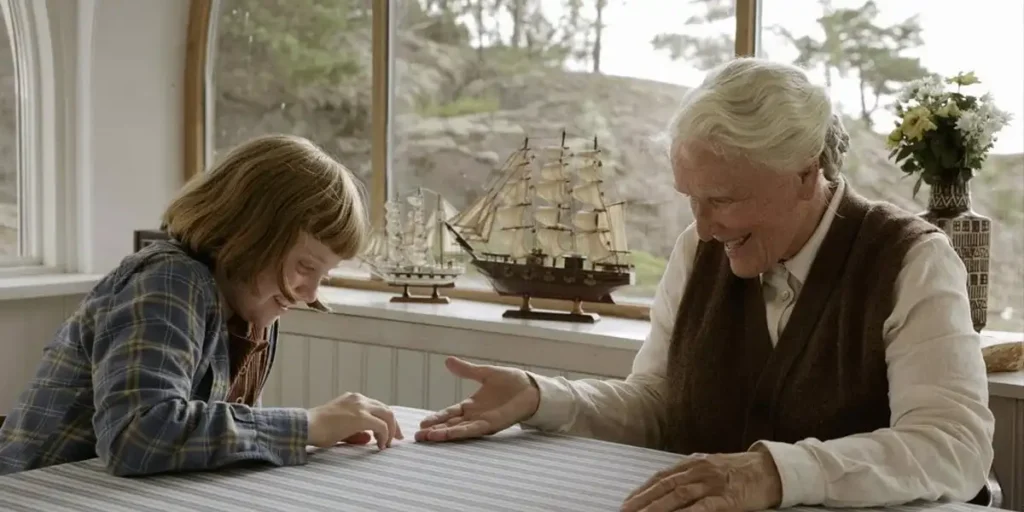
That young girl, Sophia (Emily Matthews in her debut), spends The Summer Book concerning herself with little moments, just like in the source material. The dive off of some rocks into the sea becomes something to overcome, a gifted cat teaches her a life lesson (“The more I love him, the less he likes me”). Her grandmother (Glenn Close, of The Black Ball) is credited with allowing girls to join the scouts, but with age she has forgotten what it is like to sleep in a tent. In an act of kindness, Sophia spends part of an evening in one so she can remind her.
Meanwhile, Sophia’s dad (Anders Danielsen Lie, of The Worst Person in the World) is on the fringes. He works and sketches at his desk, and he plants a poplar tree, his wife’s favourite. His emotional distance is plain to see; “he doesn’t love me since she died,” Sophia tells her grandmother. He is a grieving widow, but all the while, is forgetting to be the father his daughter needs. He thinks the place stinks of grief, but the grandmother suggests self-pity instead. She is having to step up in his place.
By its nature, The Summer Book is sparse. Conversations are not being had and a child is without her mother. Midsummer rain is the loudest sound on the island. The film doesn’t always find the emotional balancing act’s sweet spot; there’s not always enough of what there isn’t. It can be a little lackadaisical, repeatedly defaulting to shots of nature to remind us of life’s transience. The film is hampered by the lack of character interiority provided by its novel, so the complexity each of these three people are feeling is kept on the inside, always out of reach.
But sometimes the gaps work. When Sophia snaps at her grandmother while playing cards, you understand her frustration has nothing to do with the game. As the grandmother stops to take in her surroundings, her breathing laboured and deliberate, we see her appreciation for the life she has had while fully aware it will soon be over.
Close is the film’s standout as the steadfast grandmother, whose wisdom is kind but firm, and Rani’s score stands on its own as a beautiful achievement. There is grace and poetry in The Summer Book’s attempt at telling a story all about what is not being said, and it occasionally gives and withholds just enough to share in this family’s avoidance of a life-changing loss.
The Summer Book: Movie Plot & Recap
Synopsis:
A young girl, her dad, and her grandmother return to the small island in Finland they spend each summer for the first time after her mother’s death.
Pros:
- Hania Rani’s beautiful score
- Glenn Close on reliably fine form
- Complex portrayal of avoiding dealing with grief
Cons:
- Occasionally too sparse
- Hampered by inability to convey interiority the novel benefits from

The Summer Book will be released in UK & Irish cinemas from 7 August, 2026. In the U.S., the film is now available to watch on digital platforms.
Loud and Clear Reviews has an affiliate partnership with Apple, so we receive a share of the revenue from your purchase or streaming of the films when you click on some of the links on this page. This won’t affect how much you pay for them and helps us keep the site free for everyone.