

The Echo Chamber, despite the best efforts of Alicia Vikander and Luca Marinelli, is too overwrought with abstract contemplation to pack a punch.
Director: Andrea Pallaoro
Genre: Drama, Romance
Run Time: 123′
Venice World Premiere: September 6, 2026 (In Competition)
Release Date: TBA
For years, legendary Italian director Bernardo Bertolucci’s final screenplay lay dormant following his death in 2018. Known for creating films that radiate sensuality, evoke long moments of quiet contemplation and ask audiences to question their own sense of morality, Bertolucci has never been an artist who spoonfeeds his audience a succinct conclusion to his works.
When Andrea Pallaoro (Monica) took up the mantle of bringing Bertolucci’s final story to life, he must have understood what a tall order this would have been to fill.
Unfortunately, regardless of the bountiful talent from a central cast comprising Alicia Vikander, Luca Marinelli and Susan Sarandon, Pallaoro’s The Echo Chamber is unable to capture the same spark as Bertolucci’s other well-known features. The film relies too heavily on the emotional weight stories of addiction naturally carry without putting in much further effort to get audiences to understand and empathize with the looming sense of doom the story tries to invoke.
The Echo Chamber follows the torrid, on-again, off-again relationship between Leo (Luca Marinelli, of Paternal Leave) and Anne (Alicia Vikander, of Hope). While the film blurs the lines of space and time, the couple exists in a repeating pattern of love, obsession, control and dependence, all within the setting of Leo’s stunning and spacious apartment.
The couple meets when Leo, a music producer, hires Anne, a physiotherapist, to help him recover from a chronic back injury. As sparks fly during their initial appointment, Leo pushes to get to know Anne, who is happy to oblige as she has her own curiosities around Leo. What unfolds is a slow, yet bright burn capturing what it looks like for two avoidant individuals to slowly find themselves submitting to an undeniable connection.
However, things quickly get out of hand when one night Anne gives Leo pain pills as a last resort to help with his debilitating back pain. While Anne gives Leo the pills in a genuine effort to ease his pain, Leo’s addictive personality becomes all consumed by the relief he gets from abusing these pills and he begins to unravel faster than Anne can keep up with. While his pill abuse leads him to an overdose, it only serves as the first of many fatal turning points he faces as he chases his addiction on a downward and all-consuming descent into rock bottom.
While the initial relationship between Leo and Anne draws audiences in, they are left too long without substance to sustain their interest as The Echo Chamber tries too hard to hold meaning in moments of overwrought contemplation. There is beauty in allowing audiences to sit with an emotion in a beautiful still shot, but The Echo Chamber plays this hand too early on in its runtime and reuses the same tricks without doing the actual work to develop the story much further.
The highlight of The Echo Chamber lies in the performances from Vikander and Marinelli, whose character work undoubtedly saves the film from completely venturing into the abstract. Sarandon’s work serves as another notable feature of the film, but the writing of her character, confining her to exist almost purely in the presence of the always struggling Leo, puts limitations on the extent to which she can shine in a story obsessed with being meaningful.
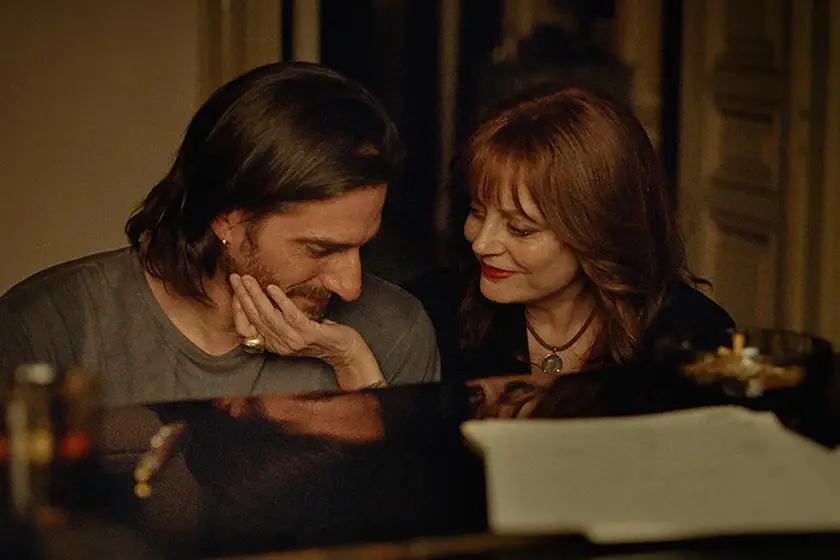
Ultimately, The Echo Chamber suffers under the weight of its own self-indulgence without doing the lifting to land the moral of any of the heavy lessons it sets out to explore. It takes too long to get the story off the ground and then only seems to navigate its downward spiral in a menial manner. While Vikander and Marinelli deliver performances that get the audience caring about the fate of the story’s central figures, they are not supported further by any genuine contemplative storytelling. The film works to capture the feel of Bertolucci’s storytelling, but isn’t able to spark the same innovation that would allow the story to fully soar.
The Echo Chamber: Movie Plot & Recap
Synopsis:
The Echo Chamber chronicles the torrid love affair of Leo and Anne as their relationship endures love, addiction, obsession and codependency.
Pros:
- Alicia Vikander and Luca Marinelli are the highlight of the film, leaving audiences wishing they were able to get more from their powerhouse performances.
Cons:
- The film is self-indulgent in its pursuit of deriving meaning from its overwrought abstraction.
- The audience is left in moments of contemplation far too long without any attempt to move the story forward or momentum to make them reflect on what is happening.
- The repetitive use of the same several cinematic tricks over and over again makes the film feel stale before you’ve reached the true second act.
The Echo Chamber had its World Premiere at the 2026 Venice Film Festival on September 6, 2026.