
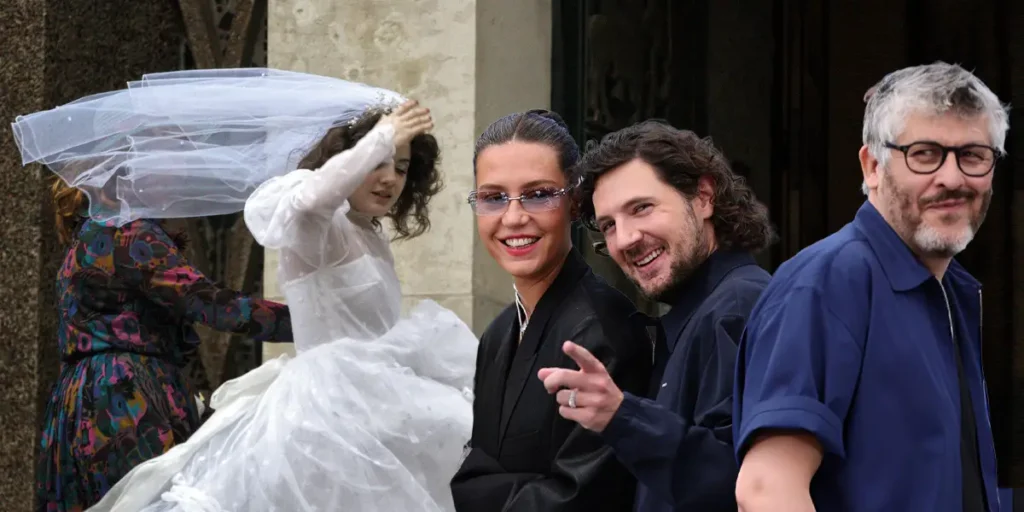
We interview writer-director Christophe Honoré and stars Adèle Exarchopoulos and Vincent Lacoste about their film Orange-Flavoured Wedding at Cannes.
Christophe Honoré is no stranger to the Cannes Film Festival. His debut feature Seventeen TImes Cécile Cassard was nominated for the Un Certain Regard award, and he has since been nominated for the Palme d’Or three times. His latest, Orange-Flavoured Wedding (Mariage au Goût d’Orange), premiered out of Competition, but is very much in his wheelhouse. It centres on people confronting uncomfortable truths about themselves, and trying to seek a way forward. It earns a certain chaotic energy from being centred on a large group of siblings gathering at a family wedding, and gains additional potency from being based on Honoré’s mother’s family.
In 1978, the Puig family assembles for the marriage of youngest sibling Jacques (Paul Kircher, of The Animal Kingdom) to Martine (Malou Khebizi, of Enzo), but each family member comes with emotional baggage. Jacques’ elder siblings, including Dominique (Vincent Lacoste, of A Private Life) and Claudie (Adèle Exarchopoulos, of Passages), could make or break the celebrations with their varying degrees of depression, alcoholism, and anger. Honoré confronts the chaos of this family, and uses it to create a vision of a family occasion that rings true in its dark humour and potential for tragedy.
We met Honoré, Lacoste and Exarchopoulos the day after the film’s successful premiere to discuss creating characters, real on-set chaos, and their own family dramas. Read the interview below.
Christophe Honoré and the Stars of Orange-Flavoured Wedding on Creating the Characters
Christophe, the Puigs are based on your own family. How did you approach bringing your history to the screen?
Christophe Honoré: They are based on my real family, but I was caught in a bind. On the one hand, I really wanted to be honest, and be as loyal as possible to the people and the facts, and not forgetting anyone. On the other hand, I realized that in the subsequent 40 years I have moved away from my family, because of the life and profession that I’ve chosen, so I cannot pretend that I’m still there and I’m still part of them. I feel that I still belong, but maybe they don’t; still, this is my vision of them, told as honestly and faithfully as possible.
Did you have actors in mind for the roles while writing the script?
C.H.: The only one that I had in mind was Vincent Lacoste, because I had already worked with him. About a year ago we had coffee together, and I saw him with this long hair, a ‘70s kind of look that reminded me of my uncle Dominique. That’s when I realized it was time for me to make this film. For the other actors, some of them I auditioned, some were suggested to me, but most of them I didn’t know. I wanted to get to know and work with this new generation of actors.
Vincent, what made you want to play the part of Dominique?
Vincent Lacoste: It was the collaboration with Christophe. He’s a director that I really love, and he offers me a very different range of roles. I was drawn to the complexity of this character, and this story that Christophe has built over the years. It was first turned into a theater play, but he was still toying with how to bring it to the cinema, and then he had the idea of this wedding day, which is the last moment of joy in the life of this family before everything crumbles.
He wrote this role thinking of me. We’d worked together before, and now we have a strong connection. It’s an easy choice when he offers me something, because I think he’s one of the greatest directors in France, and I just consider how lucky I am to be allowed to work with him.
Tell us about Dominique. He’s family-oriented, but with a dark side…
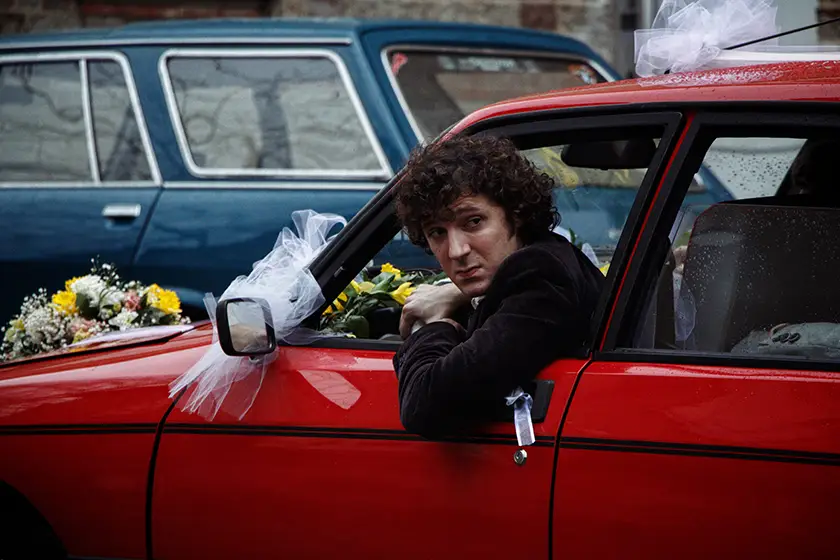
V.L.: The character is based on Christophe’s uncle, and the construction of this character was very particular. Compared to Christophe’s other movies, there was a lot of room for improvisation, as most of the dialogue was unwritten. This character is a very tender and joyful character, but at the same time he has a lot of violence in himself, and he just doesn’t want to reproduce the patterns of violence that run in the family. That’s something that the audience can feel, this tension between joy and violence.
Adèle, how did you relate to this story when you first read it?
Adèle Exarchopoulos: When I received the script, it was a bit of a nightmare. It was extremely theatrical, plenty of directions, but very little dialogue. I couldn’t see where I would fit in. I called Vincent Lacoste, who’s a friend of mine, and he said, “Don’t worry, just follow me.”
Christophe’s a great director, of course. I was familiar with his films, and I had seen how he had completely renewed the genre of musicals with Love Songs, and how he had launched Léa Seydoux’s career in The Beautiful Person. I was aware of all that, but still I was wondering how we would manage this complicated family. Once I got on set, I saw how he was able to corral this group, and how he took the plunge into this total chaos that he created on the set. I often noticed that he had his own personal monitor, but he wasn’t even watching it; he was just looking at us. We were so invested in this wedding that one time he called, “Cut”, but we went on dancing!
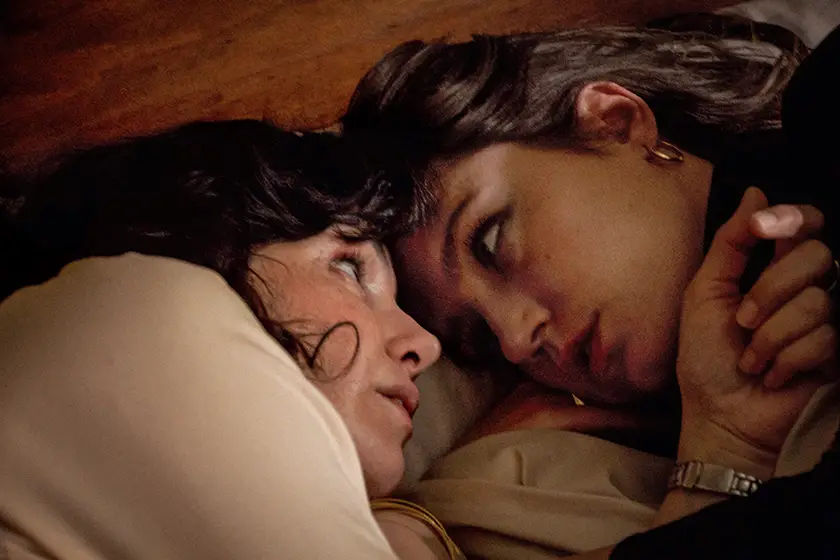
Claudie is very depressed, attending a wedding after her own marriage has ended. How did you find that sadness within yourself?
A.E.: I could easily relate to her, because I think that Claudie’s depression doesn’t come from nowhere. It really has to do with her time. She’s a woman who’s definitely too free. She has too much love, too much freedom, too much desire. She is just like plenty of other women, women to whom I can relate, who weren’t fit for what was expected from them in society.
The same year I shot this film, I had read a book called “My Name Is Lucy Barton,” that dealt with this topic. This is about women who had been considered as insane and put into psychiatric asylums just because they enjoyed life, were happy to have sex with their partners or husband, and were just bigger than the life that was designed for them, so it was very easy for me to connect with her, and with the gender emancipation that was just about to start when the film was set.
Christophe Honoré, Adèle Exarchopoulos and Vincent Lacoste on Making Orange-Flavoured Wedding
Christophe, how did you find directing such a large cast?
Christophe Honoré.: I don’t know if it has to do with their generation, but I noticed this bunch of actors had a kind of solidarity between all of them, even though they came from different backgrounds, and had different levels of fame. You had Adèle Exarchopoulos, and then you had young Prune, who was acting for the very first time. They all were very caring about each other; they had almost a union vibe to them. They all stood up for each other, with a camaraderie between them that surprised me.
Another funny aspect is that many of the actors had never been on a set with a film camera, because I always shoot in film. Because they were used to digital, they didn’t understand why I did so few takes. As it’s very expensive, I never do more than two or three takes, but they just didn’t understand why everything went so quickly. They were used to going over and over.
With its use of flashbacks and flashforwards, how did you arrive at the structure for Orange-Flavoured Wedding?
C.H.: The idea for me was first to have this view of this wedding, on one day. Once I decided that it would take place on one day in one place, I then had to find ways of escaping from that and opening to something else, and that’s how I came up with the idea of the flashforwards that would allow me to get more specific about different characters. Also, I wanted to give the impression to the viewer that whatever happened long after the wedding, the seed was already sown on that day.
Vincent, the film is shot with a lot of handheld camera. Does this make you aware of how you’re being filmed, and does it affect your performance?
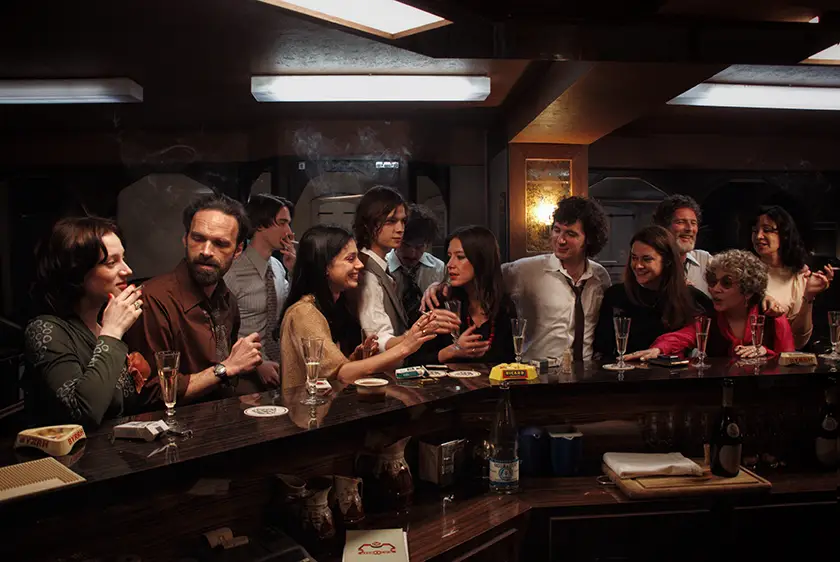
Vincent Lacoste: Christophe shot this way because he wanted to leave a lot of room for improvisation, which was probably necessary for this movie. It would have been impossible to write all of those scenes, and so he just wrote the situations and let us improvise. As actors, we will have our habits in terms of where the camera is, and we are conscious of that. In this instance, we shot for one month in this room, like 25 of us, and it’s very festive moment. At a certain point you forget where the camera is, if it’s on you or someone else, and it was somehow impossible to know who was being filmed at that moment, which I think made it quite enjoyable.
Adèle, did you and the rest of the cast have much rehearsal time before the shoot?
Adèle Exarchopoulos: We did have some prep together first. It may sound strange, but we were all terrible dancers, so we had some dance lessons! In particular, we had to learn to dance like on a wedding dance floor, having to stick to someone to feel their sweat and heat on you. Having this closeness was a strange way of starting, but it brought some things out in the characters. Also, learning how to move and be together opened us up. Of course Christophe was our cheerleader organizing all of this.
It was quite embarrassing to start doing improv in front of actors that you’ve met for the first time, and we came from so many different backgrounds. We were French, Spanish, old, young. Some of us were totally new to filmmaking, while Vincent and Paul (Kircher) had worked with Christophe before. The chemistry started working and because the theme of the film was the intimacy and cruelty of family, we soon started talking about very personal matters together. For instance, every Monday morning we would take a train to the shoot, and then we would go back home on Friday as we had families.
But each Monday morning, as soon as the train started, we all started talking together and being close to each other. That’s what making a film together is about. You’re given a unique opportunity to open up, to get so close and intimate with someone. They won’t necessarily become your friends for life, but during that period you have a level of intimacy that is unique to cinema.
Are you more comfortable as a leading actress, or working as part of an ensemble?
A.E. Of course, I love having the lead role, but I should say that I prefer supporting roles. They are something like real life; there are people who are just temporarily passing through, who play supporting roles in your life, but they can be extremely crucial to you, and they stay with you.
Adèle Exarchopoulos and Christophe Honoré on their Family Experiences
Adèle, did you have any strong memories (either good or bad) of family gatherings you could bring to the wedding in Orange-Flavoured Wedding?
Adèle Exarchopoulos: I’m lucky because I come from a very healthy family. My parents have nothing to do with cinema. My mother is a nurse. My father has two jobs, and he really wants to keep his two jobs! He’s a guitar player, but he also runs a concert venue. My brothers and I all sold popcorn and other things there. My parents really love their life, and they get on with it. My brothers are seven years younger than me, and it took them all time to realize what I was trying to do in my life.
The nice part is that they happen to be people that I would have chosen if they were not my family. Very often you have to put up with people that you haven’t chosen, and in a way you have to love them, whereas in my case I would have chosen them anyway! In a family, the tricky thing is to forgive each other no matter what you have done, and no matter how cruel you have been. I know myself that I have been unfair with my brothers, that I have blamed them for things that I had done, but there is also this high level of complicity and closeness, and all of a sudden you all start laughing in the middle of a funeral, or having this embarrassment in common!
Did your parents try to push you into acting when you were young?
A. E.: It’s not exactly what happened. My parents were willing to let me do an activity out of school, and I tried singing, I tried sports, and none of them really kept me going. But once I went to this improvisational theater class, it all changed. My parents realized that I wasn’t shy about performing as soon as I stepped into somebody else’s shoes. It’s still the same for me; there’s something very playful about acting. It’s not about having this very mental approach towards a character; it’s really about pretending, and this is what works for me.
Christophe, how does your family feel about your fame?
Christophe Honoré: Of my mother’s family, much like in the film, she’s the only one left. Her relationship to my fame is pretty distant. The only time she sees pictures of me doing publicity, she says that I should stand up straight! That’s the only thing she has to say about my fame or my work. Like in the film, once my parents’ generation died, then the family just scattered, and so we’re not really in touch with my cousins. I don’t know exactly what they think about my film.
This interview was edited for length and clarity.
Orange-Flavoured Wedding (Mariage au Goût d’Orange) premiered at the Cannes Film Festival, in the “Cannes Premiere” strand, on May 20, 2026.
Header credits: Adèle Exarchopoulos, Vincent Lacoste and Christophe Honoré pose during the Cannes photocall on May 20, 2026 (Andreas Rentz/Getty Images) / A still from Orange-Flavoured Wedding (Mariage au Goût d’Orange) (Leolo Victor Pujebet)