
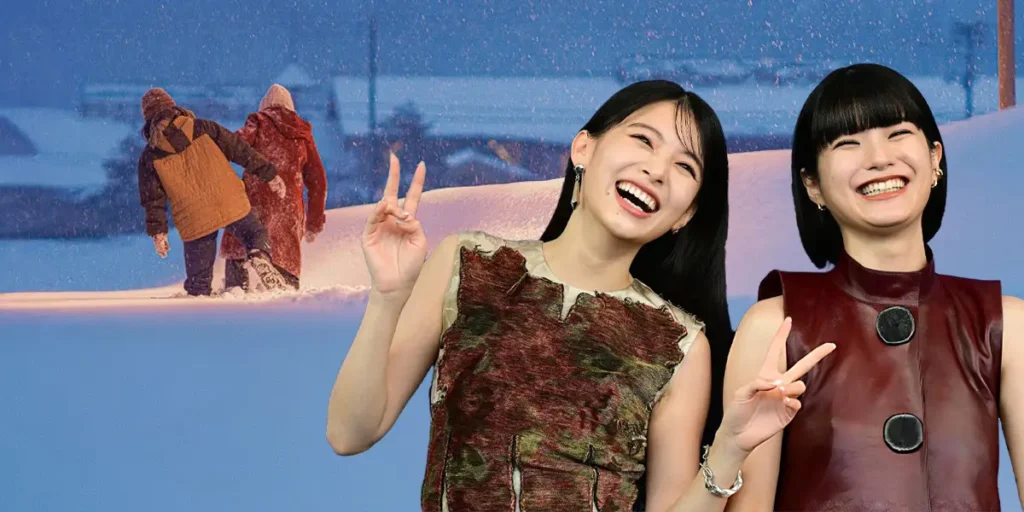
We interview Natsuki Deguchi and Aju Makita, stars of Hirokazu Koreeda’s Look Back, about taking on roles that mean so much to audiences, working together and more.
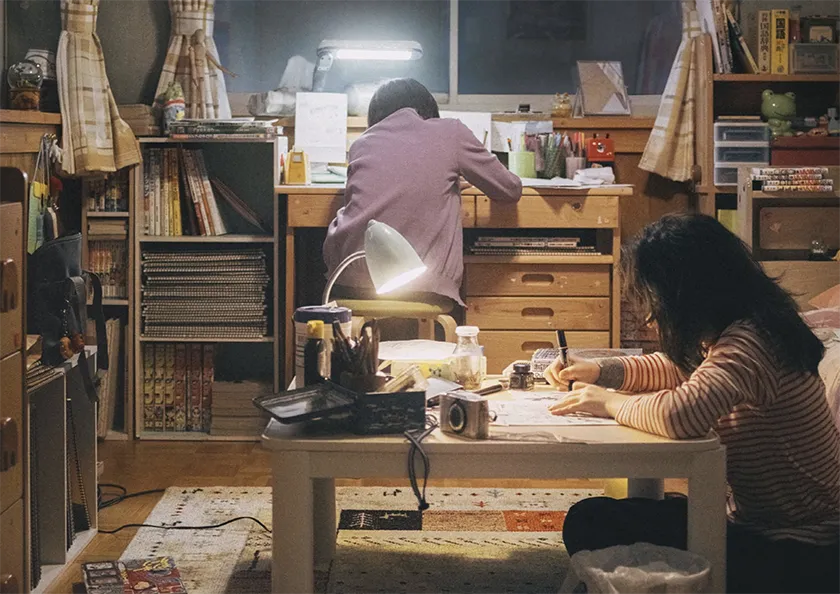
A fourth-grader named Fujino (Fūri Nanase) has a real talent for drawing manga that has earned her a regular slot in the school’s paper. For months, Fujino’s schoolmates have been looking forward to her comic strips, complimenting her skills. But everything changes when her teacher one day asks the girl to give up one of her strips so that a homeschooled classmate named Kyomoto (Rokka Okada) can contribute to the paper too. Fujino reluctantly accepts, but is shocked to discover that the new girl appears to be more skilled than she is at drawing manga. Soon, Fujino isolates herself from everything and everyone, too preoccupied with achieving one goal, and one goal only: becoming a better artist.
Eventually, the girls meet, and to Fujino’s surprise, a very special friendship is born that will accompany them both into adulthood. As young adults, Fujino (Natsuki Deguchi) and Kyomoto (Aju Makita) are the same lively, caring friends, and their bond has also evolved into a creative partnership. But just when their work is starting to be acknowledged, something happens that (to avoid spoilers) will affect both of their lives forever.
It hasn’t been long since Tatsuki Fujimoto’s manga of the same name was adapted into an animated movie by Kiyotaka Oshiyama, but Hirokazu Koreeda brings something else to the material: a tangible, visceral quality that makes everything come across as more vibrant and lived-in, with frames that make it feel like a manga is coming alive before our eyes. Natsuki Deguchi and Aju Makita excel as Fujino and Kyomoto; their authentic, raw performances will have you invested in their characters from beginning to end, making you feel so many emotions: you might even shed some tears.
At the 2026 Venice Film Festival, we sat down for an interview with Natsuki Deguchi and Aju Makita. Here’s what they told us about the pressure of taking on these roles, working with Hirokazu Koreeda, shooting in Akita, saying goodbye to their characters, and more.
Natsuki Deguchi & Aju Makita on Working with Hirokazu Koreeda and the Pressure of Taking On Their Roles
Thank you so much for these fantastic performances. This manga, and this story, mean so much to so many people all over the world. Did you feel this responsibility, taking on these roles?
Natsuki Deguchi: Since the original work was loved by so many people, I was certainly happy, but yes, playing Fujino in Look Back was absolutely terrifying! [laughs] Still, the joy really came from the prospect of working with Koreeda again.
Aju Makita: Yeah. Of course, I felt some pressure about the project itself, but since it had been five years since I last worked with Koreeda, I was also anxious about whether I’d be able to show him how much I had grown.
What’s different about working with Hirokazu Koreeda compared to working with other directors?”
A.M.: The people on Koreeda’s team are all so warm; they’re like family. Compared to other jobs, it almost feels like I’m going there to have fun. I don’t get tired, and I can just enjoy being on set without having to push myself.
N.D.: That’s right! Koreeda has directed all sorts of different projects, but the atmosphere on his sets is always incredibly warm and friendly. I’m not sure exactly why, but not a single staff member ever seems tense or on edge; I’ve never once thought, ‘I don’t want to go to set today.’
On Filming Look Back in Akita Prefecture, and Working with Each Other and the Younger Cast
You’ve worked together before. How has your relationship evolved throughout the years, and how did you work on crafting this beautiful chemistry we see in the film?
Aju Makita: Yeah, it was our third time working together, so we already knew each other. There’s only a one-year age difference between us, too. We both enjoy going out for drinks, so we’d do that together every day after filming wrapped. We were always together outside of filming as well, so we became close very quickly.
Natsuki Deguchi: That’s true. What she just said pretty much sums it all up, but the fact that we were filming in Akita Prefecture might have played a big part, too. They built the interior sets there as well, so we were essentially living in Akita throughout the shoot.
Do you think the finished film captures what it felt like to be in Akita?
N.D.: When I saw the finished film last night, I felt like the things I’d seen with my own eyes and the sounds I’d experienced were all there exactly as I remembered them. It really took me back to that time! [smiles]
It feels so natural when we transition from watching your characters as children, played by Fūri Nanase and Rokka Okada, to having you inhabit them. Did you interact with the younger cast at all? Were you conscious of having to make your performances feel like a natural continuation of theirs?
A.M.: We didn’t have any specific discussions about exactly how to approach this, but I did try to match certain details—like how the character holds a pen or other small gestures.
N.D.: I honestly didn’t think about it at all. I didn’t see Fūri-chan’s performance as the younger version of my character until I watched the finished film, and when I was filming, I simply played the character the way that felt right to me. So when I saw the finished film and realized, ‘Oh, they actually match,’ it made me feel more confident in my own performance.
Natsuki Deguchi & Aju Makita on Saying Goodbye to their Characters
Natsuki, in the second half of the film, there’s a scene where your character finds a manga strip from her past, picks it up, and kind of has this realization which is so important for the film as a whole: it’s what sets off that ‘what-if’ scenario in her head. This realization, and all this emotion, comes across so well to the audience. Where did you ‘go’ to find this moment?
Natsuki Deguchi: We spent about three days filming that scene, and I remember being so emotionally drained: I felt a constant sense of sadness. It would start right from the moment I was having my makeup done in the morning. The thought kept running through my mind: ‘Here we are again today… Kyomoto really is gone.’
There’s a scene where Fujino realizes that once her manga is out in the world, it doesn’t belong just to her anymore, and she has to let it go. Does it feel similar for you when you finish shooting a film? What was it like to say goodbye to Fujino and Kyomoto?
Aju Makita: It’s always sad when filming wraps. This time, we spent a year shooting the film, so it felt even sadder. But yesterday, during the standing ovation, it somehow felt like sending a child out into the world—like something had begun. So I feel both sadness and happiness.
N.D.: Yeah, it was definitely sad. Toward the end, I was filming by myself, so I spent that whole time feeling quite lonely. But yesterday, when we all watched the film together, it brought back all the feelings I had at the time. And like Aju said, seeing our ‘children’ was really moving. I don’t know how to describe it… Even though it was something I was part of, it all felt a little like a dream.
This interview was translated from Japanese and edited for length and clarity.
Look Back had its World Premiere at the 2026 Venice Film Festival on September 7, 2026.
Header Credits: Poster for Look Back (K2 Pictures) / Natsuki Deguchi and Aju Makita attend the Look Back photocall at the Venice Film Festival on September 7, 2026. (Stefano Rellandini, AFP via Getty Images)