
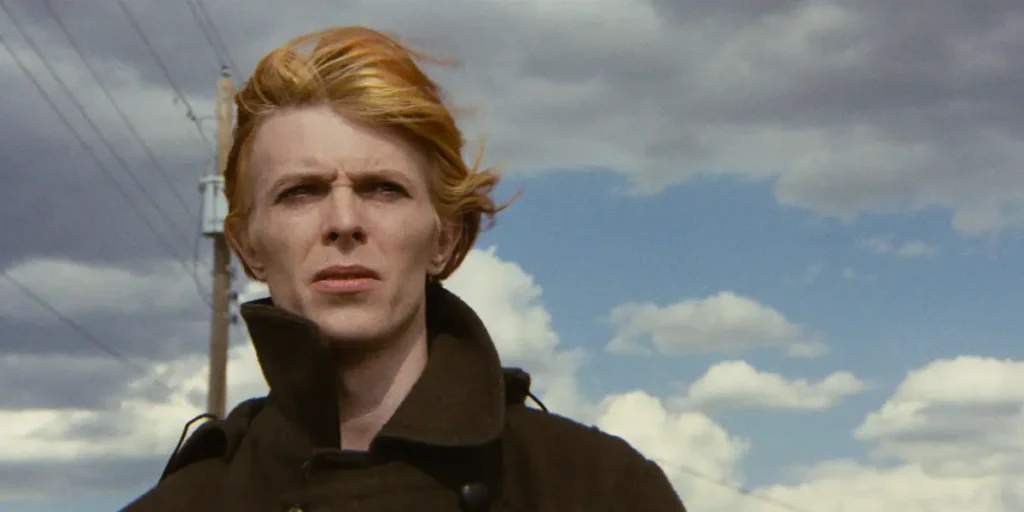
The Man Who Fell To Earth’s plunge into the loneliness of an immigrant outsider remains David Bowie’s defining onscreen role.
Director: Nicolas Roeg
Genre: Sci-Fi, Psychological Drama
Run Time: 139′
Rated: R
Original Release: 1976
U.K. Re-Release: November 13, 2026 (theatrical, limited); November 16, 2026 (Collector’s Edition)
U.S. Release: April 2026 (theatrical, limited)
Even after 50 years, having David Bowie play an extraterrestrial is as ideal a piece of casting as one can imagine. The Man Who Fell To Earth sees director Nicolas Roeg use his leading man’s status as an alien among men to drive on his tale of alienation in America. In a land of plenty, an outsider desperately seeks help and connection, and is left hollowed and despairing by the whole experience. Despite the novelty offered by its leading man, this owes more to Solaris than Star Wars in its themes and worldview.
The Man Who Fell To Earth opens with a bang and a splash, as a spaceship crashlands into a lake in New Mexico. The gangly-limbed ship’s occupant stumbles down gravelly hills towards civilization. This is Thomas Jerome Newton (Bowie), a blow-in from a far-away planet, albeit one equipped with a command of English and a British passport. Roeg and screenwriter Paul Mayersberg find themselves unencumbered by slavishness to logic, letting the metaphor of a stranger in a strange land sit uneasily on the narrative. Within a few minutes, Newton is presenting his exotic gizmos as original inventions to a patent lawyer (Buck Henry’s Farnsworth) making himself a millionaire, and turning his new company into a global powerhouse. If only more entrepreneurial tech bros were as interesting as this guy.
All of this happens in the background, as the script prioritises the interactions between Newton and the humans around him. Anyone expecting a special effects extravaganza from The Man Who Fell To Earth may be disappointed; the meat of the story lies in the contrast between Newton, his new girlfriend Mary-Lou (Candy Clark), and Bryce (Rip Torn), the newly-hired scientist at Newton’s company. Roeg’s film is an existentialist fable above all else, with Newton acting as a mirror to the humans around him just as much as they mirror him. He may have extraterrestrial abilities, but the most notable manifestation of these is his ability to watch several televisions at once. It’s the American dream!
By 1975, Bowie was firmly ensconced in his near-anorexic and uber-cocained Thin White Duke period. His gaunt features and paranoid headspace made the one-time Ziggy Stardust even more extraterrestrial in his mindset and appearance. Whenever Bowie segued into film, playing the role of an alien visitor to our world was all but inevitable, and the camera is hard-pressed to look away from him. With his hair a dark rusty red, and angles so sharp they could cut you, Bowie accentuates the oddness of this creature in a man suit with his mere presence. His soft spoken voice and handsome accent add to his outsider status, contrasting with the boorish Americans that find themselves fascinated by the visitor.
The new 4K restoration for the film’s 50th anniversary highlights Anthony B. Richmond’s cinematography, at once capturing the stunning natural vistas of the American west, while muting the interiors and the skyscrapers of New York to make Bowie’s hair the most vivid bit of colour in any given scene. He may look human, but he still stands out. Meanwhile, the playful sound design and score constantly toy with genre expectation; thrumming bass notes and tingling xylophone segue into jangly Western motifs and sappy ballads with little warning.
Roeg’s vision of America as alienating is the antithesis of someone like Wim Wenders, whose travelogue vision of the U.S. idealises it in many ways. As seen in the likes of Don’t Look Now and Walkabout, Roeg was fascinated by the ways strangers embrace their new surroundings, and decide whether to let it destroy them or not. The Man Who Fell To Earth is a film about an outsider told by outsiders. Mary-Lou brings Newton to church, but the very Southern congregation find themselves performing the none-more-English hymn ‘Jerusalem’. Whether the characters or the filmmakers, visitors will always put their own spin on a place in order to adapt.
The Man Who Fell To Earth has earned its cult classic status, not least by its potential to repel as much as entice. By definition, it won’t be to every taste. Its easygoing pace is difficult to sustain over two-and-a-quarter hours, and the prolonged sex scenes struggle to feel erotic. Before being hired by Newton, doctor Bryce’s penchant for sleeping with his college students is detailed, but rather than contrasting with Newton’s initial froideur, these moments end up leery and just goofy. The performances help the film over its speed bumps. In particular, Clark brings real heartbreak to Mary-Lou, who loves her man without ever understanding he’s not really a man at all.
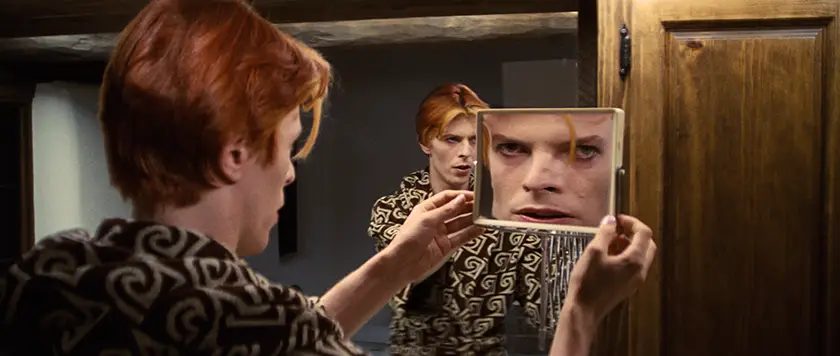
The Man Who Fell To Earth is the definition of a cult classic, but under its ‘70s stylings and playful genre splicing lies a loneliness to which anyone in a strange new world could relate. New homes are full of opportunity and fear, and Roeg captures those contrasting feelings in the form of the ultimate alien among men. The Starman wanted to come and meet us, and even after 50 years, he could still blow your mind.
The Man Who Fell to Earth (1976): Movie Plot & Recap
Synopsis:
An alien in human form lands on Earth in hopes of finding a solution to drought on his home planet, but can’t integrate as fully to human society as he wants.
Pros:
- David Bowie is ideal casting as a humanoid alien, and the cast is generally strong.
- Roeg’s direction emphasizes the alienation of the outsider, contrasting with later films that idealise the American landscape
Cons:
- The generous runtime makes some scenes and plot threads seem superfluous.
The Man Who Fell to Earth had a limited theatrical re-released in cinemas in the U.K. on November 13, 2026. StudioCanal’s “Vintage Classics” 5-disc 50th Anniversary Collector’s Edition in 4K UHD is now available to own.