
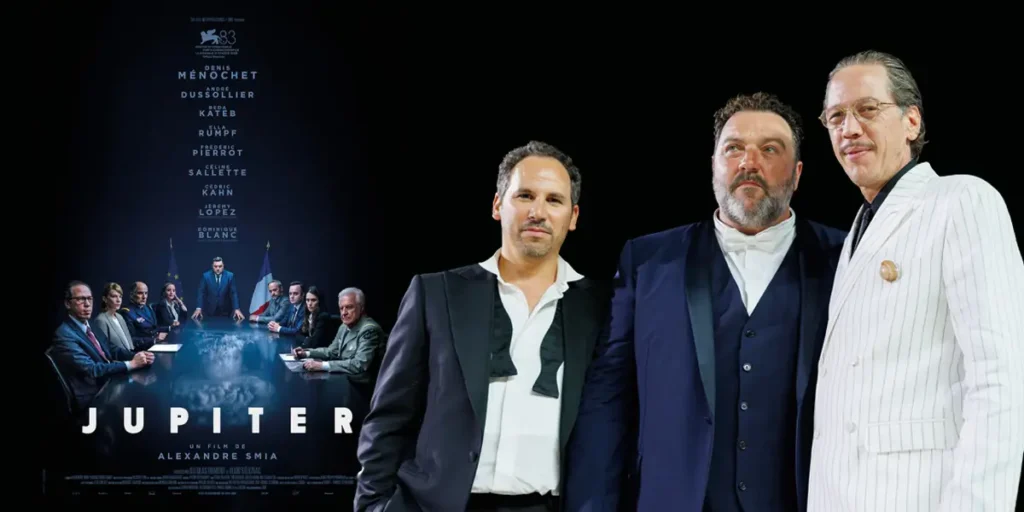
We interview Alexandre Smia, Denis Ménochet & Reda Kateb about their new film Jupiter, which explores how leaders might react in the event of nuclear war.
When the end of the world arrives, how will humanity react? That’s the question at the heart of Alexandre Smia’s Jupiter, an intense thriller that follows one unforgettable day in the life of the new French President, who is forced to react to a hostile nuclear attack on an allied country. The film asks plenty of vital questions about the increasingly volatile state of geopolitics in today’s society, the role of France within a fractured Europe, and most importantly, how the role of nuclear deterrence has changed and evolved since the Treaty on the Non-Proliferation of Nuclear Weapons was signed many decades ago.
With a sharp screenplay that breaks down these massive questions into digestible chunks, Jupiter is an incredibly timely and important film that feels like a direct response to the changing political climate of our world. Alexandre Smia isn’t just interested in bringing audiences face-to-face with the terrifying realities of nuclear warfare, but rather in forcing us to reckon with the consequences of humanity’s own actions before it’s potentially too late.
At this year’s Venice Film Festival, we sat down for an interview with writer/director Alexandre Smia, alongside Jupiter’s stars Denis Ménochet and Reda Kateb, to discuss the film. They opened up about the intense filming process, the questions that burned in their minds while filming, and the lessons they hope audiences will take away from this vital movie.
Alexandre Smia on The Inspiration Behind Jupiter
Congratulations on this film!
One aspect that particularly struck me was your decision to use fictional versions of real-life figures, such as the Presidents of Russia and France, rather than alluding to real people who held these offices. Could you explain that decision?
Alexandre Smia: From the beginning of my career, I’ve always loved talking about real things that are related to contemporary history: it’s something that I’ve always liked in cinema. If I go back to films like Fail Safe in 1964, or American thrillers in the 1970s and 1980s, they combined reality and fiction in a way that I’ve always wanted to recreate. Eventually, I started educating myself about contemporary history to help me explore all the little details in my writing that could provoke something within the audience that current news actually doesn’t provide you with. For me, combining the two things is quite natural. Of course, while creating the characters, I wanted to keep the geopolitical relations of power accurate in order to reflect what’s going on in the real world.
In terms of the casting process, when you’ve got those fictional characters in your mind, and you want to present them in a certain way, which aspects were most important to you?
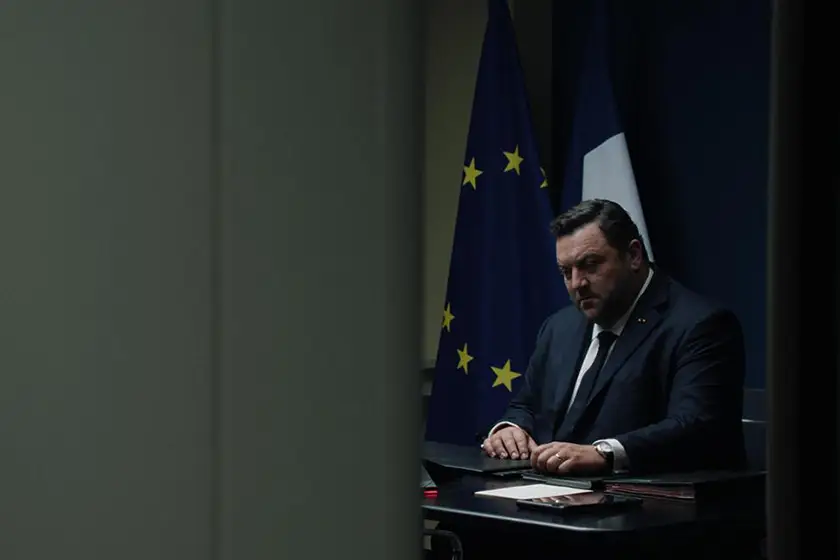
AS: When I cast Denis Menochet, who plays the President of France, it was important that there would be no physical similarities to current politicians. I didn’t want him to look like any previous French President. My versions of the Russian and Ukrainian Presidents also have something in common with reality—but I didn’t want them to look like real politicians either. This is a rule I followed for all my characters. I also wanted the American President to be different from Trump; I wanted to prove that fiction can be just as important as reality.
Why did you choose this story for your debut feature film? What is it about this film that you wanted to tell so early in your career?
AS: This is a film I’ve been wanting to make since I was a teenager. Around the time of the invasion of Ukraine, there was some awareness worldwide that France had become a new key player in nuclear deterrence, which had never been the case in the past, because France had always been a spectator. So many questions just came to mind: if this crisis were to happen one day, who would be involved and what would happen? This is how the film came about. It’s not an autobiographical one, but it’s somewhat personal for me. The story really makes me think about the principles I stand for—and how I should follow my principles when everything else is in chaos.
There are no weapons in this film. It’s all words; the enemy is unseen. You see the foreign leaders, but you can’t physically see the lingering threat of nuclear warfare in the film, and that makes it extremely tense.
AS: That’s true. Not seeing something but knowing that it’s there makes the story feel cinematic. This happens in many ways throughout the story—for example, through the personal history of the President. You know that something is happening in his life that we don’t see, and you know it’s something powerful, but you don’t know what that is. Jupiter isn’t a film about the war in Ukraine: you don’t see the fighting, but you see the consequences of the war in Ukraine that could exist in that bunker.
Denis Ménochet and Rada Kateb on Creating An Intense Character Dynamic
You both play characters who are fictional versions of real-life positions. How does that affect your approach compared with an entirely fictional character?
Rada Kateb: We had to be credible for people to believe we could be these politicians, but it was also very necessary for me to keep some space for imagination. We don’t care if everything is true: that’s not interesting, and that’s not why we go to the theater. There has to be a balance between something accurate to reality and something more cinematic.
Denis Ménochet: For me, it was the enigma of being the President of France. I was interested in the responsibility and loneliness; I really wanted to grasp how it would feel to carry the weight of his decision.
And the President of France is one of the most important people in the world…
DM: The fifth. [Laughs]
Were you eager to take on such an intense role, or was it daunting to you? Or both?
DM: Both, you’re right. I already did a pastiche of a French President [in Rumors] who was in a wheelbarrow covered in mud and lecturing people because he’s French and arrogant. So I really wanted to do this one justice.
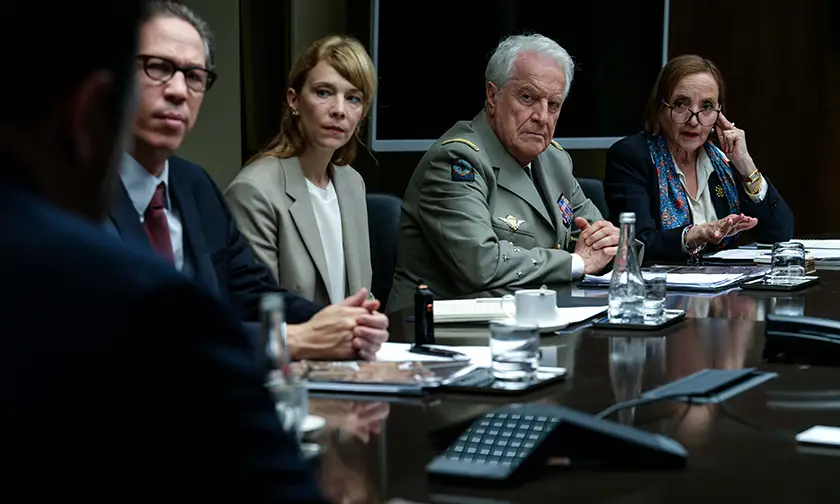
Both of your characters have very different opinions in this film, and you have to persuade each other of your arguments—which are both correct in some ways, but also fundamentally different. As actors, how do you develop the chemistry to make that work?
DM: We worked a lot together in the mornings. We would read the lines flat, and then give them rhythm, and do that five times per day. It helped us feel the energy of the piece, and that’s what we love.
RK: And sometimes we’d do this for 10 minutes, even 15 minutes, and we did this multiple times. So it was like a trance.
Jupiter deals with some very intense themes about war, peace, and politics. Did your opinions on any of those ideas change during the filming process? Did the screenplay make you see the world differently?
DM: For me, it did. I remember I was going back to the hotel in the middle of summer, and I could see people living and being happy, and it made me sad. Because I knew it could go away like this. [Clicks]. I was more aware of how fragile the world—and life—is.
RK: It was a bit troubling to think about the end of the world for 10 hours every day. You don’t have so many jobs that let you spend so much time thinking about it. Then you come home, and it’s still with you. Usually, you read an article for 10 minutes, then you can think about something else. Being in that space for such a long period of time was a tough experience.
What’s one message or thought that you hope audiences take away from Jupiter after watching?
RK: I’ll be happy if people have big discussions after the screening. I don’t think this movie tells them what to think, but the magic of cinema is that people can go to the theaters together and, after the movie, say “I really don’t agree” or “It’s not like that”. I think that’s precious. That’s something we need. I hope people will have arguments about this movie.
DM: Be aware. Be together.
This interview was edited for length and clarity.
Jupiter had its World Premiere at the 2026 Venice Film Festival on September 4, 2026.
Header Credits: Alexandre Smia, Denis Ménochet and Reda Kateb at the red carpet for Jupiter (Jacopo Salvi – Courtesy Archivio Storico La Biennale di Venezia) / Poster for Jupiter (Chi-Fou-Mi Productions)