
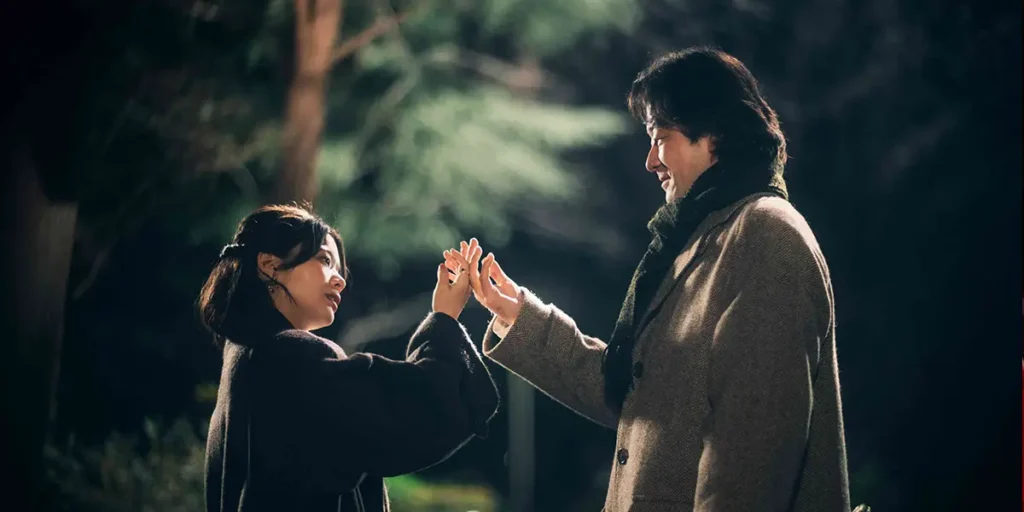
Both a hopeful search for the light and a tragic exploration of trauma, All the Lovers in the Night is a potent film about grief, isolation, and, ultimately, love.
Director: Yukiko Sode
Original Title:『すべて真夜中の恋人たち』 (Subete Mayonaka no Koibitotachi)
Genre: Drama
Run Time: 139′
Cannes World Premiere: May 17, 2026 (Un Certain Regard)
U.S. Release Date: TBA
U.K. Release Date: TBA
Thirty minutes into All the Lovers in the Night (Subete Mayonaka no Koibitotachi), I found myself wondering if the movie might turn out to be this year’s Perfect Days, with its focus on an isolated, unhappy protagonist who spends her days mostly unnoticed by the world, aiming to achieve perfection while knowing from the start she’s doomed to fail. But it didn’t take long for me to realize that Yukiko Sode’s film, which was screened in Un Certain Regard at the 2026 Cannes Film Festival, couldn’t be more different from Wenders’ 2023 masterpiece.
If anything, the two movies are polar opposites. Even so, there’s something that unites them in what they have to say about the world; it’s no coincidence that both films are set in Japan.
All the Lovers in the Night revolves around a 34-year-old woman named Fuyuko (a flawless Yukino Kishii, of Small, Slow But Steady), who works as a proofreader in Tokyo. Fuyuko spends her days sleepwalking through life, completely shut off from the world, not only physically but also emotionally, except for very occasional interactions with her supervisor/friend Hijiri (Misato Morita, of Rental Family) and former employer Kaori (Yuko Nakamura). With them, Fuyuko sometimes finds herself pondering the nature of their job. “It’s painstaking work, but the job wouldn’t exist without mistakes,” she tells Hijiri at the beginning of the movie. “Since no book is ever truly free of errors, we can never really finish a job, not completely.”
Not long after they’ve spoken, Fuyuko has a chance meeting with a high school physics teacher in his late fifties at a Culture Center in Shinjuku, where she had gone hoping to register for a class after finishing a demanding job, in desperate need of something good. Exhausted and suddenly feeling unwell, she ends up being helped by Mitsutsuka (Asano Tadanobu, of Shōgun). Reserved but curious, respectful but empathetic, and interested in analyzing the mysteries that captivate our protagonist, this magnetic stranger appears to be just as drawn to her as she is to him. And so, Fuyuko starts meeting Mitsutsuka every Thursday at a cafe close to her apartment, still unable to express or even understand her current apathetic state, but feeling more and more at ease with someone she knows nothing about but who seems to get her in a way yet others don’t.
“The first thing you learn as a proofreader is that you’re not supposed to read the story on the page,” she tells him, one day, during one of their conversations. “You’re not allowed to get lost in the text. We have to focus on finding the errors in the book.” It’s not long before we understand just how relevant that phrase is to Fuyuko’s own life, as our protagonist seems to be unable to really feel anything, stuck in a loop where she’s, at the same time, constantly focused on trying to get things right in everything she does, yet incapable of truly experiencing anything or even taking control of her own actions. Soon, All the Lovers in the Night turns into a completely different kind of story, and we understand exactly why Fuyuko is the way she is.

In fact, thanks to her conversations with Mitsutsuka, Hijiri, Kaori, and a former classmate named Noriko (Mai Fukagawa) with whom she reunites over lunch, Fuyuko starts gaining more insight into her current state too, and she very quickly realizes how unhappy – and, quite possibly, even clinically depressed – she is. The reason has to do, in part, with something she recalls halfway through the film that you definitely won’t see coming, and that won’t be spoiled in this review, but that turns this quiet introspective tale into a story of trauma and identity that taps into some unexpectedly dark themes.
In addition to that, the film also works as an accurate analysis of today’s society, and Japan in particular, in how it subtly challenges preconceived notions about gender, displays the effects of profound isolation, and highlights the dangers of a culture that requires us to put on a happy, compliant façade in public and keep our darkest, most authentic emotions to ourselves.
Writer-director Yukiko Sode (Aristocrats) cleverly adapts Mieko Kawakami’s 2011 book of the same name in a way that lets us know what Fuyuko is feeling at all times, despite not being able to read her thoughts like in the novel. We can occasionally hear our protagonist’s inner thoughts – interestingly, they’re voiced by a man (Tōri Matsuzaka), in a thoughtful device that that subtly examines Fuyuko’s fractured sense of self and complicated relationship with womanhood – but what also helps is the way she’s framed throughout the film.
There’s a moment when Fuyuko looks at herself, at the beginning of the movie, right after finishing a difficult job, and we know exactly how sad and lost she is. Soon, we’ll be given insight into her past, but even before that happens, cinematographer Yasuyuki Sasaki (Cloud) uses subjective point-of-view shots meant to disorient the viewer, where Fuyuko is looking toward us but not directly at us, as if she were staring at something positioned right next to us.
Since Kawakami’s novel employs the first-person narrative to tell its story, readers always know what Fuyuko is thinking about, and notice that things are deteriorating before she does. In Sode’s film, it’s a little different, but that only makes All the Lovers in the Night more compelling, as our realization comes later, when Fuyuko is ready to face it herself too. This makes the movie quite an interesting adaptation, as there are things you won’t understand or notice early on – including a certain habit of Fuyuko’s that affects her conversations with Mitsutsuka – that will become much clearer by the end; if you watch the film a second time, you’ll have a completely different experience.
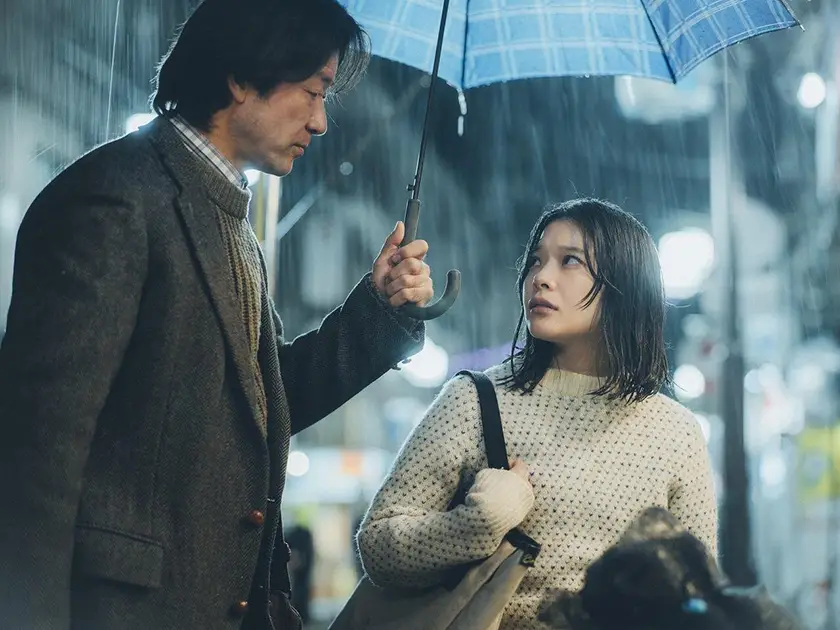
Some of the movie’s most experimental scenes are bound to alienate audiences who enjoy more straightforward storytelling, and there were points where I struggled to grasp the exact timings of events myself, or distinguish truth from fiction. But by the time the end credits rolled, I understood exactly why Sode chose to tell this story the way that she did, as that’s what makes All the Lovers in the Night the fascinating film that it is. This fiercely original gem is, at the same time, an empowering tale of acceptance, a disquieting exploration of trauma, isolation and fragmented identity, and a tragic love story not just in the romantic sense of the word, but also – and first and foremost – with one’s self.
“Why is the sky blue?”, Fuyuko asks Mitsutsuka halfway through the film, not long after they’ve started meeting up with each other. “The light of the sun is made up of an infinite range of colors,” he says; “Even the atmosphere that looks empty contains numerous particles, so what reflects off those particles is what we see as light.” He proceeds to explain that in outer space, we can’t see any colors because no matter how far light travels, there’s nothing there for it to hit. “But if there’s something there that reflects light, we can perceive it,” he adds, summing up the entire message of All the Lovers in the Night – a film where everything comes down to Fuyuko’s search for light.
By the end of the movie, Fuyuko realizes she just needed something, or someone, to reflect her own light back to her. Of course things aren’t that simple, especially for people like Fuyuko, who celebrates her birthday by taking a walk in the middle of the night, a habit that’s symbolic of her entire existence. But if light can’t be seen in the darkness, that doesn’t mean it’s not there.
All the Lovers in the Night (Subete Mayonaka no Koibitotachi): Movie Plot & Recap
Synopsis:
After a chance encounter, a withdrawn proofreader forms an unexpected connection with an older physics teacher, and this leads her to confronting long-buried trauma and question her identity as a whole.
Pros:
- A poignant adaptation that reinforces the themes of the novel with both its filmmaking style and clever narrative choices.
- Yukino Kishii delivers a quietly devastating lead performance.
- An effective exploration of trauma, acceptance, and the effects of profound isolation that delves into dark territory but doesn’t forget about hope.
- Clever narrative choices will reward repeat viewings.
Cons:
- Its fragmented structure, deliberate ambiguity, and experimental storitelling may alienate some viewers.
- One late revelation dramatically changes the tone of the film by introducing subjects that might be triggering to some audiences, so viewers sensitive to certain themes may want to look up content warnings beforehand.
All the Lovers in the Night (Subete Mayonaka no Koibitotachi) premiered at the Cannes Film Festival in Un Certain Regard on May 17, 2026.