
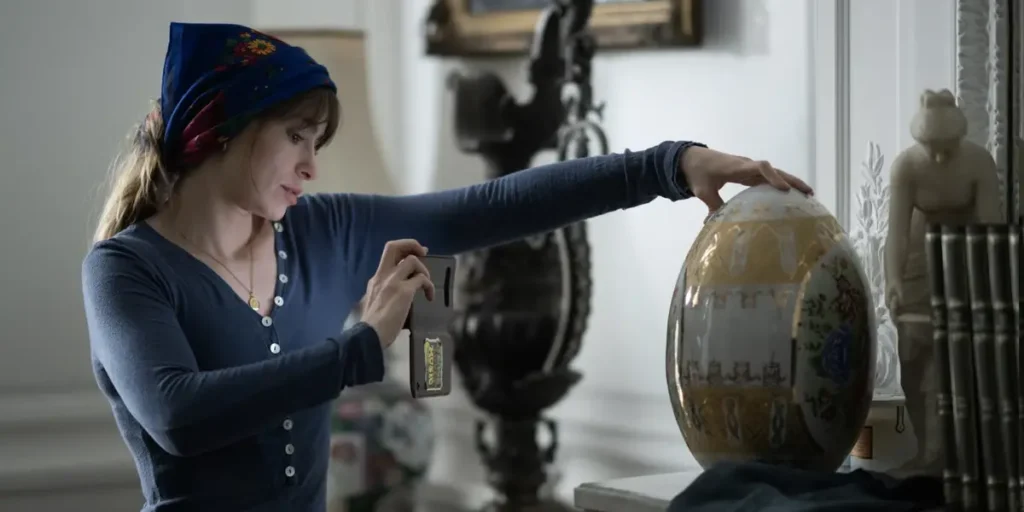
With The Diary of a Chambermaid, Radu Jude unveils his bleakest film, masterfully commentating on hypocritical socioeconomic class disparities.
Director: Radu Jude
Original Title: Le Journal d’une Femme de Chambre
Genre: Comedy, Drama
Run Time: 94′
New York Film Festival Screening: October 8, 2026
U.S. Release: TBA
U.K. Release: TBA
While Radu Jude has built a name for himself as an outlandish director, willing to go the lengths necessary to defy traditional cinematic expectations in the name of one-of-a-kind storytelling, his latest feature shows a much tamer side of the provocative filmmaker. The Diary of a Chambermaid plays with a distinct bleakness that feels worlds away from Jude’s other works, but serves as the rationale behind why the film works so well.
The Diary of a Chambermaid follows Gianina (Ana Dumitrascu, of Dracula), a young Romanian woman working as a live-in nanny and housekeeper for a well-off family in Bordeaux. The couple Gianina works for, Marguerite (Mélanie Thierry, of A Woman’s Life) and Pierre (Vincent Macaigne, of Arco) are progressive in theory, but conservative in practice, constantly saying they want the best for Gianina but only if the best thing for her is also the most convenient for them. The couple’s son, Louen (Louen Bouteiller) is spoiled yet harmless enough in the eyes of Gianina.
While Gianina may be living and working in France for the Donnadieu family, her heart lies in her home country with her young daughter Maria (Sofia Dragoman) who is being looked after by her affectless mother. She’s trying to make enough money to eventually get Maria to her one day. Gianina is meticulously counting down the days until she is able to go home to see her daughter again at Christmas in two months and until then is being held over by frequent facetime calls.
In an attempt to make Gianina’s life more fulfilled in Bordeux, the ever-so-considerate Donnadieus have her join a local theather production of The Diary of a Chambermaid, a modern adaptation of Octave Mirbeau’s 1900 novel of the same name. The Donnadieus insist she stars in the play as even they themselves get enraptured in the stories that Gianina tells to Louen. It’s through this production that Gianina is able to unleash part of herself and perhaps even her own feelings towards her employers that she does not currently have a platform to express them through.
As the time leading up to Christmas begins to run out, Maria grows more and more impatient of Gianina being away from her for so long and jealous of her mother’s relationship with Louen. While Gianina finds this both silly and harmless, she does everything in her power to ensure her daughter that they will be together soon and she could never love Louen the way she loves her sweet Maria. However, when the Donnadieus’ grandmother has a medical emergency, Gianina’s homecoming plan is thrown into chaos and threatens the trust her daughter has put in her to follow through on her word.
The Diary of a Chambermaid is hilarious in its plain absurdity. Seeing how the Donnadieus work, act and operate, especially when it comes to their performative progressive ideals, emulates the major issues that face the echelon of the oblivious upper class. They parade their Romanian nanny in front of dinner guests like a party trick and beg for her input on foreign politics in order to feign for some good will points with their equally as performative guests.
They are interested in Gianina conceptually, but only from an extremely comfortable distance. It’s once her problems and life materialize in front of them that they distance themselves from emotional involvement despite their overfamiliarity when it comes to involving her in their lives at times it suits them. Jude makes the Donnadieus’ cowardice just the right amount of absurd for it to succinctly reflect how the upper class views the working class and their issues.
While the script may have you laughing at the film early on, as it progresses its ability to poke fun despite the very real problems happening in Gianina’s life becomes more sobering. These moments where a lack of consideration and care into Gianina and her life as its own separate entity outside her involvement within the lives of the Donnadieus create a dark nuance to the film and leave audiences feeling ashamed for ever finding disrespect funny for the sake of its absurdity.
In The Diary of a Chambermaid, Jude becomes an entirely different filmmaker than audiences are used to viewing him as. His signature humor becomes sharper and his wild visuals are tamed in pursuit of building out a substantial and nuanced view of class politics in the modern day landscape. It feels like the last sort of film you’d expect from Radu Jude, but one that unveils a glimpse into a well of untapped potential from an already captivating filmmaker.
The Diary of a Chambermaid: Movie Plot & Recap
Synopsis:
A young Romanian woman, working as a live-in nanny and housekeeper for a well-to-do family in Bordeaux, stars in a local production of Octave Mirbeau’s 1900 novel The Diary of a Chambermaid.
Pros:
- Ana Dumitrascu is mesmerizing.
- Seemingly Radu Jude’s most sincere work to date.
- The humor of the film works as a catalyst for its darker undertones on multiple levels.
Cons:
- The film feels fragmented into several different storylines that leave it up to the audience to connect the dots, but the lack of weaving the stories together leaves its messaging less potent.
The Diary of a Chambermaid will be screened at the New York Film Festival on October 8, 2026.