
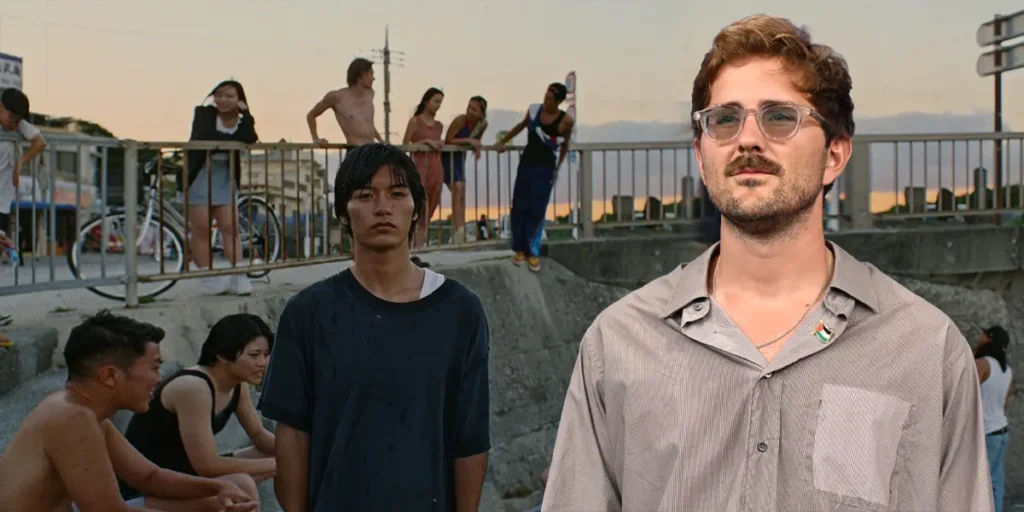
At the Venice Film Festival, we interview Xavier Tera, writer-director of the FIPRESCI Award-winning The Color of the Sun, about the film, its characters and themes, Okinawa, key scenes, and more.
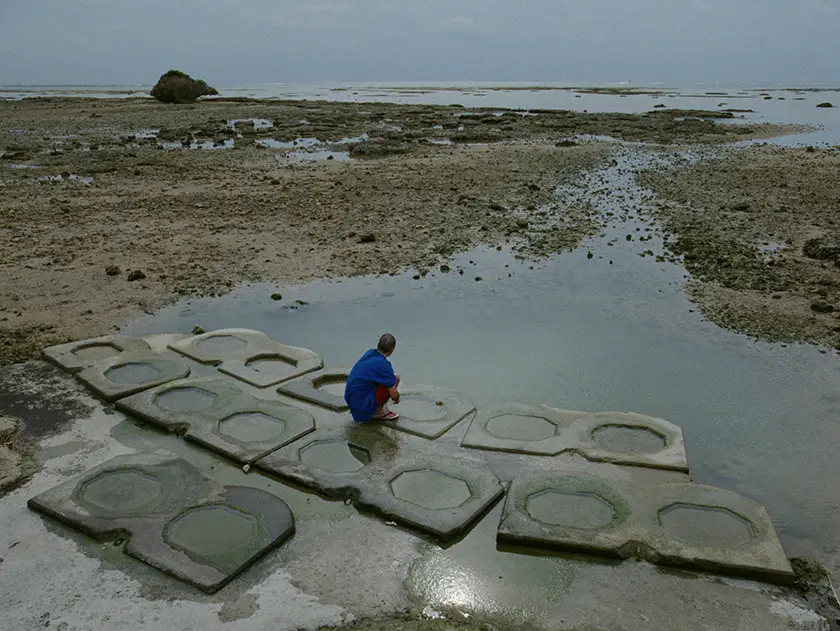
“On that island, where blue means yellow, the meaning of things changes, with time. Isn’t it strange?”, asks one of the characters of Xavier Tera’s The Color of the Sun, early in the film. The island is Ōjima, off Okinawa, Japan, and the colours refer to one of the Japanese characters used to write it, which is associated with the color blue, but in some cases used to mean yellow. It’s even more significant, then, that the movie’s protagonist, Kamei (Naoto Shimajiri) is color blind.
Some changes are definitely in order for the teenager, who’s still grieving the loss of his father, and it all starts when he meets an American boy named Colin (West Mulholland), who was raised on the American military base on the island. Beneath the drone of helicopters, Kamei, his friends Chokun (Daido) and Juyu (Ichiro Andre Castro), his girlfriend Sayaka (Yuma Taira), and Colin spend a summer thinking about their futures, getting to know each other, and, eventually, growing up.
The Color of the Sun, which won the FIPRESCI Award at the 2026 Venice Film Festival, is one of the most effortlessly original films to have come out of the festival. This highly symbolic, stunning coming of age story is a meditation on how the places we belong to, and the people we meet at key moments in our lives, can shape our identity and drive us to grow up. It’s a movie where every single character helps make the story as layered and raw as it is, and where what’s left unsaid is just as important as what we get to see.
We sat down with an interview with writer-director Xavier Tera, who told us about his cast, the colors of Okinawa, the way in which culture shapes us, the intimate scenes in the film, the character of Sayaka, and more.
The Color of the Sun is a ‘Story for Those Who Live Between Worlds’
Congratulations for this fantastic film!
In the press notes for the movie, you describe yourself as someone who ‘tells stories for those who live between worlds.’ It feels to me like this is definitely one of these stories.
Xavier Tera: Completely. I’m just very curious about Third Culture [a term coined by sociologist Ruth Useem to define an identity shaped by growing up between different cultures]. I think a lot of people, especially right now with the push towards nationalism, think that culture should stay fixed. But we cannot stop culture: culture is evolving every second, and it will change according to how the world is changing. I think the far right and the current governments in place are misunderstanding the idea of culture and how it’s been changing forever. That’s what I mean by stories between worlds, you know. We find ourselves with people with very different backgrounds and very different stories all together, and I think it’s beautiful.
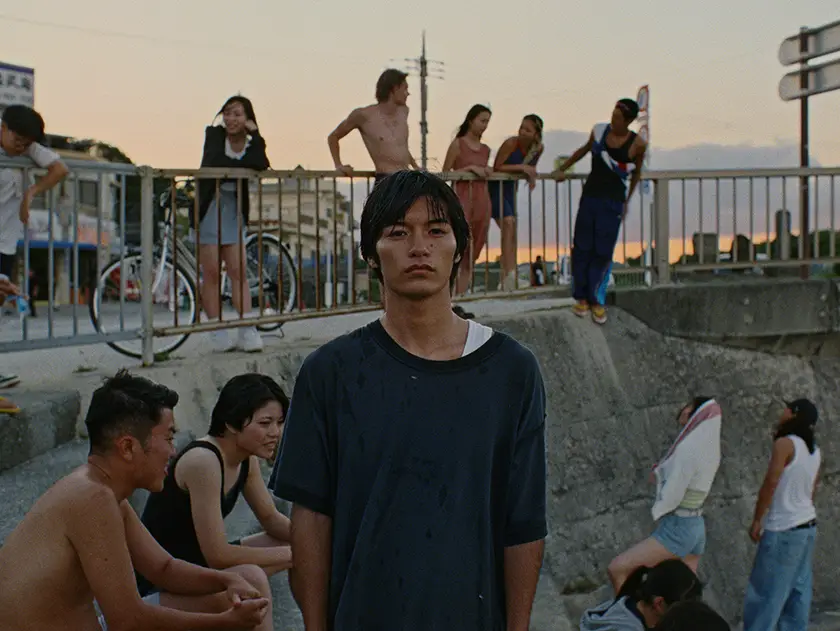
I really like that in the film, you don’t necessarily tell us everything there is to know about a character’s background. There’s a scene I really like where Sachiko Fukumoto’s character, Ailyn, tells Kamei, “I don’t come from anywhere.”
What was your approach when you decided what to tell us and what not to tell us about these characters?
X.T.: I tend to write very visually, and all my favorite films are more in that kind of idea. I don’t like being told things; I prefer watching a movie that lets me dream and think about it instead of feeding you every single piece of information, and I think that’s how I approached this film too. I think the public is intelligent, and I just hope that they enter the story without necessarily having all the information.
Xavier Tera on The Colors of Okinawa, and Two Intimate Scenes in the Movie
From the start, the film describes Okinawa as “that island where blue means yellow,” and there are so many references to these two colors throughout, both visually and symbolically – even more so since Kamei is daltonic. You’ve previously explained that Ōjima, an island off Okinawa, was originally written with the kanji「青」, commonly associated with blue, but in some cases also used to mean yellow.
With this in mind, I found it so interesting that, when Kamei gets a fish, he names it Midori, which means green.
Xavier Tera: Yeah, which is yellow and blue together.
It’s one of my favorite lines in the film!
X.T.: It’s funny because the whole film is about perception. Obviously, Kamei is going through grief and is kind of meeting up with a new friend, Colin, whom he’s trying to understand but doesn’t fully, yet he has some preconceived ideas about him. The idea of color blindness is to show that sometimes we can see something a certain way, but maybe it’s not, you know? The fish is the father [it represents Kamei’s father, who was a marine biologist], and becomes the answer, representing the characters moving forward. I thought that it would be interesting to mix those two colors and have the fish represent that.
There are two intimate scenes in the movie that I found very interesting. The first is when Kamei and Colin watch a porn film together: I think it could have been very uncomfortable – as they end up masturbating to it, which Colin initiates – but it really isn’t. I love the framing in the scene: the way you positioned the characters, and us as viewers, was really clever.
X.T.: Yeah, throughout the film in general, I wanted to approach this as if we were observing – as in, not being with them, but observing the scenes, letting them just happen, and staying with them.
It’s funny you should say that, because another journalist said the opposite to me! She found that scene uncomfortable. Personally, I think it’s a mix of discomfort and funny.
And sweet.
X.T.: And sweet, you know? [nods] I think that’s why I really like this scene. Because Colin, who’s American, probably thinks it’s totally normal, culturally. And then Kamei is like, “What is happening?” But then, with the pressure from the other, he still does it. I thought that was an interesting [dynamic to show] in their relationship at this point: even if Colin doesn’t mean to put any pressure on Kamei, he probably just means to say, “Why are you not doing it?” Because for him, it’s normal. It’s still a question of pressure, but at this age you don’t understand it, you know?
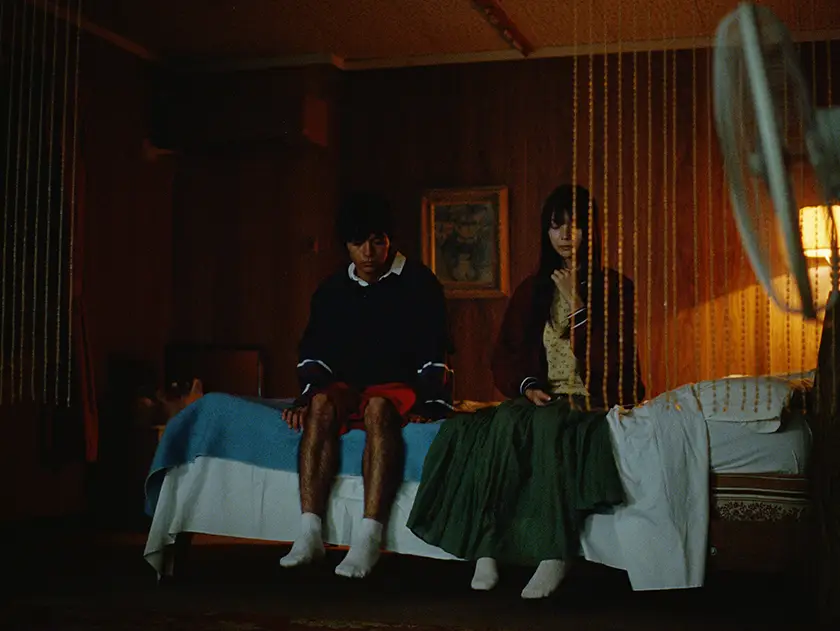
This scene also creates such an interesting contrast with another intimate scene, later in the film, when Kamei is in a love hotel with Sayaka, feeling a different kind of pressure.
X.T.: Completely. And I love these actors so much. This was their first time acting, and that scene in the love hotel with Sayaka… Every time I watch them, I think, ‘They’re so good.’ I love them so much.
You feel so much for her: she’s ashamed, and she probably thinks [Kamei is unable to perform] because of her, but you know, he’s just stressed out.
“F*ck, It’s Him.” — On Casting Naoto Shimajiri, and the Character of Sayaka
Sayaka comes across as such a smart and brave character! She’s so much more articulate than I would have been at her age, and it also feels like she knows who she is and what she’s worth.
Xavier Tera: Yeah, that was the idea with her character. She’s kind of funny and weird, like at the beginning, when she disappears [while out on the island with Kamei] and you think that the film is going to tap into darker territory, but then she comes back, and you’re like, “What? Why did she disappear?” She’s always saying these kinds of things — about hiding or disappearing.
At some point she tells Kamei not to fall asleep, because “if you fall asleep, I might vanish again.”
X.T.: Yeah, exactly. There’s a little spirit in Okinawa called the Kijimunā: they’re mischievous trolls, or creatures, that hide in the trees and play pranks on people.
How very Studio Ghibli of Okinawa!
X.T.: [smiles] Exactly. And I thought it could be fun to incorporate some of that spirit into the character of Sayaka. It’s almost as if she’s way smarter than all of them, and she’s just like… This ‘thing’ that’s just here, and very real in this moment. But like she says at the end, “I might disappear again.”
She’s the best. I love this character so much! I was writing down all her lines when I watched the film. Another one is, “We are like the trees, and we all hope that someone will hear us one day.”
X.T.: Yeah, that’s what she’s like. She says it herself: “I told you I was gonna hide behind the trees.” And [at that point] they’re in a monorail, over the top of the city, you know? She’s actually my favorite character. Don’t tell the others! [laughs]
Yuma Taira plays Sayaka, and you said at the Q&A in Venice that Naoto Shimajiri, who plays Kamei, is Yuma’s actual boyfriend!
Why do you think it took you so long to find him? What were you looking for?
X.T.: It’s hard to say. It’s a feeling, right? I met over 250 kids on the island, and it’s very hard to find kids who want to be actors in general, as they’re just very shy. Yuma was the first one I cast, as Sayaka. And she never talked about her boyfriend until I had a conversation with her: I was like, “It’s been a year and a half and I can’t find Kamei.” She said, “Well, I can ask my boyfriend to come if you want to see him!” I said, “Sure, I want to see everyone.” And he came in and I was like, “F*ck, it’s him.” [smiles]
He’s perfect for this role.
X.T.: It’s crazy. He’s never thought about acting before… And he’s so good.
Xavier Tera on the Ending, and How The Color of the Sun Is a Generational Story
Spoilers in the next two questions
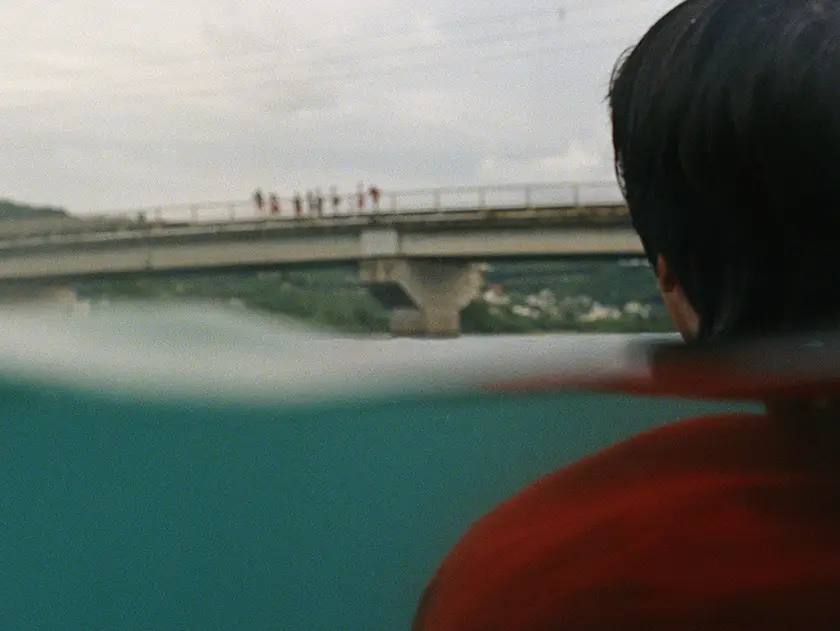
The ending shows Kamei jumping off a bridge, and I didn’t see it coming. He does it in a liberated sort of way, but we also don’t know if he’ll survive the jump. Did you always know he was going to do this?
Xavier Tera: Yes, it was always going to be that ending in my head. We were always supposed to be able to shoot on the bridge and have people jump off the bridge; there are a couple of shots of people jumping off the bridge at the beginning of the film too.
There’s also one, early in the film, where the other characters are standing there, looking for Sayaka, and one of them asks, “Did she jump?”
X.T.: Yeah, exactly. There was a whole thing with the local community in Okinawa, because unfortunately a kid died accidentally from jumping off the bridge. The kids always jump there: it’s a normal place to jump in the water. But this accident happened just before we started shooting, so we couldn’t shoot much on the bridge because of that. We had to rethink [the way in which it was going to be shot] a little bit, but I’ve always had this ending in mind. The ending was the first thing I thought of, actually.
No more spoilers from here
It’s also very interesting that this comes after Kamei receives an encouraging letter from his mother.
X.T.: The letter has more to do with the idea of freedom; it’s kind of spiritual.
Yes, of course, Kamei’s mother and also his grandfather are such fascinating characters. I love that this is a generational story.
X.T.: Yeah, I’d say the mother is the heart of the film. She’s trying to keep Kamei in line, and she loves him so much, but he’s at an age where relationships with your parents can be hard, and even more so when you’ve recently lost someone. But I wanted another generation to come into play, because I think the older generations in Okinawa had it harder, especially those who are around 70 now. The US was in charge of Okinawa until 1972, so back then, right after the war, you were almost in an American-led country, but in Japan. So [those generations] saw that, but they were also speaking more in the dialect back then.
Ryukyu [the native term for Okinawans] traditionally had their own language, so older generations carry that history more heavily. Even if things have changed a little bit, there are still a lot of problems, and things still have to change. With Kamei’s grandfather, I wanted to confront that, but I also wanted to show him as a flawed character. You know, he’s trying to guide him, but he wasn’t there for his family and his grandson when Kamei’s dad died. And since the dad committed suicide, it’s a source of great shame for [Kamei’s grandfather].
Of course.
X.T.: Especially in Japan, suicide is something you try to not talk about. It has a very complex, cultural kind of meaning, and that’s why I wanted to include that other layer.
Xavier Tera on the Venice Premiere and What’s Next for Him
What was it like to be at the screening, in Venice, for the world premiere of your film? Did anything surprise you about how people reacted to it?
Xavier Tera: I was just so happy to be with my actors! You know, it was their first time outside of Japan — except for West [Mulholland], who came from the U.S. So I was mostly thinking about that, more than the audience’s reaction: just seeing what it would be like for the cast to watch it for the first time. But I’m so happy! It feels like people have liked it, so I just feel so grateful.
Are you working on something else at the moment?
X.T.: Yes, I’ve been working on a couple of scripts that are set in Japan. I’m pretty sure I’m gonna go for one in particular that’s set in Tokyo, with very similar themes [to this film].
We’ll keep an eye out for it! Thanks for speaking with us.
This interview was edited for length and clarity.
. had its World Premiere at the Venice Film Festival on September 9, 2026.
Header Credits: Naoto Shimajiri in The Color of the Sun (Sayombhu Mukdeeprom) / Director Xavier Tera at the Venice photocall (Aleksander Kalka – Courtesy of Archivio Storico La Biennale di Venezia)