
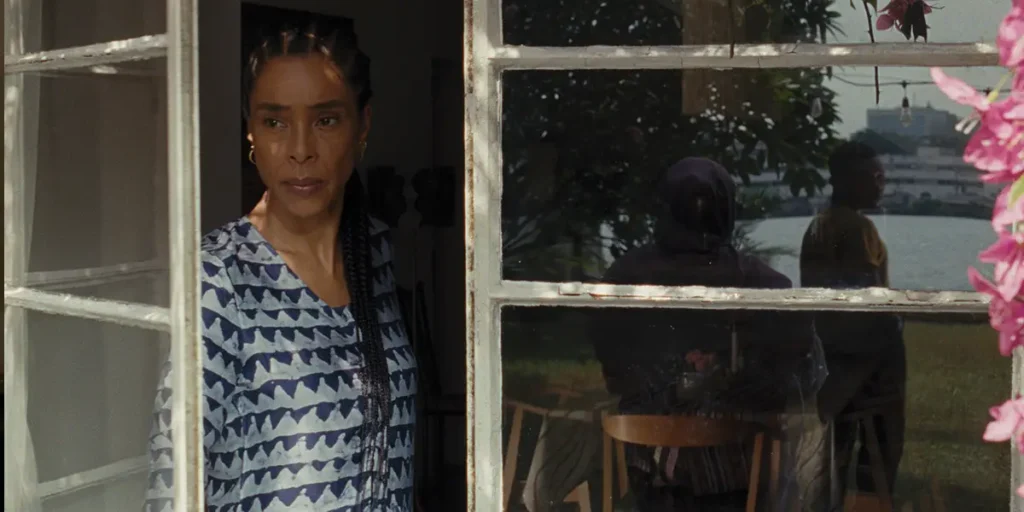
In the winning Clarissa, Arie and Chuko Esiri move Virginia Woolf’s ‘Mrs Dalloway’ to modern-day Nigeria for a film of memory, regret, and the ripple effects of colonialism.
Directors: Arie Esiri, Chuko Esiri
Genre: Drama
Run Time: 134′
BFI London Film Festival Screening: October 12, 2026
U.S. & Canada Release Date: December 11, 2026 in select theaters
U.K. Release Date: TBA
Virginia Woolf’s 1925 novel ‘Mrs Dalloway’ is having a moment at this year’s London Film Festival. Rachel Rose’s The Last Day, with Alicia Vikander and Wagner Moura, is loosely based on the novel. Also showing is Clarissa, an adaptation from twin directors Arie and Chuko Esiri, who make a couple of alterations. The title is renamed from Dalloway’s surname to her first name. Most crucially, the duo have transported the story from 1920s London to modern-day Lagos, creating a winning, contemplative film in the process.
Now Clarissa (Sophie Okonedo, of Mouse) is a society woman in Nigeria’s capital city, married to Richard (Jude Akuwudike, of Beasts of No Nation). Over the course of one day, she prepares for a garden party held for her birthday. She has invited her old friends: Peter (David Oyelowo, of See How They Run), who has returned to Nigeria to attend to his father’s estate; Sally (Nikki Amuka-Bird, of Old); and the lively Ugo (Danny Sapani, of The Amateur). This leads Clarissa and the others to remember their shared past, as we flash back to the 1990s and a summer in Abraka that changed their lives. Clarissa (played here by India Amarteifio, of Queen Charlotte: A Bridgerton Story) was at her parents’ estate. The younger Peter (Toheeb Jimoh, of Ted Lasso) was an aspiring, passionate writer.
For Clarissa, her burgeoning attractions to Peter and to Sally (Ayo Edebiri, of After the Hunt) are complicated by the arrival of Richard (Ogranya), an analyst at Shell. Meanwhile, the present day also has a parallel section the Esiri brothers have retained from Woolf’s original story. One of her main characters was Septimus Warren Smith, a WWI veteran suffering from PTSD. In Clarissa, Septimus (played by newcomer Fortune Nwafor) is traumatised after fighting the insurgent Boko Haram. He is one of many Nigerian men sent to the frontline without any real care from those in power, who sell off their ammunition. Though Septimus is in denial over his trauma, he now sees literal ghosts from his service.
All these sections (Clarissa and her friends, Septimus, the flashbacks of both sets of characters) come in and out of Clarissa in non-linear fashion, which could have seemed confusing or jerky in lesser hands. Therefore, it is to the credit of Chucko Esiri’s script that the narratives overlap with great poise and precision. The Esiris have adopted a style that is perfectly unhurried and restrained yet richly detailed. You can tell everything about these people’s inner lives through Clarissa’s opulent house, spacious both inside and out, or the hotels Peter and Sally are seen at. Furthermore, the film is full of imagery that illustrates the Nigerian environments. The heat haze of Septimus’ barracks, the heavy traffic of Lagos, the wind rushing through, calm waters. All are shot in sun-soaked 35mm by Jonathan Bloom, with the directors often focusing their attention on their actors with close-ups of their faces.
Legendary casting director Nina Gold (Hamnet, Conclave and so much more) has helped assemble a superb cast for both the past and present versions of Clarissa, Peter, Sally and Ugo. Some of the younger versions (Amarteifio) carry over an uncanny resemblance. All of them carry over subtleties and characteristics that flow between generations. For instance, Richard’s plainness and stability are rendered even more drab with age by Akuwudike’s turn. And there is melancholy to Peter, rooted in his unrequited love for Clarissa that Jimoh and Oyelowo both bring, with the latter adding an expression that indicates how worn down he has become over the years.
Elsewhere, Okonedo (who has always been a great actress) shines as the composed, particular and reflective Clarissa. The way her face scrunches and lights up whenever she sees a face from her past effortlessly conveys the joys Clarissa gets from reuniting with lost friends, and also the regrets she may be ruminating on.
In one of the flashback scenes, we see Clarissa’s father fiercely admonish a servant for not wearing gloves. This happens in front of the group, who sit around awkwardly before continuing as they were. Their privilege is evident. It is a scene that articulates how the Esiri brothers absorb Woolf’s theme of high society into their story of Nigeria’s own class system. Clarissa, Peter and Sally all speak with British accents, implying an upper-class upbringing. Clarissa’s house couldn’t be further from the bustle of the city and its working-class population, and her life couldn’t be more different from the way Septimus (who she meets only fleetingly) lives. The film then links this to the colonialism that still ripples through the nation like its bodies of water.
Of course, Woolf’s ‘Mrs Dalloway’ is also a story of memory and regret; of how the passing of time and reflections reveal desires, chosen loves and unfulfilled aspirations. As Clarissa tells Peter here: “we all put our great futures behind us and settle.” Arie and Chuko Esiri capture those aspects too and, in the process, accomplish the balance every great novel adaptation strives for: to be fresh and original whilst retaining the spirit of the original work, tailoring its enduring themes and truths in a new way. Thanks to the cast (especially Okonedo and Oyelowo) and the visual aesthetic created by the Esiris, Clarissa achieves that with aplomb, becoming a multifaceted portrait of Nigeria and the inner lives within.
Clarissa: Movie Plot & Recap
Synopsis:
In a Lagos-set adaptation of Virginia Woolf’s Mrs Dalloway, a wife prepares for a party. As she reflects on her youth alongside her friends, a soldier struggles with the trauma of the conflicts he’s faced fighting Boko Haram.
Pros:
- Manages to create an adaptation that is fresh whilst retaining the spirit and enduring themes of Virginia Woolf’s original.
- Thanks to casting director Nina Gold, a superb cast has been assembled for the main characters (Okoendo, Oyelowo, Amuka-Bird) and their younger versions (Amarteifio, Jimoh, Edebiri).
- Richly detailed.
Cons:
- If you don’t like your films unhurried and restrained, this might be one to miss.
Clarissa will be screened at the BFI London Film Festival on October 12-17, 2026.