
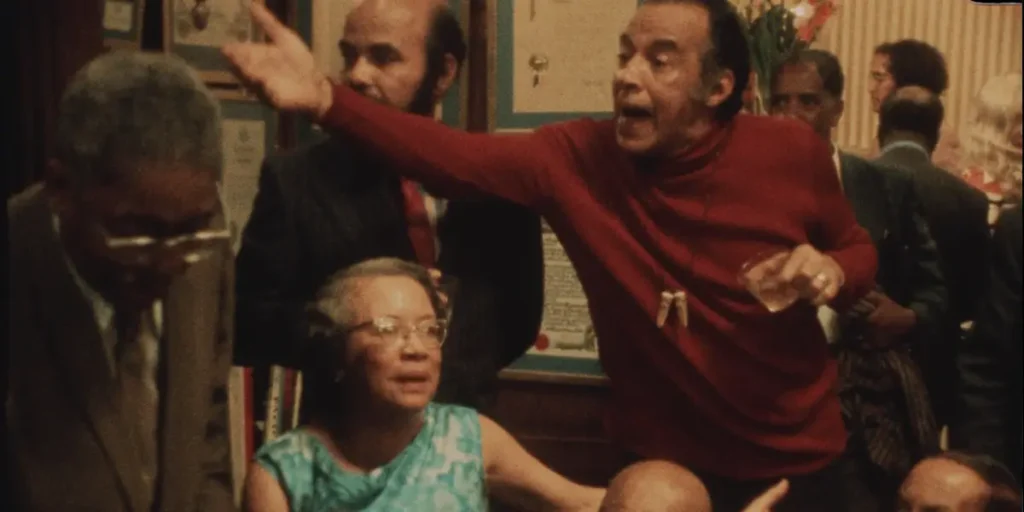
Just over 50 years since the footage was filmed, Once Upon a Time in Harlem is a must-see account of a single evening with members of the Harlem Renaissance.
Directors: William Greaves, David Greaves, Liani Greaves
Genre: Documentary, Historical, Music, Family
Run Time: 100′
Rated: PG-13
BFI London Film Festival Screening: October 10, 2026
U.S. Release Date: October 16, 2026 in select theaters
U.K. Release Date: TBA
In 1972, legendary filmmaker William Greaves (Symbiopsychotaxiplasm) invited a group of intellectuals and artists to Duke Ellington’s apartment and filmed the ensuing evening of lively discussion and a fair share of alcohol. Said archival footage sat unseen for five decades, only now seeing the light of day in the form of Once Upon a Time in Harlem. It’s a snapshot that says an incredible amount in only 100 minutes—a documentary about the production and editing process alone would be a good watch—but most importantly, it’s a historical time capsule as important as any film released this century.
It was never going to just be one night at Ellington’s. For William and his creative partner and wife, Louise Archambault Greaves, it was always going to be a years-long project. Ultimately, this, along with a myriad of other reasons, led to the work remaining unfinished until the mid-2010s, when William and his son David began to form everything into a final product. Finally, we have Once Upon a Time in Harlem, 12 years after William’s death and completed by David, granddaughter Liani, and Anne de Mare. The scattered, freewheeling nature of this work mirrors its lengthy creation process, but credit to David and co for making it such a focussed experience.
For William, the events of Once Upon a Time in Harlem are the most important he ever filmed. Living members of the Harlem Renaissance—a movement of African-American art, music, literature, and so on in the 1920s and 30s—reunite for the soiree, the large group of people consisting of numerous pivotal figures from this cultural movement, including the musician Eubie Blake, photographer James Van Der Zee, and Ida Mae Cullen (the widow of Countee Cullen). The spontaneous discussions that erupt over the course of the night are captured in glorious observational detail by William. He’s an onlooker with a clear enthusiasm and adoration for his subjects, asking occasional questions but mostly sitting back and letting them do the talking. He captures the comedy perfectly as well, often zooming onto frustrated or bemused faces.
The real invigoration comes from the glorious words spilling out of the mouths of such talented people. It’s highly engaging—the film dips in energy only a few times—and the many different topics that come up for discussion are endlessly fascinating, often moving, always empowering. There is a particularly interesting stance taken from the group about the younger generation—indeed, one critic in attendance is a few decades younger—and the need for them to learn about their history, about the older generation’s experiences. Doubling or even tripling the 100-minute runtime wouldn’t be an issue, such is the deep, rich quality to Once Upon a Time in Harlem’s subjects and their stories.
That isn’t to say that Once Upon a Time in Harlem flows completely seamlessly; some more breakaways from its main setting, perhaps with more interspersed music, would have helped. As it is, the only more stylised moments bookend the main section of the documentary. The sparsely used original score by Tamar-kali (Mudbound) is also great when it does play. But David’s main aim with Once Upon a Time in Harlem is to portray the spirit of that evening that his father captured so vividly without ever diluting it too much.
The mammoth project of putting all of this footage together is almost inconceivable in scope, but David, along with editors de Mare and Lynn True, do a magnificent job. They say great minds think alike, and whilst this can be true, Once Upon a Time in Harlem highlights a more complex spin on this saying. These great minds wanted the same destination of freedom, as one of them puts it, but each took varied roads, both thinking alike and differently. This is the true beauty that Once Upon a Time in Harlem captures.
Once Upon a Time in Harlem: Movie Plot & Recap
Synopsis:
In 1972, William Greaves filmed a gathering of Black intellectuals and artists involved in the Harlem Renaissance. Once Upon a Time in Harlem is the long-awaited release of this footage, over 50 years after its filming.
Pros:
- The observational camerawork from William Greaves is a marvel
- Must-see accounts of some of the greatest artists of the 1920s and 30s
- Edited with a stunning clarity
Cons:
- Occasional dips in energy
Once Upon a Time in Harlem was screened at the BFI London Film Festival on October 10-11, 2026. The film will be released in select theaters on October 16, 2026, with the U.S. theatrical premiere at Film Forum.