
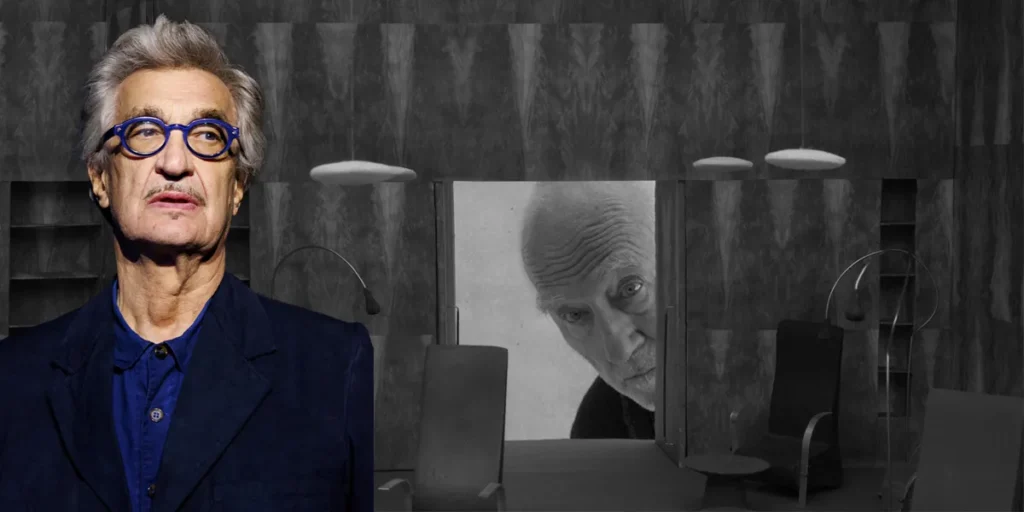
We interview Wim Wenders about From Inside Out – The Architecture of Peter Zumthor, the poetic potential of 3D, his approach to documentary filmmaking, and more.
“We all live in houses,” says Wim Wenders in his director’s statement about From Inside Out – The Architecture of Peter Zumthor, which has just had its World Premiere at the 2026 Venice Film Festival. He goes on to explain how much our ‘homes’ mean to us and the role they play in shaping our identity, but also how we tend to take them for granted. “I wanted to change that with this film,” he adds, a goal he absolutely accomplishes.
From Inside Out explores the work and philosophy of influential architect Peter Zumthor by letting the audience experience his buildings not just as empty spaces, but also through the eyes of the people Wenders places in them, from their actual residents to visitors and artists encountering and reacting to them. Told in stunning, immersive 3D, From Inside Out takes us to sixteen of Zumthor’s buildings, introducing each one in a unique and haunting way while also highlighting the architect’s creative process. The result is a mesmerizing, poetic documentary that serves as a showcase for what can be done with the medium.
At the Venice Film Festival, we sat down for an interview with Wim Wenders, who told us about Peter Zumthor, how the project evolved in the fourteen years it took to make it, using ‘native 3D’, his approach to documentary filmmaking, and more.
“It Comes From the Heart” – Wim Wenders on Peter Zumthor’s Approach to Architecture
Thank you for this fantastic film!
You’ve spoken about similarities between architecture and filmmaking in terms of how one constructs a film, but I wanted to ask you about an emotional parallel From Inside Out made me think about. Peter talks about creating spaces where people can feel safe and protected, and I think your films can create ‘spaces’ where viewers can feel the same way. Did you feel that connection while making this film?
Wim Wenders: I was not sure how Peter was conceiving his buildings [before making this film]. I knew some of them: I had been at the thermal bath in Vals before knowing Peter, and I spent a week there. I had wondered a lot about how he conceived these buildings: how much he pre-visualized them, or how much he was really able to inhabit the purpose of the building before he was building it… And how much he thought of the people who were going to live or work there, or visit it.
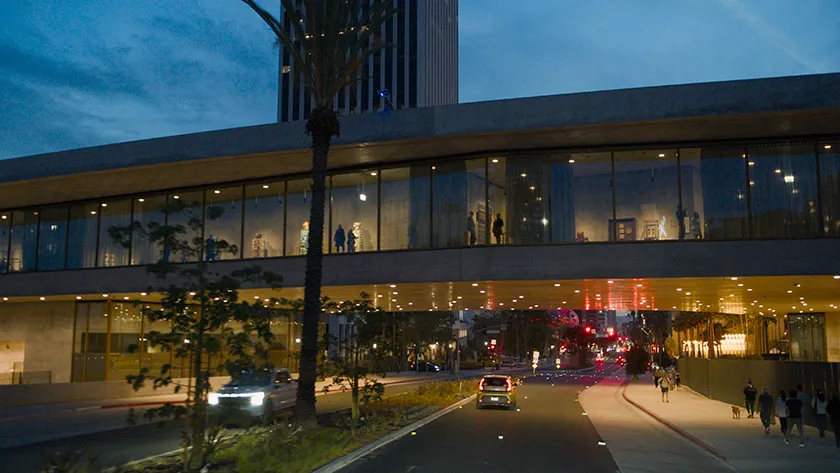
So I had all these questions, and after spending 14 years on and off with Peter, I realized his approach is highly emotional, much more than I’d ever thought, because I had thought of him more as a cerebral guy. And then, following him, I saw the problems that he had with conceiving buildings, and the time he had to take to penetrate their purpose, but also to do justice to the place [where each building was going to be built]. It was painstakingly long. As Michael Govan [the CEO of the Los Angeles County Museum of Art] says in the film, he’s probably the slowest architect in the world. And you see all the buildings he has done in the film: it’s not that much.
And yet that slowness pays off, judging by what you show us in the film.
W.W.: I realized that a lot of Peter’s work is not [just driven by] the ‘brain’; it comes from the heart. He puts a lot of his own experiences into it: he knows what [kind of feeling using certain] materials or [having certain] views produce; he knows how much you need to feel safe, and how much you need to feel connected to the world.
There’s a lot of thinking that goes into each of the buildings, and into their purpose. And in the end, if Peter finds out he cannot really do justice to that purpose, or he doesn’t really feel it’s all that necessary – for example, if he feels that the people who want to have this building made aren’t really convinced of what they’re going to use it for – he’s not going to touch it, because he wants to be sure the building is necessary, and that that purpose is something he can respect. If he doesn’t, he’s not touching it. He does say a lot of nos to buildings, because he doesn’t really know if they’re necessary, because he doesn’t really like the surroundings, or because he doesn’t feel like he can do a certain urban place justice, if there’s already too much there.
Peter is very, very picky, but in the long run, it’s not to satisfy his ego; it’s to do justice to the place and to the people who will live there. But on the other hand, he’s an author. He doesn’t think he’s a provider, and he doesn’t want to just give you the plans, so that somebody else can build it, and walk away. He wants to be there until the very end.
Most architects deliver the plans and then somebody builds it, and they’re already gone, but Peter is there until people move in. And then, he [doesn’t intrude in their lives] because he respects that they’ll do God knows what to the building. But until the project is finished, Peter is convinced that you can still continuously improve it. This is also my approach to filmmaking: a film is not done with the script, but it only appears in the making. In the same way, Peter’s buildings might also turn out different, and he accepts all the consequences.
A lot of people who want to have a house from Peter walk away after a while because they realize he’s going to be with them until they open the door and walk in. He’s a perfectionist, but not for his own sake; he wants the building to serve its purpose in the best way possible. And if you look at it from outside, he wants it to belong to that place as if it had always been there. He goes through a lot of difficulties to make sure the building is not an intruder, but it’s welcomed by the place.
The film’s title, From Inside Out, feels particularly significant to Peter’s approach to architecture. Where did it come from?
W.W.: I feel that Peter’s artistic process is more from the inside than from the outside. It’s more from the inside, meaning more from the heart, but if you look at the projects, it’s also more about the interior spaces forming what the outside looks like. It’s not so much about building something and then having rooms that are the way they are because of what it looks like from the outside. It’s built from being lived in: he creates the inside space first, and then he looks at what it does on the outside.
But of course, he also has to look at the outside, because the outside corresponds to the place. So the outside has to do justice and be friendly to the place, in his philosophy. He looks at it from the outside for a while and then goes back to look at it from the inside. It’s a constant process, but it comes so much from the heart.
That’s why I finally found the title in Sophie Hunger’s song [which she wrote for the film and performed in the final scene, at the Beyeler Foundation art gallery in Basel, Switzerland]. She wrote the text for that song on her own; I didn’t write it. She looked at the film several times and got involved in Peter’s work. I had just asked her to discover the building with a guitar, and then she wrote that song. It’s in the song that I found the title for the film, so I’m deeply thankful to her.
The song is in several different languages as well, isn’t it?
W.W.: She sang it in German, Swiss German, French and English.
That’s amazing.
W.W.: Believe it or not! But she’s at home in all the languages. That’s a privilege of the Swiss. They all speak French and they all speak German, even if their Swiss German is really very ancient German.
Wim Wenders on Native 3D’s ‘Poetic Potential for Documentaries’
You’ve mentioned before that From Inside Out – The Architecture of Peter Zumthor is in 3D ‘because architecture needs it.’
Wim Wenders: Architecture can only be experienced if you’re in it. Ideally, you would go to all these buildings and you don’t need a movie, but not many people can travel to all these sometimes remote places that Peter built in. So I wanted the audience to be able to [experience that] as much as you can do that with a movie. I knew that 3D has an affinity to space, and I knew how to take the audience along so it would come close to being able to [move] in there.
When you made Pina 15 years ago, you were very optimistic about the future of 3D. How do you feel about where the medium is today?
W.W.: Well, you still need the glasses, at least if you insist on doing 3D in a physiologically correct way, so that it gets as close as possible to what two eyes do to adjust to a place, to see something close and far. Your eyes do a lot of work. If you look here [lifts up a hand], they converge on my thumb; if you look in the distance, they go parallel. They do lots of things. Eyes are marvelous instruments.
And we try very hard to repeat that with two cameras, but not many people go through that process anymore. Actually, James Cameron and I are the last defenders of what he calls “native 3D,” which is doing it from A to Z with two eyes. Most 3D films today are done with one camera, and it’s a computer that calculates it, which cannot—will never—be physiologically correct. It can hurt your vision, or at least hurt your brain.
A lot of animation films are done correctly, because they’re not shot in reality; they’re made in the computer, so you can do it quite correctly. I like some 3D animation films because they’re nice. The eye feels relieved, except that most of the time they’re cut so fast that you don’t have time to take the space in. But that’s a different issue.
With native 3D, not many people do it, and the medium still has the reputation of being a tool for action. Nobody really grasped its poetic potential for documentaries, and for inviting you to be in a place instead of in front of a place. So 3D has a bad reputation.
“I Didn’t Think the Film was Going to Be as Personal as it is Now.” – The Evolution of From Inside Out – The Architecture of Peter Zumthor
How did you decide how best to showcase each of the spaces in the film, and how did you select the people to feature inside each of those buildings?
Wim Wenders: It wasn’t one decision; it was a decision for each building. I chose [novelist and essayist] Siri Hustvedt to walk through the Witches Memorial [the Steilneset Memorial in Vardø, Norway, commemorating 91 people executed during the Finnmark witch trials] because she had written on the witches in the north of Norway, and she’d written on Louise Bourgeois, the French artist who made the sculpture of the burning chair [an installation titled “The Damned, The Possessed and The Beloved”, featured inside the Memorial]. Zumthor built that little black house for the work.
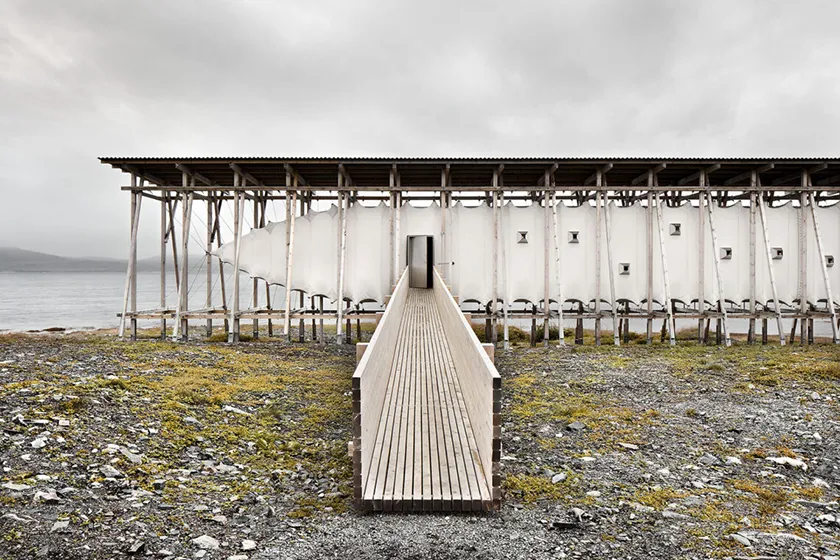
Siri had written about the persecution of witches, but she’d never been to the place, so I thought she could bring something to it as a visitor. I invited her to come there, and when she comes into it, it’s the first time she sees it. I thought that brought a lot to her performance and to her discovering the place.
The idea was simply that, instead of showing the place abstractly, as if the camera was discovering it, I felt it was good if people would discover it for the audience. For me, it was a softer entrance than just having the camera. That was a choice, and I was a little scared that it wouldn’t work, but I’m happy with that choice now.
Each building took a while to find the right person to be [in the space]. And of course, I didn’t put anyone else into the houses where people actually live: I shot those with the people who lived and worked there.
I noticed that Aoi Yamada, who was also in Perfect Days, appears in From Inside Out: it’s one of my favorite scenes. This film was fourteen years in the making, and since you made so many other films over those fourteen years, do you think any of those projects had an influence on this one?
Wim Wenders: Well, they all left their traces in it somehow. I made 3D movies in between, I made flat-screen movies in between, but it was mainly coming back to the editing room each time and looking at what I had before I was going to see Peter again, and realizing, “I’m still not sure about this question; this is still open.”
Each time we shot together, a new idea opened up. The film really slowly grew together, and we became better friends and more at ease with each other. In the beginning, I didn’t think the film was going to be as personal as it is now. I really thought I was going to look more at the buildings and not so much at the man.
In the end, I realized how much he invested his own youth, his own experiences, his own heart in each project. So I realized I had to get more into his own biography—not in a traditional sense. The film is not a biographical film of Peter Zumthor, but you feel some of it.
You feel that his father was a carpenter, and maybe you also feel that Peter was a craftsman at first, before he became an architect. His appreciation of craft is so strong in the film, and he wants to see the traces of people’s hands and of human work in his buildings.
All of this makes him a very singular person in today’s world of architecture. He’s not a star architect; he didn’t build enough to be a star architect. But his ideas are very, very basic ideas about what architecture can be, and how it can serve people, places and nature, and have a lasting impact on people who work or live there.
Wim Wenders on What Drew Him to Peter Zumthor’s Work and How the Idea of From Inside Out Emerged
When did you first start paying attention to Peter’s work? Was there a particular project that drew you to it?
Wim Wenders: I stayed in his thermal bath in Vals a couple of years after it was built. I love thermal baths; I’ve visited them all over the world, especially in Japan and Switzerland. I’d seen pictures of this building, and it was so clean and simple: just the local stone and water, with glass and brass and nothing else.
So I went to see it; I spent a week there, and I enjoyed it enormously: the sobriety of it, the almost spiritual feeling of the place, and the connection to the mountains around. I stayed there in winter, so it was all snowy mountains, and you would be in the warm water with soft snow coming down on you. It was really beautiful.
I thought this place was very, very, very special. I had not experienced architecture like this: so gentle and so modest, only referring to the materials of the place: water and stone.
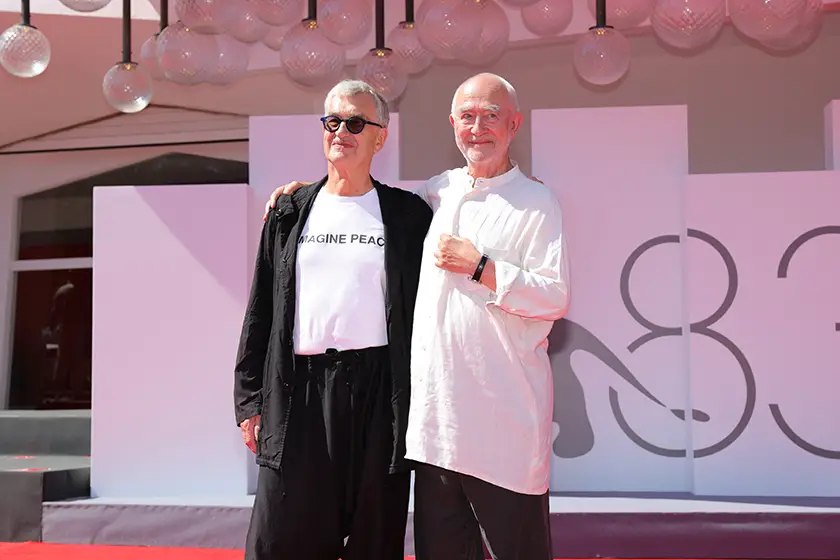
Then I witnessed a competition he took part in in Berlin for a gallery building that he didn’t do in the end. I loved his building, and I got to know him, too, because it was my gallerist [Heiner Bastian] who [commissioned] this. In the end, it was built by David Chipperfield, but I liked Peter’s model very, very much.
When did the idea of making a film about him first emerge?
W.W.: When David Chipperfield was the director and curator of the 2012 Architecture Biennale, David asked me if I could make a short film about Peter Zumthor. Peter had won the Pritzker Prize, but not many people knew his work, although he had won the most prestigious prize an architect can win.
I was very happy and jumped at the occasion. I shot with Peter for two days, and we made a short, two-minute film, basically on his models and drafts of the secular retreat that you see in the film in Chivelstone. He was working on the idea mainly with models, and I filmed him thinking and talking about the English landscape and the thing he wanted to build there.
His main idea was to make it really as simple and primitive as the initial idea of Stonehenge. It started with very brutalist elements. So we filmed it, and I realized it was probably going to turn out very, very differently, because Peter tried many ideas.
At the end of those two days, we realized we had just looked at one building, and there were lots of others that he might want to do, could do, or was already doing. My curiosity was even higher than it had been at the beginning.
We had a last glass of wine and talked, and in the course of the conversation, we realized we both wanted to do something more solid, something real. We shook hands on making a long-term film together there and then. I started it that very year, in 2012. That’s why the film is now 14 years in the making.
I thought it was going to be long, meaning maybe five or six years. I had no idea it was going to take 14, because some of the buildings he started in the course of our first years took a long time to be completed. LACMA took an endless time.
In the end, I wanted to finish the buildings that we had started to watch and follow their birth through. I made other movies in between, of course, but always came back and revisited his places. Some of them I shot three or four times; some I visited in different seasons. In the end, I visited them all and got a pretty complete idea of Peter’s approach.
And as I was able to edit each time after each shoot—we shot maybe 10 or 12 times—I could edit for a while and then maybe come back a year later. So the film slowly grew together, also like a piece of architecture.
“I Don’t Have a Script. I Have a Page in Which I Explain my Curiosity.” – Wim Wenders on Documentary Filmmaking
You’ve moved between fiction and documentary throughout your career. Do you see those as fundamentally different modes of filmmaking?
Wim Wenders: If you look at my feature films, especially my early work, they’re all shot like documentaries. I shoot movies in chronological order, although it does not make sense financially, and I produce them myself because no producer would let me shoot in chronological order. I realized I cannot make films the way I want to make them; I have to produce them myself.
My whole approach to storytelling was documentary in nature. I wanted to invent the story, not have it and then shoot it. I didn’t want to know how the film ended. I wanted to find out through the making. I wanted to live the adventure in order to be allowed to shoot an adventure. And that is a documentary approach.
And if you look at my documentaries, there are always efforts to tell a story in them. In Anselm, but also in Soul of the Earth, or in all my documentaries, there are storytelling elements. So I have always mixed them, and it never made sense to me that they would be two separate things, separate jobs.
The beauty of a documentary is that everybody accepts that you don’t know how you’re going to do it when you start. I’m still teaching, and I see that my students, when they try to make a documentary, are now asked to write a script. They actually have to do a script before they are allowed to get the financing to do a documentary.
I don’t do that. I don’t have a script. I have a page in which I explain my curiosity, and that’s how I do a documentary. But movies go more and more into prefabrication. People have to develop scripts on documentaries now in order to get the financing, which is a disaster, if you want to know my opinion.
Pure documentaries are beautiful witnesses of their time. There’s nothing that reflects our time so purely as free documentaries that are made without rules, that allow curiosity to be [the driving force], and preserve stuff that is not prefabricated.
I want storytelling to be just as authentic. And I think that 3D is a beautiful storytelling tool. It’s not a technology—that’s a misunderstanding. It is also technology; filmmaking is technology. But 3D is a storytelling tool, not technology. It allows you to penetrate your subject deeper.
Thank you for speaking with us!
This interview was edited for length and clarity.
From Inside Out – The Architecture of Peter Zumthor had its World Premiere at the Venice Film Festival on September 6, 2026.