
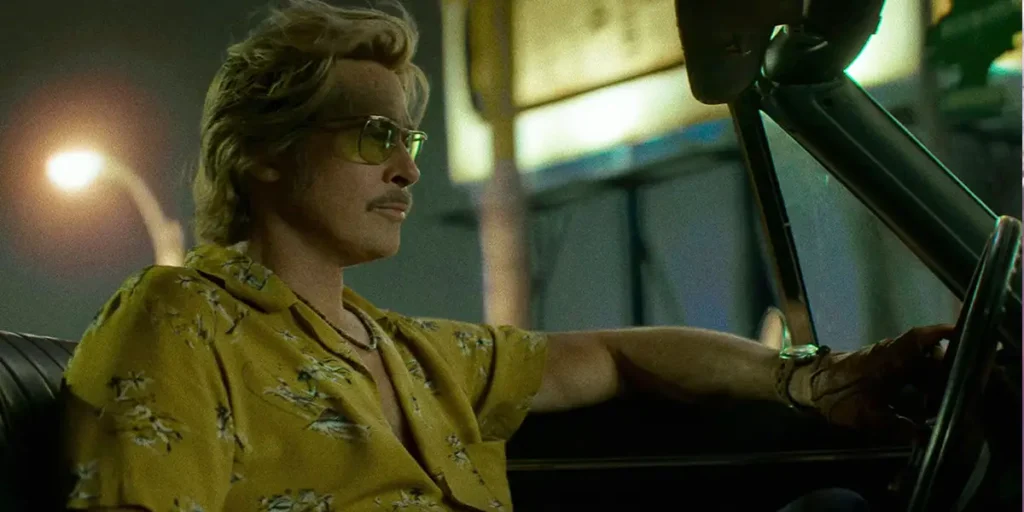
David Fincher and Quentin Tarantino give us the ultimate hangout movie in The Further Mis-Adventures of Cliff Booth.
Director: David Fincher
Writer: Quentin Tarantino
Genre: Drama, Action, Comedy
Run Time: 140′
Rated: R
Theatrical Release: November 25, 2026
Netflix Release: December 23, 2026
Seeing David Fincher’s The Further Mis-Adventures of Cliff Booth on the launch day of Rockstar Games’ Grand Theft Auto VI was a surreal, almost out-of-body experience. The standalone sequel to Quentin Tarantino’s Once Upon a Time in Hollywood isn’t so much concerned with telling a story as with capturing a particular atmosphere that feels so far removed from how our society currently interacts.
The movie immediately lures us in through a thrilling opening sequence solely by its mood, as our titular character (played by Brad Pitt) works in the projection booth of the New Beverly Cinema and is currently screening an in-universe Blaxploitation film, Soul Brothers Die Hard, starring renowned actor Roderick Harrison (Yahya Abdul-Mateen II).
Not much else needs to be shown, but the deliberate gestures of reel changes and cigarette burns quickly absorb us into Tarantino’s cinematically literate universe, as murky and unengaging as the images might be. It’s a strange and frequently bewildering choice to shoot the sequel to one of the most vibrant and electric films of the 2010s with variations of grey and mud, especially when the 1970s were far more eclectic in their cinematic artistry than the pinnacle of New Hollywood. In fact, The Further Mis-Adventures of Cliff Booth might be Fincher’s most aesthetically unremarkable film, despite him once again teaming with Oscar-winning director of photography Erik Messerschmidt.
Perhaps the switch from film to digital kills the emulsifying, heightened colors of Tarantino’s world. Or maybe it’s the garish (rumored) AI-generated imagery that attempts to integrate fictional actor Charlie Peters (Scott Caan) inside classic television shows of the period. Bar none, the film’s most inept scenes occur when Fincher attempts to stage Tarantino’s usual brand of extreme, if not cruel, violence. In his depraved vision of the late 1970s, children get brutally murdered by a group of Filipino gangsters, and popular figures get senselessly beaten to a pulp in the middle of an open street. As shocking as these moments may be, the film’s digital seams are highly apparent, and they never make us react the same way as Once Upon a Time in Hollywood’s blood-soaked finale, because nothing we see on screen feels real.
Fincher has been working in digital textures ever since 2010’s The Social Network, but he’s always pushed the limits of photography to genuinely exciting horizons. None of that is found in a movie that needed to be far more aesthetically invigorating and capture the same lived-in atmosphere in its photography as the muddy, sludgy and artificial frames of one of our (usually) most exciting image-makers. Even Mank, a film I’m not a particular fan of, contains some of the most arresting cinematography of Fincher’s entire career. He certainly knows how to film talent agent Karen Crosby (Elizabeth Debicki) in an alluring fashion, but since the compositions fall flat, the connection between the characters and the audience is almost non-existent.
Thankfully, Fincher has Quentin Tarantino’s words to help him shape a mood piece that would have hit even harder if he cared about his images. But the thing is, as controversial of a public figure he has been in recent memory, especially with his desire to make only ten films throughout his career, Tarantino is one of our greatest screenwriters. The way he writes tension-filled dialogue exchanges in drawn-out sequences is unparalleled, and The Further Mis-Adventures of Cliff Booth features his usual brand of exciting and fully-three dimensional characters that make each word of that screenplay come so alive that they are able to (lightly) surpass the film’s lifeless frames. It’s almost a miracle unto itself that a movie that’s mostly based on vibes.
There are no real plot or character arcs to follow. The film is essentially a snapshot of a week in Cliff Booth’s crazy existence, as Rick Dalton’s former stunt double is caught in an event he wants no part of. We track Booth’s misadventures with little texture or development, but that’s the point. Cliff stays exactly the same as he was in the 1960s, except that he’s older. That said, we do get a look into his private life, mostly his relationship with his father, Gus (Peter Weller), as they watch television and build miniatures together. It develops elements about his life, without necessarily developing the character, but that’s a feature, not a bug, in the way Tarantino has written both iterations of Once Upon a Time in Hollywood.
For him, this is a world you should enjoy visiting and want to return to at a different point in time, because it feels so tangible, as twisted as it may be. We believe in every single character, since every minute detail they have adds so much to our understanding of how this ever-evolving City of Angels operates. Tarantino has always been detail-oriented, and so is Fincher. Theoretically, this should be a match made in heaven, but it’s clear that the only person who can truly bring Tarantino to life is the man himself. The world just doesn’t have the same weight as when Tarantino visualized it, though the attention to caring about how each character is shaped through recognizable traits remains intact. And the performances are incredible.
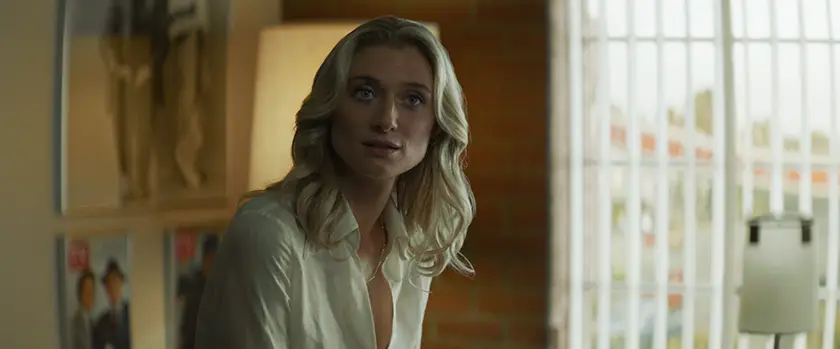
We all know that Pitt delivered one of his career’s most memorable performances in Once Upon a Time in Hollywood, and his Oscar-winning charm remains intact as he once again reckons with his age and dwindling star power through the figure of a stunt double now forgotten in the annals of the public eye, despite the mythology surrounding the character. Most impressively, however, is the two-note-perfect supporting turn from Scott Caan, who more often than not channels his late father James’ energy in a performance that will hopefully give him the flowers he’s deserved ever since he starred in Steven Soderbergh’s Ocean’s Eleven. That said, it’s Debicki who ultimately steals the show and who, strangely, benefits the most from Messerschmidt’s camera. Her allure is so palpable (Trish Summerville’s costuming certainly helps) that one wishes an entire movie were made about her.
In fact, an entire movie should be made about every single character we meet in this sequel. They all feel so fully fleshed out and interesting that it’s even more disappointing that the film’s image-making can’t live up to Tarantino’s writing or elevate everything on screen. Even the show-stopping Figure 8 race, a set piece worthy of the magnifying power of the IMAX screen, disappoints in how dark and unimpressive it looks. And yet, there’s still lots of fun to be had with a movie that, on paper, might not have worked, given two clashing conceptions of cinema. Fincher has been experimenting with the digital form, whereas Tarantino has been sharing his passion through celluloid-based referential works ever since his debut in Reservoir Dogs.
But The Further Mis-Adventures of Cliff Booth works despite its obvious inconsistencies, because Tarantino’s writing remains on top form, and the atmosphere he imbues in the free-flowing streets of Los Angeles, as Cliff drives his car around town, is the perfect primer for what we’re likely all going to do during this next month while exploring Leonida in Grand Theft Auto VI. It even has a direct visual callback to Rockstar’s third-person driving, a reference so explicit that someone in the press screening was happy to say “GTA!” when it happened. God, imagine if Fincher (or Tarantino) made an actual Grand Theft Auto movie. I’d go see it, and I’m sure others would, too…
The Further Mis-Adventures of Cliff Booth: Movie Plot & Recap
Synopsis:
A week into the continued adventures of Cliff Booth, during the summer of 1977 in Los Angeles, California.
Pros:
- A thrilling mood piece that isn’t much concerned with plot and is more reliant on pure hangout vibes.
- Brad Pitt, Elizabeth Debicki, Scott Caan and Yahya Abdul-Mateen II are all incredible as three-dimensional, detailed characters one wants to follow in their misadventures.
- The soundtrack perfectly captures the best of 1970s music, in an era of constant innovation and change.
- Quentin Tarantino remains one of our most treasured screenwriters, elevating the film’s murky aesthetics through his immersive sense of tension-building and character work.
Cons:
- Erik Messerschmidt’s cinematography is his most unimpressive and flat, failing to capture the lived-in textures of Robert Richardson’s work in Once Upon a Time in Hollywood.
- The purported use of Artificial Intelligence to integrate Scott Caan into vintage television series is frequently garish.
- Trent Reznor and Atticus Ross’ music disappoints.
The Further Mis-Adventures of Cliff Booth will be released globally in theaters on November 25, 2026 and on Netflix on December 23.