
The Black Ball is brilliantly made and heartfelt in its ambition, even if it can’t convey its characters’ passion as well as their suffering.
Directors: Javier Calvo, Javier Ambrossi
Original Title: La Bola Negra
Genre: War Drama, Historical, Romance, Musical
Run Time: 155′
Cannes Premiere: May 21, 2026
U.S. Release: October 16, 2026 in theaters
U.K. & Ireland Release: November 6, 2026 in cinemas
Netflix Release: Dec. 4, 2026
The 79th Cannes Film Festival boasted more than its share of queer cinema offerings. Some were sweet (Flesh and Fuel), some were irreverent (Jim Queen), some did both (Teenage Sex and Death at Camp Miasma). Meanwhile, the Competition titles mixed provocation (The Unknown) with the type of tragic gay stories that appear labgrown for awards consideration. Coward and The Man I Love both feature men foolhardily searching for queer joy in the face of war, disease and disaster (All we needed was a lesbian romp set in a famine to trigger the Apocalypse, apparently).
The Black Ball (La Bola Negra) is a pleasantly trickier proposition, at once more conventional and more subversive than its fellow Palme d’Or competitors. Its historical setting and reconciliation to tragedies past screams for trophies, but its era-spanning multiple narratives are burdened with breathtaking ambition. Writer-directors Javier Ambrossi and Javier Calvo (affectionately known as Los Javis) shoulder the thematic weight with a lightness of touch, and make The Black Ball one of the most memorable entries of this year’s festival, even though it’s less romantic than it first appears.
The Spanish poet and playwright Federico García Lorca is the subject of The Black Ball, but we never see him until its finale. He lingers over proceedings as a guiding spirit, reminding all involved of his and others’ sacrifices in the heat of the Spanish Civil War. The film takes place over three timelines. The first, set in 1932, is an adaptation of Lorca’s unfinished play ‘The Black Ball’, in which a young man (Milo Quifes’ Carlos) applies to become a member of an exclusive casino, but the voting members (including politicians and clergy) vote against him due to the open secret of his homosexuality.
As the votes line up against him (The ‘black balls’ of the title), he is forced to reevaluate his strategy. The gay man having to reconsider how he behaves to get ahead in the world is not a subtle metaphor, but it was controversial for its time. As Carlos’ vote reaches a crescendo, the scene is interrupted by something he and Lorca could only have dreamed of: a Grindr notification. Los Javis chart the evolution of gay rights over a century, sometimes in unexpected ways.
The man getting the notification is Alberto (Carlos González), a researcher in Spanish literature. In 2017, he gets a call from the executor of his estranged grandfather’s estate. The old man has passed on, leaving Alberto an inheritance that he must collect in person. Thus begins an odyssey to discover who his grandfather was, and what the significance is behind this mysterious inheritance. The Black Ball juggles a lot over its 2.5 hours, but it is mostly concerned with righting the wrongs of the past. It’s a noble aim, but Los Javis are covering a lot of ground, and it takes a while for its various storylines to come together. The volume of detail and narrative they aim to encompass means that something gets lost along the way.
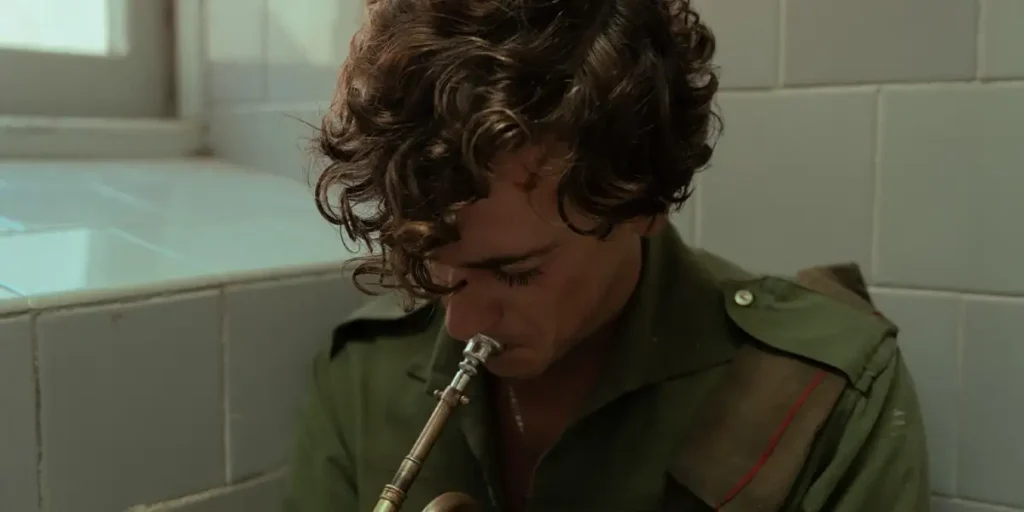
In between the stories of the black ball and Alberto’s research lies a third narrative. The film opens in 1937, in the middle of the Spanish Civil war, as young Nationalist soldier Sebastián (Spanish guitarist/lyricist Guitarricadelafuente) witnesses his village be destroyed by friendly fire from Italian planes coming in to support General Franco’s forces. Sebastián’s support of the regime doesn’t grant him immunity from its brutality, and Los Javis use their wide canvas to capture the horrors visited upon the populace by the fascist forces. Sebastián finds himself in a military hospital, where he is assigned to guard the handsome and badly-injured Rafael (Miguel Bernardeau).
Sebastián’s story is the lynchpin of The Black Ball, as he runs the most risk of all its protagonists. He finds himself drawn to Rafael, even though his comrades would kill him for being gay, and Rafael is already pledged to someone else. Los Javis understand the risk of desire, as it can arise anywhere and can’t be explained away. Love, lust and longing are overwhelming, though the directors exercise more restraint than their characters manage.
What Los Javis attempt structurally with The Black Ball is impressive. The three narratives dovetail slowly but surely, tying together in a satisfying finale that sees Lorca’s hopes realized, a world where conflict is fruitless and love finds greater expression. The problem is that the details of how these stories come together are a greater priority for the writer-directors than the feelings that drive the characters on. Compared to Coward, The Black Ball is less interested in the very sexuality that separates the protagonists from their social contexts.
Coward at least allows its characters some intimacy, but The Black Ball is more concerned with queerness as a definition of separation, rather than an inherent part of the characters’ selves. Of course, wartime prevents everyone from seeking their happiness, but the gay characters can’t help but feel like markers in an academic exercise. Alberto wants to help his late grandfather, who had to live his life as a gay man in secret, but he’s dead now. The Black Ball wants to recontextualize the lives and loves of times past, even if it’s of no benefit to the people involved.
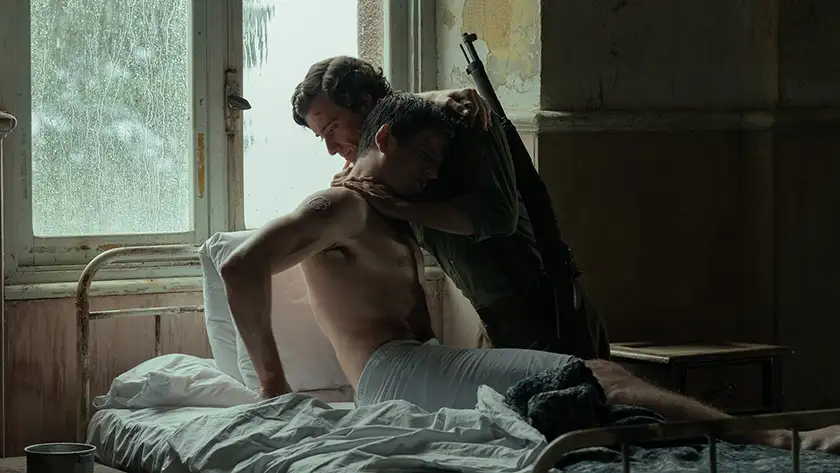
If the characters of The Black Ball aren’t allowed to feel their passions, that doesn’t mean there isn’t passion in the making. Gris Jordana’s cinematography distinguishes wartime grue and intimate contemporary interiors without sacrificing quality or unity of purpose. Los Javis keep their camera moving in the 1930s strands, sympathizing with their characters who are forever on the run, while the 2017 narrative is told at the more relaxed pace of a happier time and place. In a Cannes lineup dragged down by overlong self-importance, editor Alberto Gutiérrez deserves special mention for keeping the narratives coherent and nimble; the 2.5 hours fly by.
Meanwhile, the performances are uniformly strong; it’ll be fun to see Guitarricadelafuente cause awards hosts some pronunciation difficulties, while the big names in the supporting cast do dynamite work. Lola Duenas, Penélope Cruz and Glenn Close respectively offer moments of raw anger, seductive showstopping and palpable emotion with limited screentime, like the committed professionals they are.
The Black Ball is ambitious, and says what it wants to say with intelligence and skill. It’s just a pity that those traits keep it emotionally at arm’s length. By the end, we may be happy to see the resolutions play out, but the gaps across time are too big to bridge. The Black Ball is a hug from a ghost: well-intentioned and full of closure, but you just can’t feel it as deeply as you’d like.
The Black Ball (La Bola Negra) – Cannes 2026: Movie Plot & Recap
Synopsis:
Across a century, three stories of political and emotional upheaval unfold, revealing themselves to be connected, and in need of reconciliation.
Pros:
- Los Javis’s direction and script is full of intelligence and breathtaking ambition, tying the film’s narratives together masterfully
- Strong performances and production values across the board
Cons:
- The narrative complications deny the emotional throughlines the passion and heartbreak they deserve
The Black Ball (La Bola Negra) premiered in competition at the Cannes Film Festival on May 21, 2026. The film will be released in US theaters on October 16, 2026, in UK and Irish cinemas on November 6, and on Netflix on December 4.