
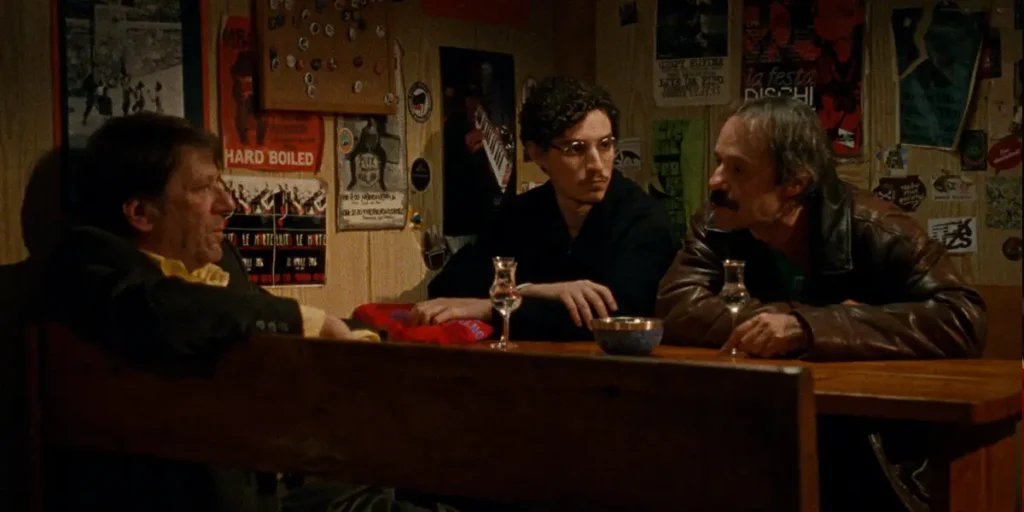
The Last One for the Road is a nostalgic but not very successful portrayal of a side of Italy audiences don’t often see.
Director: Francesco Sossai
Original Title: Le Città di Pianura
Genre: Comedy, Crime, Drama, Road Trip
Run Time: 100′
U.S. Release: June 16, 2026 on digital platforms
U.K. Release: July 10, 1016 in cinemas
The Last One for the Road starts with Carlobianchi (Sergio Romano) and Doriano (Pierpaolo Capovilla), two broke men who are desperately in search of the last drink of the night before picking up their friend Genio (Andrea Pennacchi, of Primavera) from the airport. Hoping to find one last drink, the two travel to Venice, where they meet Giulio (Filippo Scotti, of The Hand of God), a shy architecture student who is celebrating the graduation of a woman he has a crush on.
Although initially reluctant and focused on his studies, Giulio ends up joining the two men in their journey and opening up to them as he hears more about their backstory.
The setting of the film is fascinating, as it portrays a side of Italy that is not often shown in media and that many non-Italian people in the audience will not be familiar with. The Last One for The Road is set in the Veneto region, in north-east Italy. The usual stereotypical depiction of the country with olive trees, pizza, and overly friendly but loud people is replaced by a more realistic and sombre portrayal of this part of the country with mountains, a lot of alcohol, and disillusioned middle-aged men.
Giulio is also an interesting, if not the most interesting character of The Last One for The Road, which only really gets started when he comes on screen. With his at times naive attitude and humanistic approach to life, he portrays an often forgotten and not very visible side of today’s world and the younger generation. If the other two characters represent Italy’s past, Giulio is very much the hope for the country’s future. Filippo Scotti’s layered and sensitive portrayal of this character is also what makes him likeable to the audience and at times even relatable in his doubts and fears.
The rest of the characters, however, are more caricatures than anything else. With no clear backstory or character arc, Carlobianchi and Doriano remain frozen in time and, unfortunately, somewhat unlikeable. On one hand, this portrays the feeling of nostalgia that is present throughout The Last One for the Road very well, but on the other it is incredibly hard to relate to or empathise with these characters whom we virtually know nothing about. The two main characters remain one- dimensional throughout the film and never really go through any character growth, nor do they particularly want to, as they make clear in the movie.
While nostalgia for better days when the economy of the country was in boom is a key part of The Last One for the Road, if not its driving force in many ways, the script does not explore this element of nostalgia nearly as much as it could have. Generally speaking, the film leaves a lot of its themes on the surface rather than delving deeper into the consequences for the characters and for the country at large. It also has a lot of exposition in its first half which contributes to the very slow pacing of the movie and sense that nothing is really happening for its entire one hour and 40 minutes runtime.
The cinematography is a missed opportunity: the opening sequence uses the light and colour in a fascinating way, but this is soon forgotten as the film goes on to employ very different techniques in terms of its visual storytelling. At times unsettling and at times just uninteresting, the latter is not used as successfully or originally as I would have hoped. Unfortunately, The Last One for The Road shows us surprisingly little of the Veneto region, except for snippets of the city of Venice and some shots of the mountain landscape. The editing could have also been more successful, with too many overly long sequences, abrupt cuts to a past storyline that is never explored during long exposition scenes, and flashbacks to the same scenes over and over.
Overall, The Last One for the Road feels like a movie made up of missed opportunities to explore its setting and its themes better and with more nuance. Instead, everything, including its main characters, remains annoyingly at the surface level, leaving audiences with very little to take home or think about once the movie ends. This is especially a shame because the initial premise and idea of the film had a lot of potential on paper, but this remains unfulfilled as the film creates more questions, and admittedly frustration, than it answers.
The Last One for the Road: Movie Plot & Recap
Synopsis:
Two middle-aged men and a shy architecture student travel across towns in Veneto in their search for their last drink of the night.
Pros:
- A realistic portrayal of Italy, and more specifically, the Veneto region.
- Giulio is a fascinating character who the audience feels connected to.
Cons:
- The characters are one-dimensional and often caricatures of themselves.
- The script is expositional and very wordy, which ultimately hurts the overall pacing of the movie.
- The editing and cinematography could have been better used to tell this story, and feel like missed opportunities.
The Last One for the Road will be released on digital platforms in the US on June 16, 2026 and in UK & Irish cinemas on July 10.