
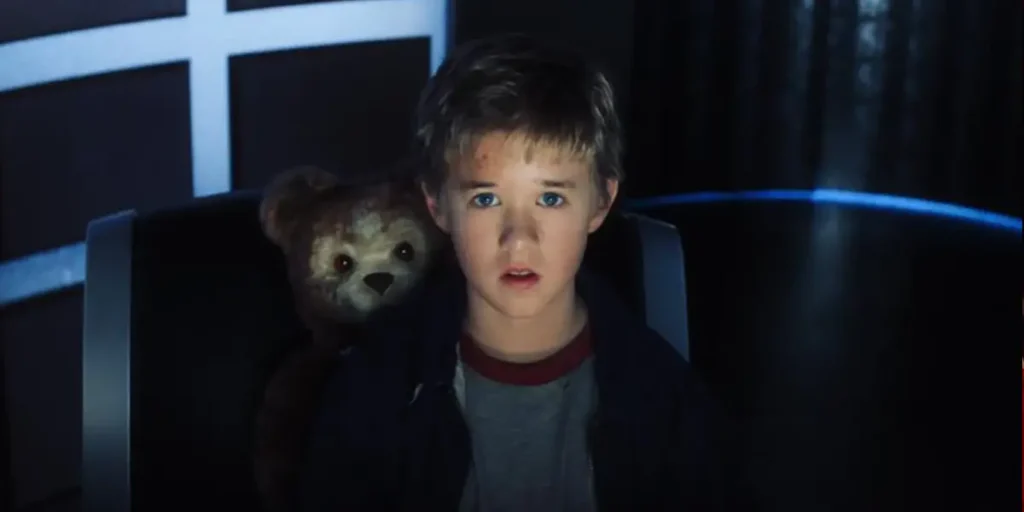
A.I. Artificial Intelligence remains a challenging Spielberg film, mixing an eerie tone and sentimentality to purposeful effect.
Director: Steven Spielberg
Genre: Psychological Drama, Adventure, Sci-Fi
Run Time: 146′
Rated: PG-13
U.S. Release: June 29, 2001
U.K. Release: September 21, 2001
Where to Watch: On digital and on demand
Whenever a movie includes “An Amblin/Stanley Kubrick Production” in its opening credits, you know you are in for quite the ride.
Much discussion has been given to whether A.I. Artificial Intelligence is ultimately a product of Steven Spielberg, who wrote and directed the final product, and Kubrick, who acquired the rights to the story and kept it in development hell for many years.
This mishmashing of styles and tones, however, is precisely what a movie like this needed. Balancing a sentimental outer shell with a deeply cynical core, A.I., even 25 years after its initial release, accurately depicts humanity’s fears in the digital age.
The movie does this by being less concerned with the mechanics or even the ethics of artificial intelligence itself and more concerned with the essential question of what it means to be human. And while that may sound like a sci-fi cliché, it applies to no other film more perfectly than A.I. (okay, maybe Blade Runner, but you get the point). The fact that the technical jargon about the androids depicted in the film does not go too far beyond Professor Hobby’s (William Hurt) desire to “build a robot that can love” means that focus is instead given to the emotional questions the movie poses. If too much attention had been given to the details of the technology, the film would have risked becoming dated. Instead, it remains just as relevant—if not more so—than ever.
Already deep into his career by 2001, Spielberg pulls out all the stops for A.I., producing a cinematic atmosphere that feels both shiny and eerie. This paradox is evident in the direction, cinematography, and performances. The set designs feel realistically futuristic, and every frame features a distinctly Spielbergian glow. Shots are composed from unconventional angles. Haley Joel Osmet, portraying the android protagonist David, delivers the exact performance he needed to, balancing a genuine sense of humanity with an underlying uncanniness. While the answer regarding the film’s ultimate authorship is certainly more complicated than this, it feels as though A.I.’s exoskeleton is Spielberg’s usual sentimentality with Kubrick’s pessimism leaking through.
The whole thing feels—dare I say—artificial, and Spielberg achieves this feeling not flippantly but with purpose. He wants his audience to feel slightly uncomfortable sitting through David’s homeric journey to find “the blue fairy,” the entity he believes can turn him into a real boy. By seeing a sense of faux humanity on display, in David, in Gigolo Joe (Jude Law), the pleasure robot he befriends, and in the other androids, we are forced to reckon with our own. With A.I., Spielberg suggests that an overlapping sense of love and wonder are the essential qualities of true humanity. These are emotions and ideas few human characters in this film seem to possess, begging the question of how we as humans might demonstrate or withhold them in real life.
Because of the film’s illusory presentation of sentimentality, and the conversations it wants to start, I am deeming it Spielberg’s most challenging, confrontational work to date. I am also deeming it his most relevant. It will certainly feel slightly “off” to Spielberg fans on a first viewing, especially the final 20 minutes, which are shot in a purely magical way even though the implications are deeply disturbing. But grappling with A.I.’s complexities may just help us navigate a world that is growing increasingly interested in the artificial.
In a pivotal scene, David’s “mother,” Monica (Frances O’Connor) offers an apology for not teaching him about the cruelty of the world. The great sci-films like this one, though, do teach us about such things and beg us to become interested in genuine humanity again.
A.I. Artificial Intelligence: Movie Plot & Recap
Synopsis:
David is an advanced android model programmed to demonstrate love for his mother. When his mother abandons him, David goes on a quest to become a real boy.
Pros:
- The film grapples with themes of technology and humanity that put it on the level of other great works of science fiction.
- Spielberg’s compositions and framing are some of his most sophisticated to date.
Cons:
- Especially on a first viewing, the final 20 minutes will leave some viewers bewildered and confused about the movie’s overall tone and theme.
A.I. Artificial Intelligence is now available to watch on digital and on demand.