

One Minute to Midnight is a meandering, albeit earnest attempt from Nicolas Pariser to craft a story analyzing love and identity amid a mid-life crisis.
Director: Nicolas Pariser
Original Title: Un peu avant minuit
Genre: Drama
Run Time: 111′
Venice World Premiere: September 10, 2026
Release Date: TBA
Nicolas Pariser’s One Minute to Midnight is a dialogue-driven character study of a middle-aged man in the midst of an identity crisis. The film begins as Leo (Melvil Poupaud, of Jeanne du Barry), a 49-year-old man living in Eastern France, is going through a drawn-out separation from his current partner when suddenly he gets news that his biological father has passed.
While he must go to Italy to deal with his estranged father’s inheritance and estate, he decides to take this opportunity to spend a few days in Paris with his own daughter, 19-year-old Emma (Clara Pacini, of The Ice Tower), whom he also isn’t particularly close to. When reconnecting with Emma and trying to unpack his feelings surrounding his father’s death, Leo begins to take stock of his past, which leads to him developing a fascination with who he was as a young man and who he has become.
When Leo was young, he was a culture writer at a magazine he helped run. Now he works as a TA and doesn’t do any writing of his own. As he is currently in crisis over his romantic life, he can’t help but also reminisce about the woman he was helplessly in love with, named Tina (Golshifteh Farahani, of Reading Lolita in Tehran), who served as the magazine’s muse. As he tells Emma about this great love, she points out that he sounds eerily similar to his late father, who, while Leo never met him, claimed Leo’s mother was the love of his life regardless of the fact he only knew her for a handful of months.
Emma asks how he could still be claiming to have loved Tina as much as she did without him ever knowing her deeply, much like his father did by putting his mother on an impossibly high pedestal. When Leo brings up a young intern at the magazine he was having an affair with at the same time he was in love with Tina, Emma points out how troubling his past behavior is proving to be, specifically in the context of modern-day, gender-driven power imbalances and nudges him to look back at his life with a harsher eye.
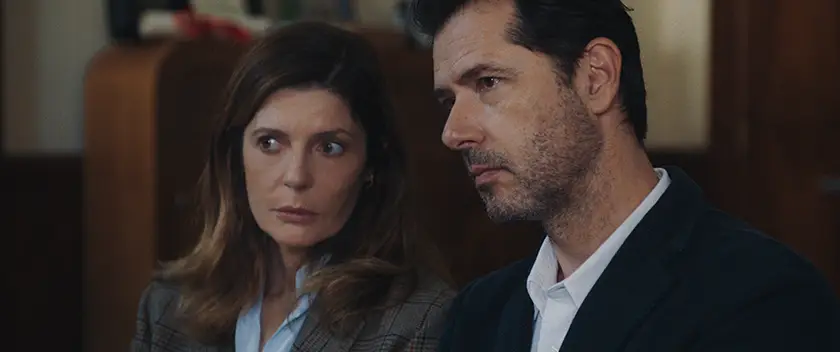
As Leo tries to unpack this, he feels an intense need to reconnect with Tina, the woman he had an affair with at the magazine and the others who knew him when he was young. Leo begins a journey to try and find out the type of man he is by making peace with the young man he once was.
If you’re going to watch a film about a middle-aged man’s mid-life crisis, One Minute to Midnight goes beyond the standard “cheats-on-his-wife” and “buys-a-red-Ferrari” tropes to find something much more introspective at the center of Leo’s identity crisis. Pariser’s exploration of the modern politics of gender and sexuality, along with the excruciating feeling of being listless when you are supposed to know what kind of person you are, creates an extremely intriguing context for Leo to look back at his life through.
The most refreshing aspect of One Minute to Midnight comes from the writing of the film’s female characters. For Leo, the women in his life and the women he comes to interact with throughout the film serve as his moral guardrails of sorts. While they allow him to speak freely about his past, regardless of how crude or cold his past behavior has been, they are quick to point out the ways in which his actions have been inconsiderate to those around him, particularly women. The best part of this dynamic is that Leo actually listens and makes a genuine attempt to use their points of view to revisit his past through a far more enlightened lens.
It’s a hard thing to watch a man learn he should have been looking at women as human beings to empathize with rather than trophies to chase, but characters like Emma and Tina do not let Leo have these grand epiphanies without pointing out what a ridiculously unexamined life he has led. In the most powerful scene of the film, when Leo finally is able to speak with Tina, she warns him, “I’ve had it with masculine self-pity.”
Her sentiments acknowledge the lunacy of Leo’s lack of self-reflection and how tired she, and most other women, are of explaining to men why and how to fix their behavior in order to find peace within themselves. Pariser is careful in his crafting of Leo in that he ensures that when these women do give him the time of day to impart their wisdom, Leo is an active listener who seeks to correct the course of his mistakes rather than exhaust audiences with a defense that is riddled with holes.

Beyond its examination of love, One Minute to Midnight also serves as a nuanced, yet slightly underexplored, examination of ambition as we age. While everyone from the old magazine declared Leo to be a legendary writer who would one day be a famous publisher, somewhere along the way Leo’s star burnt out and he settled to live his life in a creative darkness. He thinks it’s too late for him to chase his dreams and passions, but through reconnecting with the ghosts of his past, he understands that there is still so much life left for him to explore and no reason to avoid doing so any longer.
Unfortunately, the film wanders slowly through other thematic elements without giving them a full breath of explanation, attention or meaningful weight. It is established upon first meeting Emma that she is an activist who has begun to devote her entire young life to politics and trying to reach a state of equality for all of France. In this aspect, the film gets a jolt of political charge that quickly disperses as the plot line is abandoned in favor of exploring more talk of love and identity.
It’s hard to believe Leo would be so far removed from the current news as he seems to be, given his past working in print media, and yet he doesn’t appear to understand the gravity of the issues Paris is facing during his stay. Perhaps it’s meant to show how long Leo has been figuratively asleep in his own life and this experience in Paris has awoken something within him, but if that is the case, the film doesn’t do enough heavy lifting to get those points across in an artful way.
One Minute to Midnight is a story about both accountability and identity, and the ways in which one lends itself to the other. While some thematic elements are not fully cooked and the film takes a moment to get audiences to care for and about Leo, Pariser ends up delivering a surprisingly contemplative look at a man cast adrift and the people who help him find his way back to a better version of himself.
One Minute to Midnight (Un peu avant minuit): Movie Plot & Recap
Synopsis:
In the midst of separating from his partner, Leo learns his father has passed away. Prior to traveling to Italy to deal with his estate, he decides to spend a few days in Paris catching up with his 19-year-old daughter and old school friends, leading him to contemplate his life thus far.
Pros:
- Golshifteh Farahani’s performance is a standout that truly lands the emotional climax of the film.
- It’s a pleasant thing to see a male character hear the women in his life out and earnestly attempt to hear their point of view.
- Pariser’s script creates deeply interesting conversations surrounding identity, love and ambition as you age.
Cons:
- The political commentary throughout the film shows more than anything a complete lack of knowledge Leo has in relation to current events and therefore makes his attempts at understanding their importance in the context of the present landscape futile.
- It feels all of Leo’s curiosity in his past, specifically as it relates to women, is rooted in a desire to absolve himself of guilt or wrongdoing.
- The pacing of the film drags.
One Minute to Midnight (Un peu avant minuit) had its World Premiere at the 2026 Venice Film Festival on September 10, 2026.