
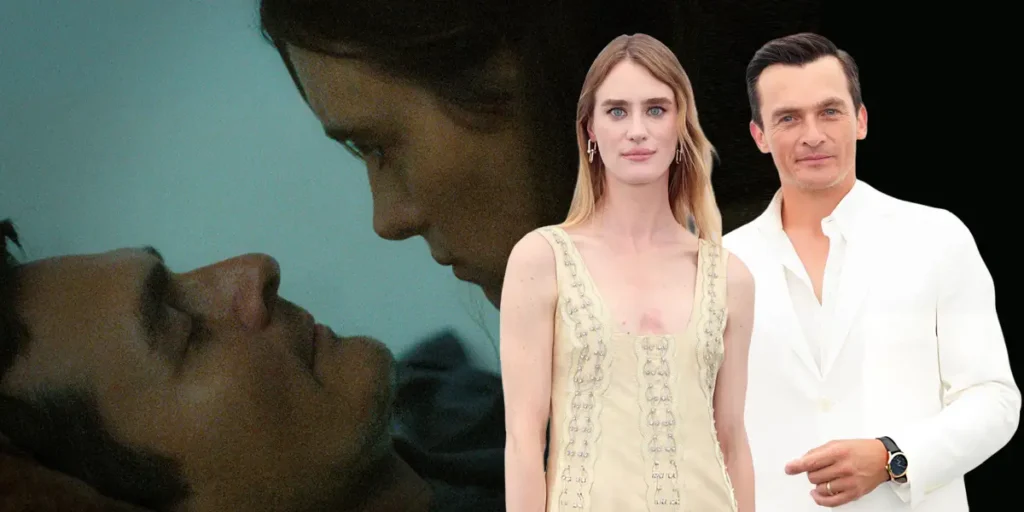
We interview Mackenzie Davis and Rupert Friend about My Notes on Mars, their complex characters, their off-screen interests, working with Lili Horvát, and more.
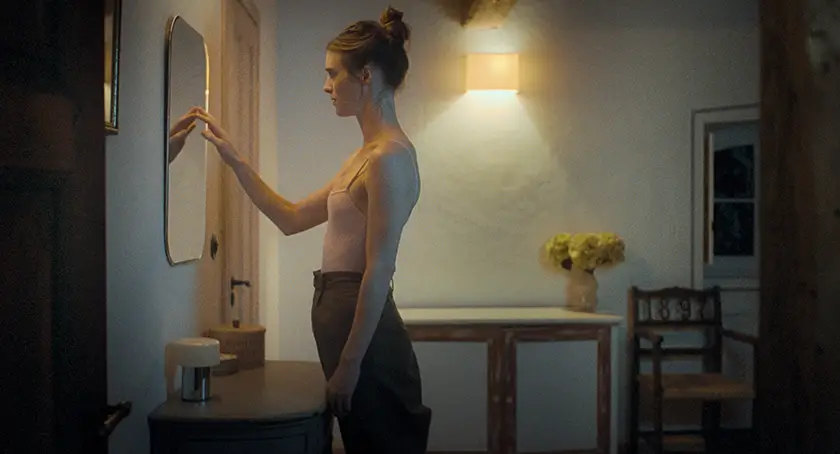
At the beginning of Lili Horvát’s My Notes on Mars, married couple Margot (Mackenzie Davis, of Station Eleven) and Sam (Rupert Friend, of Homeland) already seem to inhabit two very different worlds. She’s a brilliant scientist whose research on Mars has brought her close to proving the existence of alien life, while he’s a horse breeder who has never been able to fully understand his wife or the work that means so much to her. When Margot mysteriously disappears during a hiking trip, Sam remains convinced that she’s alive, until two months later, she’s officially presumed dead. But when a memorial service is held in her honor, something impossible happens: Margot comes back. She looks exactly the same, but she doesn’t remember her past — and, in ways that Sam can’t quite explain, she no longer feels like the woman he married.
What follows is a fascinating sci-fi tale about alien life, doppelgängers, and the mysteries of the universe that’s ultimately an intimate story about two people learning to see one another again. Davis is phenomenal in what effectively becomes a dual performance, finding both subtle and profound differences between the Margot we first meet and the woman who returns. Friend beautifully conveys Sam’s vulnerability beneath his much more restrained, initially unlikable exterior, earning our empathy as we witness him change. Their chemistry makes Horvát’s strange, deeply metaphorical film feel remarkably human, as the relationship between Sam and Margot becomes a way to explore love, grief, identity, and what it really means to know another person.
My Notes on Mars opened the 2026 Venice Film Festival’s Venice Days section, where we sat down for an interview with stars Mackenzie Davis and Rupert Friend. Read what they told us about their characters, the film’s ambiguity, love and relationships, working with Lili Horvát, and much more.
“You Do it With a Good Conductor” – Mackenzie Davis on Finding Her Character, Lili Horvát, and the “Magic” of a Film “Defined by Metaphor”
Mackenzie, you play not one but two incredibly complex versions of Margot in the movie. Was it important for you to find your own interpretation of what was happening, even if the film itself remains ambiguous?
Mackenzie Davis: It’s different, what you need to do your job, from how it matters in the movie. There are practical considerations I need for my job, where I need a logic that I can follow. I have an interpretation of the character that makes sense to me within the movie, that isn’t abstract or a metaphor, and that is actionable, so I’m not just dealing with ideas.
But I don’t think the movie needs to be defined by the logic that made it possible for me to do my job. I think the film is defined by metaphor, and I prefer the magic of that.
Did you have any specific inspirations for how you approached the second Margot?
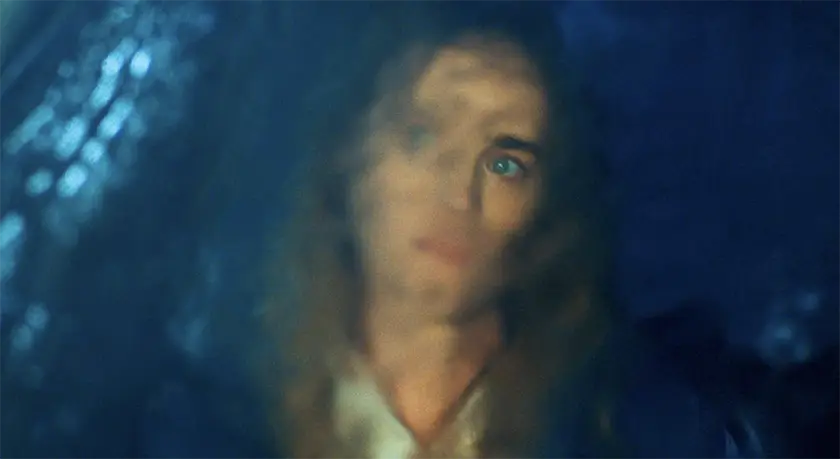
M.D.: Definitely David Bowie. And we talked about Breaking the Waves as well, and Emily Watson. How do you portray guilelessness without being a baby? How do you portray naivety and innocence, or a lack of, I don’t know… Damage, in some way? Or a shield to keep the world from hurting you, if you haven’t been hurt before? And how do you just express pure desire without turning into a sort of baby-wife doll?
There are elements of these things. We used those films to have conversations about who Margot is, rather than taking specific things from them.
So how do you do that?
M.D.: It’s hard. You do it with a good conductor. I’m myself, and I’m interpreting what that means, and then I’m hearing from Lili if my interpretation is her interpretation, or if I need to change it a little bit.
It’s a beautiful movie to look at, but Lili is such a wonderful director with language, and with actors, and with precision. She’s watching the performance to make sure that it’s pitched exactly as she intends it to be, and it’s her conducting of the score that makes it possible.
I was also very intrigued by the first version of Margot we meet, who’s almost the opposite of the second one because we aren’t trying to decode her. When we first meet her, we don’t know anything about her, and you’re mostly on your own, looking at things or reacting to events. And yet, you really manage to convey her sadness and her inner world.
M.D.: There are certain behavioral things that Lili and I discussed that mark the different versions of Margot in the film, and I think those are in what you’re talking about. But that Margot is much easier to play because she’s a whole person with a history that I can imagine. She resembles a woman that I know and can relate to, and she has not just desires, but also her weapons up. She’s hurt, and she’s scared, and she’s defensive, and she has all the things. She can be thrown off guard because she’s on guard.
Whereas the second Margot just exists in the present tense at all times, and that’s more tricky. So I also like the first Margot more.
“The More your Hubris, the Further There is to Fall.” – Rupert Friend on His Character’s Journey in My Notes on Mars
Margo’s inner world and feelings are all over her face, but Sam keeps it all inside and only lets emotion show in specific moments, so at first I didn’t quite know how to figure him out. But then there’s a scene that broke me, when the second Margot is having a medical exam and it becomes clear that Sam is a stranger to her. And then you say, “Do you really not know who I am?” and tears started pouring out of me.
Rupert Friend: Well, thank you. I think anyone who’s ever been in love can understand that it’s a very profound and devastating thing to consider: the idea that your child, your husband, your wife, your best friend would just look you in the face and say, “I don’t know who you are.” It sort of upsets all we think we know as a species.
We’re a tribal group. We seek to make connections, sometimes professional, sometimes platonic, sometimes romantic, but we’re looking for that all the time. And it takes sometimes years to build that trust. Love is another thing that can happen fast, but then has to be developed, and worked at, and believed in. And to have that just taken away… It’s like being stripped naked and sent out into the street. You just feel completely, as you said, vulnerable.
I think it’s something maybe we can all understand, even if it’s never — I hope! — happened to any of us.
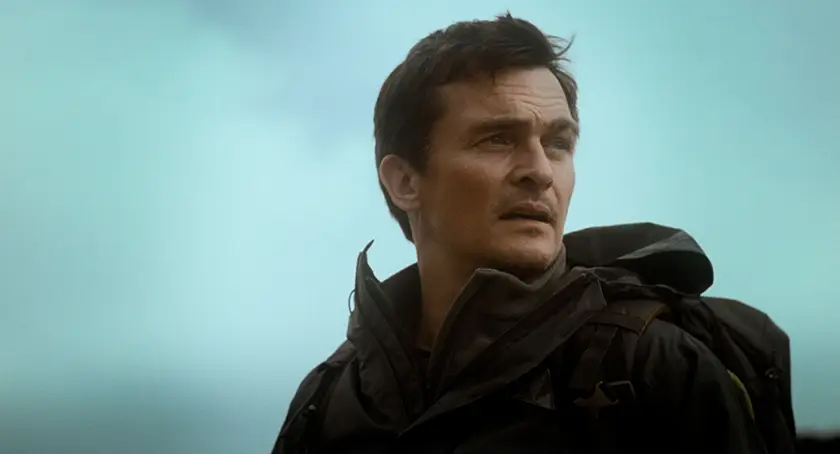
Sam also has very little agency for much of the film.
R.F.: That’s a very interesting observation, and in fact, what you get there is dramatic friction, which is the source of any drama. The character wants something that they can’t have. There is an obstacle; there is therefore a friction. How do they overcome it?
What you see, which I think Lili drew out rather brilliantly, is the impotence, the frustration that is expressed in riding your horse hell for leather, in screaming at the Danube, because it’s like, “What am I supposed to do with this information?” You could kick her out, but he loves her. You could go beat the other guy up [Alex, played Atanáz Babinchak, whom the second Margo is attracted to], but what would that do? There’s a sense of powerlessness, which I think is brilliant, dramaturgically.
At the top of the film, he has decided, “You’ve had a breakdown. You will come to my ancestral home to do my horse thing and my hiking thing.” It’s completely overbearing. It’s complete colonialism. It’s not listening, not being present, not being a good husband. And he has to learn all of that so that, by the end of the movie, we hope there is someone who’s maybe going to be a better partner for Margot — at a high price.
But then, as in any kind of Greek tragedy or hero’s journey, the more your hubris, the further there is to fall. I feel like he has so much to learn when we first meet him, and rightly so. You think he’s just a supporting character, like he’s just going to be on the phone, kind of annoyed. I feel like that is deliberate on Lili’s part, to keep you in the Margot world. So when we’re robbed of Margot, you’re all robbed of Margot, and we’re all going, “Now who do I watch?”
This relationship is almost Bergman-esque, even more so with the added supernatural element.
R.F.: Yeah. I mean, you think about The Seventh Seal, where we’re bringing in death, but obviously Scenes from a Marriage is a reference point. Persona is one of my favorite films.
“I Understood, For the First Time, an Entirely New Movie.” – Mackenzie Davis & Rupert Friend on Relationships and My Notes on Mars‘ Ambiguity
I love that the movie feels like two different films in one. There’s the sci-fi element, with this completely absurd, impossible premise, but it’s also about relationships in a surprisingly realistic way.
Rupert Friend: Yeah. I wouldn’t take any credit for that; that’s entirely Lili. I think what she’s done is she’s drawn a parable, and in parables, you have things working on two levels, right? You have what is happening, and you have the allegory. I feel like that’s what good film can do, and here it’s writ large, because we have this notion of: Who is Margot? What is she? Where did she come from?
I love the idea. I’ve spoken to people just since the premiere in Venice who swear up and down that they’ve got it figured out, and I’m like, “There isn’t a right answer, as far as I know.” But people have said doppelgänger, amnesiac, alien…
Mackenzie Davis: For me as well, the script that I read, the movie that I made, and the movie that I watched at the Venice premiere are three independent things. I thought I understood the script, or I had my logic for what it meant. And then, with the movie that we made, I wasn’t sure I quite understood it all the time. At the screening, I felt like I understood, for the first time, an entirely new movie.
And what a gift, to not have somebody tell you what it is, so that you want to watch it again, and experience it again. It also lets you age with a piece of art. If you read a book when you’re twenty and then read the same book when you’re forty, it’s completely different. Like Elena Ferrante: if you read Elena Ferrante when you’re 19, it really speaks to something profound about female friendship that you’re going through in that moment. If you read that when you’re forty, it’s speaking to something really profound about being a forty-year-old woman who’s had this lifelong friendship.
Those are the sorts of books in particular that I seek out, but it’s the same for cinema as well. I want to grow. I want something to be mature enough to grow with me, and for me to grow with it, and to allow itself to unravel as I have different experiences.
R.F.: And by the way, the film is really quite considerably different from the script, and better. But I thought that the metaphor Lili was trying to explore — which was not overt in any way — came from a simple idea that she told me, which wasn’t crystal-clear in the script. The idea was this: If, in any given relationship, you could go back to the fork at which it started to go wrong and course-correct, would that be possible?
Could you? In any long relationship that’s gone sour, like theirs has when we meet them, you could say, “Well, hang on. When did Sam stop listening? When did he start projecting his own fixings onto the thing? If he could go back and not do that, would she have had a breakdown? Would it all have been great?”
And, of course, the film itself is an allegorical journey for that idea. But really, when you’re in the playing of it, you can’t play an allegory. You can’t play a theme, or a concept, or an abstraction. You’re playing the truth of “What if?”
M.D.: I’d say that’s the tricky part of the film: you meet these people not at the end or the beginning, but kind of in the late middle, where it’s not good. There are so many stories about falling in love, or fewer, but still stories about being in love at the end of your life. But they don’t really include that year where you hated each other, or the two years where you didn’t recognize each other.
I think we are on the precipice of that time when we meet the couple in the film, where it’s like, “It’s grating, and it’s mean, and we’re not going to get divorced, but we’re not happy and we don’t know each other anymore.”
And then there’s this rebirth that happens. “Rebirth” connotes something new and wonderful, but it’s also an identity shift, and identity shifts are very painful — not only for one person, but for another person who finds themselves in a relationship with somebody who doesn’t resemble the person they fell in love with.
I think it’s very romantic in a very mature way, that to stay in love with somebody requires falling in love with them again and again. And each time isn’t going to be the pheromone sparks of first love. The next time, it’s going to be a bit more muscular, maybe. It’s going to take work, and not just pleasurable, date-night work. It’s going to take a lot of ego stuff: allowing somebody to be new to you and not feel betrayed by it.
You mentioned the script being different from the finished film. In what ways?
R.F.: The ending. I only learned what the ending was at the Venice premiere, and I loved it. It’s almost magical realism.
I remember, as a kid, there were stories about Thumbelina and pixies and elves and things, and they would appear, flying on dragonflies, and offer a human character the opportunity to go into the fairy world, but they’d have to forget all their human life and never come back. I always wondered what I would do if that opportunity presented itself. And in some ways, I suppose film is a bit like that.
So that ending is very new. I hadn’t seen — and there was no way to describe in a screenplay — any of the visual, fractal things, the kind of yonic Mars stuff. It was almost impossible to describe that. The jarring, kind of clawing back to love, back to each other, was there. And that was where I thought, “This is something we can really get our teeth into”. As you pointed out, it’s the horror of not being known.
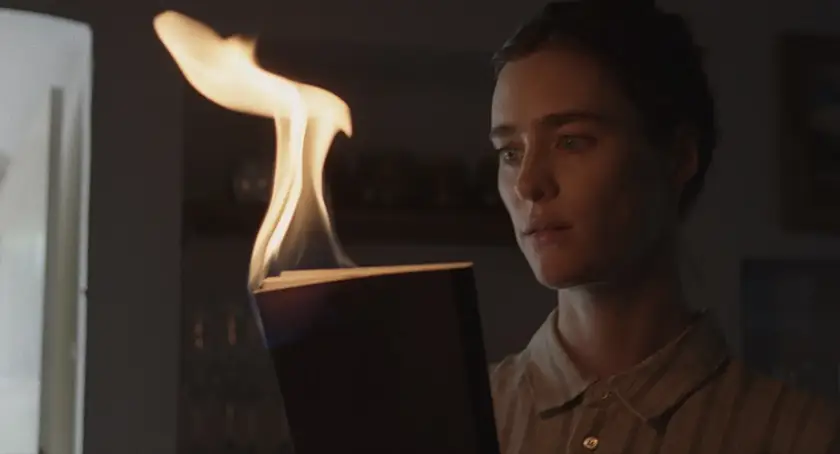
“I Seek Joy.” – Mackenzie Davis & Rupert Friend on the Unknowable, Obsession, and Acting
Do you share a certain kind of fascination with the universe? With the stars and magic?
Rupert Friend: Yeah, definitely with the unknowable nature of the universe we live in. There’s the moment when Margot talks about four dimensions: the idea that we talk about five senses, yet everyone knows that weird feeling that you’re being followed. Well, which sense is that? There has to be another one, at least.
These, to me, are very self-evident truths that we are being quite restrictive in our language about what we know. We just got rid of a planet, a year or two ago! There were nine, and now there are eight. Well, what? That’s just labels. That’s just words. So I’m convinced and fascinated by the things we don’t know.
Mackenzie Davis: Yeah, I’d say I believe in magic as a concept of allowing magic to exist in the world. Allowing things to exist that can’t be explained, and loving them despite explanation.
I think this movie kind of argues for that. What’s it like to be grateful and patient with a thing that you don’t understand, and not need to know every corner of it? Or to own it by knowing everything? There’s a real sort of colonizing that can happen in love sometimes, and a feeling of betrayal if somebody changes and is no longer the thing that you once owned.
I love the argument for ambiguity. It requires a lot of generosity and a lack of ego, to allow someone to be different and unknowable and still love them without needing to claim them.
Margot is completely consumed by her research. Do either of you have anything that you’re similarly obsessed with?
R.F.: Currently, tennis!
As in, playing it?
R.F.: Yeah. [Smiles] It’s one of those things where I haven’t yet found a reason to stop in a day, aside from the desire to be with my family. There’s not a tiredness or a lack of interest. It’s just a very fascinating and frustrating sport that I love.
How come?
R.F.: Frustrating because, when you get to the place where you can actually play tactically, it’s entirely mental, which is extraordinary. As you’re playing the game, you’ll be like, “Ah, I wonder when I’m going to Venice,” or whatever — another thought comes in. And the moment that happens, you’ve lost.
So you’re trying to be a Zen monk and an athlete at the same time, and that’s fascinating and frustrating. It’s like meditating. Have you ever done meditation?
I have!
R.F.: Right. So initially, it’s very frustrating, and then it’s bliss. And then suddenly you go, “How long have I been—?” Ah, there’s a thought [that interrupts the flow].
What about you, Mackenzie? Is there anything you’re obsessed with at the moment?
M.D.: I don’t know… I wouldn’t say that I’m obsessed with movies. I love what I do, but it doesn’t define me in any moment that I’m not doing it, which sounds a bit sad. Maybe it would be nice to be somebody who feels that way, but I feel defined by my relationships. I’m not an obsessive person, especially with work.
I look at people who are married to their job — and I don’t mean working 70-hour work weeks, but people who just live and breathe their vocation — and part of me is jealous that some people have that, because it must be so nice to have such a clear definition in the world. I feel like mine is less clear, but I know that my relationships are the things that define me.
That sounds a lot healthier.
M.D.: Probably long-term, but I always like to think that whatever I’m doing is wrong and something else would be right. [Laughs] You know? It’s just like, [ironically] “Maybe that’s the way you should be alive?” [Shrugs and smiles] If something is the way I do it, it’s probably not the key to life. It’s probably the way somebody else is doing it that would be the key.
I love acting, though! It doesn’t give me a lot of identity, but it does give me joy. I find it challenging, and, at its best — in an “I’m always chasing that dragon” kind of way — you’re intellectually challenged. It requires an intellectual rigor to understand the world that you’re in and how you fit into it, how you’re going to decode this. Decoding a script feels almost like a math problem: “Okay, how does this equal this, and this equals this? And then where’s the illogic, and how does the illogic actually work to make this a more interesting picture?”
So you need that, and you need collaborators who make going to work every day, if not fun, at least interesting and rich. This is such a long answer to say: I seek joy.
“Things That Are Great Change With You.” – Mackenzie Davis & Rupert Friend on Curiosity
Mackenzie, this film revolves around your character’s “Notes on Mars.” Do you journal yourself?
Mackenzie Davis: Yeah, I do write.
Do you ever look back at your journals, in the same way that you revisit books?
M.D.: I do it to be mentally sane. I think when I was younger, I used to journal, but I was always — it’s such an actress-y thing — doing it while imagining someone reading it one day. And so there was always a performance in it, of being like, “They’re gonna love this. Future — future whoever finds this notebook is gonna have a ball.” [Laughs]
I love that you mentioned Elena Ferrante just earlier. Are there any other books that you found yourself going back to in your life?
M.D.: Oh, with Elena Ferrante, I was thinking of something that spanned generations, that I’ve read twice and that had a really different meaning to me the second time. But, for example, if you read Kurt Vonnegut when you’re sixteen, you think, [in a funny voice] “This is so funny and profound, dude!” And then you meet Kurt Vonnegut when you’re older and you’re like, “This beautiful man!” Things that are great change with you.
So very true!
Rupert, just now, before we started the interview, you were telling us that you’re currently learning Italian. Do you like learning new things, or is it something you mostly have to do for the roles you play?
Rupert Friend: Most of the things I’ve done that I have really gotten a lot of satisfaction from, I’ve done out of no reason other than curiosity. There’s been no money and no career advancement: it’s just the thing [itself that fascinates me]. And that includes horse whispering, studying Italian… All these things have been very rewarding, and sometimes, as in this film, you get to ride a horse, and then it’s a little bonus, but it wasn’t the reason why I did most things in my life.
What drew you to horses in the first place? I’m a horse person as well.
R.F.: Oh, really? Oh, cool. I got really fascinated by the idea of communication without words. At the same time, I got into horse whispering and dance. I can’t dance, but watching dance — watching art that did not require words to be effective — and communicating with another animal without words was beyond rewarding. I’m sure you know.
It’s one mind—
Rupert Friend: One mind and two bodies, yeah. You’re sharing the four legs — or six, if you’re on the lead.
When I was learning it, my teacher was explaining the trust element, and after a lot of work, we ended up going up a mountain and camping out with our horses, up into the snowline. She was explaining that if you’re up there on a steep mountain and you say to the horse, “Put your right foot there,” and the horse can’t see that that’s the safe place because he can’t see down there, he just needs to feel it. If he trusts you and puts his foot there and it’s good, it’s like you did it together, because you can see and he’s the body. It’s an extraordinary symbiosis.
There’s a joke that, at some point in every actor’s career, they go to a casting and are asked, “Do you know how to ride a horse?,” and of course they say yes, even if they don’t. Have you ever said you could do something just to get a role and then had to learn it?
Rupert Friend: You know what, things have changed in the acting world. I think when I started, there was far more time to prepare, so I would be given the time to learn a new skill. Now, oftentimes, people will say, “Can you get on a plane on Monday?”
Fortunately for me, having been doing this for twenty years, I’ve accrued a fair amount of skills to a proficient level — not expert, but proficient — so when they said, “Can you just get on this horse and go?,” I said, “Sure.” But if they said, “Can you play the saxophone?,” no. If you give me two weeks and I practice every single day, I might be able to get something going. [Smiles]
Part of the joy of this job has been being exposed to so many different skills and disciplines, and oftentimes having the greats teaching you. “Fake it till you make it,” I think, is what you’re talking about. And certainly, I would counsel a young actor: if you have just enough time, say yes and work your a*s off. Just say you can ride the horse, and then every single day, all day, you ride. And then on the first day of set, good luck to you. But don’t say yes and then just be lazy, because you’re gonna get thrown.
Mackenzie Davis & Rupert Friend on What’s Next
Mackenzie, you have two upcoming TV projects that are coming out quite soon. Can you tell us more about them and the characters you play?
Mackenzie Davis: Yeah, they’re both on Netflix. One, which is called Below, I shot in Newfoundland last year. It’s about a small fishing community in Newfoundland, and that’s coming out in October. It’s kind of Jaws-like. Is it horror? Yeah, sort of horror-suspense, but it’s also quite funny.
Newfoundland is a magical province in Canada and hasn’t been represented in mainstream pop culture very much, but it has an incredible sense of humor and incredible artists, and the dialect and accent are incredible. So there’s a lot of color in the show, and it’s really good. I’m playing a marine biologist who is helping to solve a mystery.
Another scientist!
M.D.: Yeah, always scientists. It was Scientist Summer last summer. [Laughs]
The other one is a Scottish show — it used to be called The Undertow; I believe it’s called The Twin now — that takes place in the Scottish Highlands. It’s with Jamie Dornan, and it’s about a murder. I’m playing a Scottish woman, the wife of a man who gets murdered, and the story is about her reconnecting with his twin brother.
You’ve both directed short films in the past. Is directing something you’d like to pursue further, or do you prefer to wait until you find a project that feels right?
M.D.: I’m very interested in directing, and I loved making my short film [2023’s Woaca]. I have a rhythm that is mysterious even to me. I’m like, “I wish that I was directing a film right now,” but I want to write it, and it just takes me a long time.
Ideally, I would have already had something ready to go after I finished that film, but I don’t know. I just had a great time, loved making it, and I’m going to make another one when it all comes together. I’m just kind of a slow person.
Rupert Friend: There are quite a lot of things in the works for me. There’s a plan, but I’m a bit superstitious about talking about it. I’d rather be sitting here after you’ve seen something and you can tell me truthfully what you think than talking hypothetically about what might be.
Thank you so much for speaking with us!
This interview was edited for length and clarity.
My Notes On Mars had its World Premiere at the 2026 Venice Film Festival on September 2, 2026. The film will be screened at the BFI London Film Festival in October.
Header Credits: Mackenzie Davis and Rupert Friend attend a photocall for the movie My Notes on Mars at the 23rd Giornate Degli Autori during the 83rd Venice International Film Festival on September 02, 2026 in Venice, Italy. (Maria Moratti/Getty Images) / A still from the movie (Courtesy of the Venice Film Festival)