
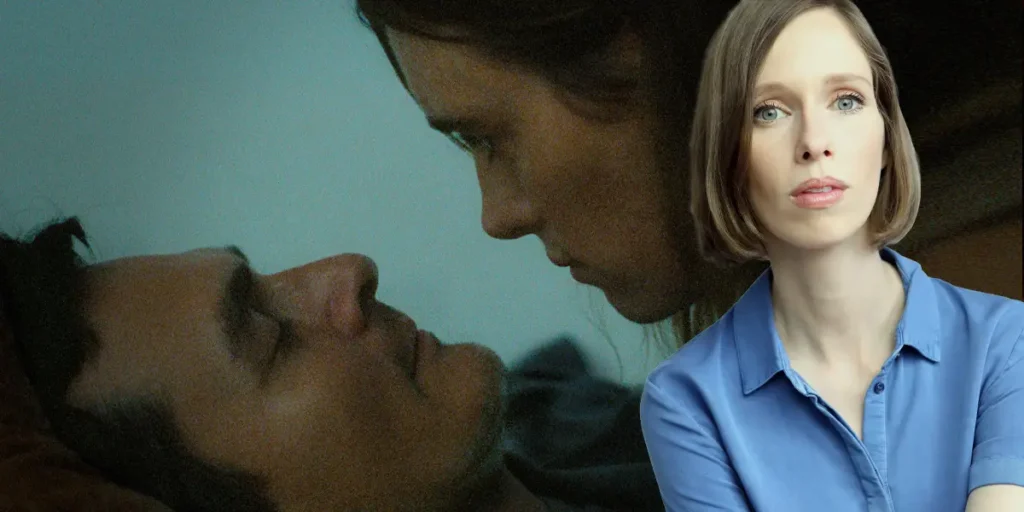
We interview Lili Horvát, writer-director of My Notes on Mars, about the film’s themes and characters, filming on 35mm, casting changes, her creative process, and more.
When brilliant scientist Margot (Mackenzie Davis) vanishes on a hiking trip, at the beginning of Lili Horvát’s My Notes on Mars, her husband Sam (Rupert Friend) insists that she’s alive, despite all evidence to the contrary. Two months after the disappearance, Margot is officially presumed dead, and a memorial service is held in her memory. Besides her husband, several scientists and mathematicians are in attendance, as Margot was so close to proving alien life on Mars: she dedicated her whole life to her research and spent her last months obsessing over a final detail that she somehow couldn’t grasp. Just when everyone is ready to make peace with this loss, something unexpected takes place: Margot shows up at her own wake. Or, rather, she looks like Margot, but she doesn’t feel like Margot, in ways that Sam cannot understand.
With this incredibly fascinating film, writer-director Lili Horvát (Preparations to Be Together for an Unknown Period of Time) tells a hypnotic sci-fi story about doppelgängers from Mars that’s really, at its core, about a couple that’s falling apart. As things get more incomprehensible for Sam, and more intriguing for a Margot who can’t even remember her past and yet finds herself so fascinated by her present, Horvát cleverly asks us universal questions about relationships: are we capable of being in a relationship with someone without trying to change them? And more importantly, can we love another person even if we don’t fully understand them?
At the 2026 Venice Film Festival, where My Notes on Mars opened the Venice Days section, we sat down for an interview with Lili Horvát. Here’s what she told us about her creative process and inspirations, how the movie came to life, shooting on 35mm with limited film stock, casting changes, the film’s themes and characters, the Venice premiere, and more.
Lili Horvát on How Her Film Comes to Life and the ‘Fragment of an Idea’ that Led to My Notes on Mars
Thank you for this fantastic film!
Your movies have such a distinct visual and narrative identity, and watching them can be such a visceral experience. What do these stories look like in your head, before you start shooting?
Lili Horvát: One of the things I love the most about filmmaking is that you get to spend time with a film, as you shape it and crystallize it. I can’t tell you that when I first had the idea, I already saw the whole film in my head. I don’t pick my subjects: I just see a fragment of an idea, and I don’t know where that will lead me. It’s those unexplored grounds that excite me most. And then gradually, I try to visualize the whole thing. It helps that I’ve been working with the same DP [Róbert Maly] for a long time: we were classmates at film school! We watched films together for the first time, saw paintings and photos together for the first time, and that’s an incomparable experience.
Oh, how wonderful! What was the ‘fragment of an idea’ you had that led to you making My Notes on Mars?
L.H.: I had a fragment of a scene, really: a woman who goes missing in an accident miraculously reappears the day of her own memorial service, and then she mistakes another man for her husband. That was the core idea around which the story would start to develop. And then, step by step, I started to construct this marriage story, which I think argues for great love, but also shows the eternal limits in getting to know the person we love.
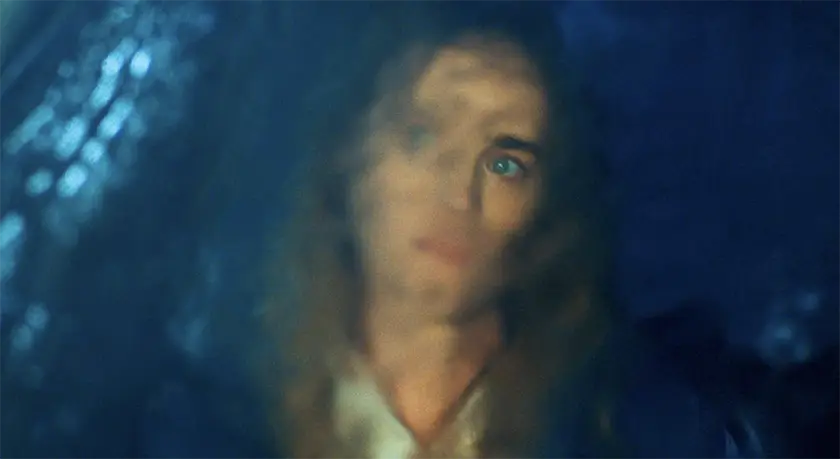
Then we created the visual imagery, so of course, by the time we stepped into the shooting phase, we already knew exactly what we wanted. I knew that I wanted this metaphorical layer to be present, but I felt that the script would do that justice anyway, because it’s already in the narrative. So in terms of both the acting and the visual approach, we [didn’t approach it in a] stylized way, as we wanted it to be as raw and emotionally relatable as possible.
Did the sci-fi element in the story feel natural to you from the outset?
L.H.: Yeah, the ‘scientist’ aspect was always going to be there. This film talks a lot about how [in a relationship] we let each other do the thing they need to do [in order to feel fulfilled], and that’s why I picked an exceptionally talented scientist to be the protagonist. And then, as I was wondering which field to give her, I ended up with astronomy. It came gradually, the whole Mars thing. I liked that we could build a metaphor around it, as Mars used to be a distant planet of lust and desires – and war too.
But as science progressed, it has now become more realistic for Mars to be a terrain that humanity can conquer and would subsequently – probably, hopefully! – treat as something that should be protected.
I felt that we could build a parallel about human relationships around this.
You can definitely feel that parallel in the movie. Your films also feel so meticulously crafted, narratively, because of all the clever symbolism – maybe almost in a scientific sort of way? – but there’s also so much poetry in the way you tell these stories.
L.H.: Oh, that’s lovely to hear. I don’t really have a talent for science, but I was raised around literature a lot, and also my father, who’s been maybe the biggest influence in my life, was very good at science. I was fascinated with it, so maybe that’s why it feels that way? We used to observe the stars with an amateur telescope when I was a child, so I had this experience with him.
“I Could Suddenly Breathe Again.” – Lili Horvát on Casting Mackenzie & Rupert, and Shooting an Empathetic ‘Ghost Story’
That scene of Margot showing up to her own memorial is so strong. It reminded me of Capricorn One, where something similar happens but the ‘scientist’ is an astronaut who was supposed to have died on a trip to the Moon. But in that film, it’s the resolution; here, it’s a beginning, in a way.
Lili Horvát: Yeah, I think those tropes, and those well-known genre elements, can be very helpful when you’re making an arthouse film. And in this particular film, it helps make it a ghost story. Of course it’s not up to me to interpret it – it’s up to the audience – but the first level of interpreting it could be that it’s all a dream that’s taking place in Sam’s head.
I actually had a very moving conversation with Rupert, halfway through the shoot. Someone in the crew was telling me that this shoot was going so unusually fast, and I said that it felt like that to me too: it was already the fourth week and yet it seemed like the second. Rupert was there too and I asked him, “What about you? What does it feel like to you?”. He stayed silent for a little while, and then he said, “I don’t know… It’s been like a fever dream where you don’t know if you’ve slept for two hours or two weeks.” I felt so touched, because in a way, this whole film is Sam’s fever dream!
It’s a very interesting journey for Margot too, especially from a physical point of view. When she comes back, after the memorial, it feels like she has to reconstruct human desire from scratch. How did you approach that part of the narrative? Were you conscious of avoiding similarities to films like Poor Things, for example?
L.H.: Yeah, there’s a connection with Poor Things, but we didn’t spend a lot of time thinking about how other films did this. We felt that this film had such an empathetic view on its characters, and that aspect would already make it different. It was an immense joy for me to work with Mackenzie on this character arc, and it was so inspiring.
We had a rehearsal week before the shoot, so we were already quite there when we started, but then we did some fine-tuning during the shoot too. Because of the production schedule, we couldn’t film in chronological order, which is usually something filmmakers complain about, but on this project, I came to love this. We were shooting from the beginning to the middle, and then back to the beginning again; it gave us an opportunity to play with time. We were also able to fine-tune Mackenzie and Rupert’s performances, based on the footage we had shot. They were both great allies in that.
Greta Lee and Andrew Scott were initially meant to play Margot and Sam, but they were replaced by Mackenzie and Rupert before production. Did the casting change influence the final version of the film at all?
L.H.: I lost the previous cast due to scheduling conflicts, and of course that was a very desperate moment: years of work had gone into this, and the team was already booked for a summer. It was a very, very bad moment for us. For the next few weeks, it was crazy; we didn’t know how to handle this. And then, I remember having this very calm and inspired moment when I just said, “Okay, Mackenzie Davis and Rupert Friend.” It was such a strange, “wow” kind of moment, and then I could suddenly breathe again.
Luckily, they got on board very quickly, and they loved the script. Then, we talked over Zoom, and they said yes almost instantly. It was all so easy: I didn’t have to push for it, it just happened. And from then on, I couldn’t imagine anybody else doing this. The very first version I wrote, it felt as if I would have written it for them.
That’s amazing.
Yeah. [smiles]
My Notes on Mars was Shot on 35mm With Limited Film Stock
My Notes on Mars is a very intimate story at its core, but nature also feels very present in it, particularly those big, spectacular views.
Lili Horvát: I think it was important for me to have those big sights – you know, the big river, and the mountain – so that we’d have a background for this story that showed things that are beyond man’s control. The horses were always meant to be there too, as a symbol to show that Sam is Earthbound, while Margot is somewhere in the sky. I wanted to capture, both visually and viscerally, these two distant worlds gradually growing closer to each other.
Did you always know that you wanted to shoot on film?
L.H.: Yeah, absolutely. We had huge budget constraints, so our producer initially told us that they couldn’t allow it, but she eventually changed her mind, because she understood our concept. She told us, “Okay, if you guys insist… You can have 20,000 meters”, which is a very low amount. It means that you can basically do two or three takes of each scene and then that’s it, so it’s very little.
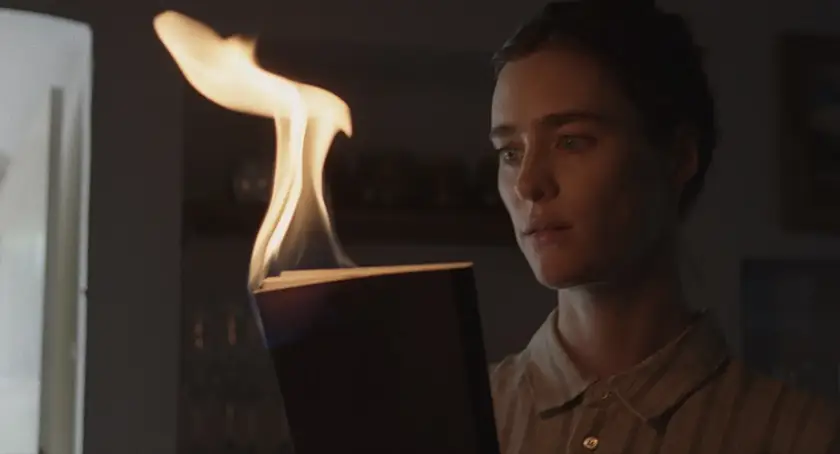
But then it turned out to be for the best! I think the mystery and the imperfections of film, as a material, helped show these ‘secretive’ parts of the movie much better than very sharp digital images would have. And when we were making it, it also created such a strong focus in the whole team. How will we end the film if we run out of film stock? This idea made the whole team so focused – especially the actors, of course: they accepted it really joyfully, like a sports challenge. And the rest of the team too, from the DP to the focus puller and everyone else: nobody was looking at their phones on set.
Oh, wow. These kinds of restrictions can be very creative.
L.H.: Yes! I also had to get rid of some shooting days, for budget-related reasons, but then, I think it only made the script stronger, because you don’t have the infinite possibilities you’d have with digital cameras.
Lili Horvát on Sam and Margot, David Bowie, and Venice Reactions
I really love the evolution in the character of Sam: the way he unravels is subtle but intense, and also relatable despite the absurdity! One of my favorite scenes is when he’s basically mansplaining Margot’s own memories to her.
Lili Horvát: I wanted this film to be a real two-hander, which is something I’ve never done before. Obviously, Mackenzie’s part is such an attractive role for an actor: she gets to play two different versions of her character, and she has this big arc. But then I realized that the ‘guy’ character could be just as interesting: he could also undergo a huge transformation, only in a different way. For example, Sam’s relationship with the audience shifts throughout the film: at the beginning he’s not too likable, and you side more with Margot. But then, you gradually come closer to him. I found it really fascinating to construct it all with Rupert.
Like you said, Margot must have been such a fascinating role to play, because she’s essentially two characters. Did you have any inspirations when you were writing Margot and her doppelgänger?
L.H.: We mainly used the trope as a tool to talk about how two people in a long-term relationship can embrace each other’s changes and individual growth. Still, if there’s a particular film that influenced this, it’s The Man Who Fell to Earth, the Bowie film. And also, Bowie himself: I listened to him a lot while writing this.
You mentioned being friends with DP Róbert Maly since university, and discovering films together. Were there any movies that shaped your way of working together?
L.H.: Well, I think you can find resemblances in my work to Hitchcock, Kieślowski, or even Tarkovsky’s work, but these aren’t the films that meant the most to me. The human mind works in complicated ways! [smiles] I think what had the biggest effect on me were those big classics that I watched for the first time when I was very young: Cassavetes, early Truffaut, Antonioni… And David Lynch, of course. Your mind soaks it all up, and then it just pops up eventually.
Did anyone come up to you with crazy theories about the film after the screening in Venice?
L.H.: No, but what was really interesting was that people would come to me and start talking about their own relationships. A lot of people told me things like, “Oh, I started to think about this aspect of my own marriage.” I was super happy about that! I didn’t expect that, but that’s the most beautiful thing that can happen with a film.
Thank you for speaking with us!
This interview was edited for length and clarity.
My Notes On Mars had its World Premiere at the 2026 Venice Film Festival on September 2, 2026. The film will be screened at the BFI London Film Festival in October.