
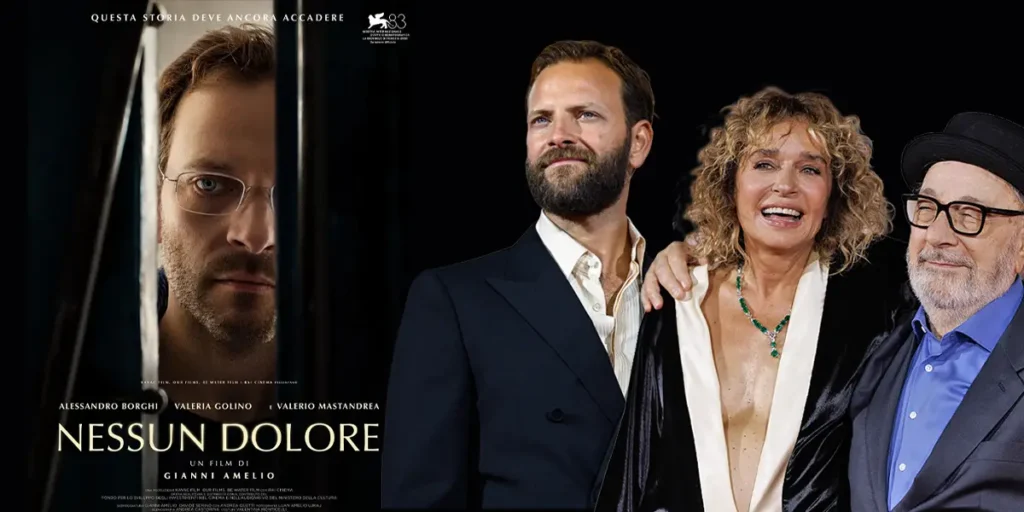
We interview Gianni Amelio, Alessandro Borghi and Valeria Golino about Nessun Dolore, its themes, Amelio’s filmmaking process, a near kiss, books, and more.
“But out of all these books, how many have you read?”, Davide‘s (Alessandro Borghi) most loyal customer, Elsa (Valeria Golino), asks the bookstall owner one day. “Don’t tell anyone, but I’m very ignorant,” he tells her, explaining that he doesn’t actually read a lot, but he likes recommending them to people – not that anyone ever buys them, as the opening scene of Gianni Amelio’s Nessun Dolore painfully reveals. Elsa has just brought him more second-hand volumes to sell, and as always, she doesn’t want any money. “I envy you, you know? I’d like to do your job,” she says, smiling. Davide takes her at her word, asking Elsa to cover for him for thirty minutes while he gets something to eat. She enthusiastically agrees, and Davide leaves the Roman square, only to have his day, and his whole existence, turned inside out.
On his way to the cafe, a complete stranger stops Davide, who, thinking he’s asking for money, immediately looks for his wallet. But the man wants something else – for Davide to take the young North African boy he’s trying to “deliver” to him. “You must follow that man: never lose him. He’s your father,” he tells the child when Davide tries to leave, and the boy complies, silently following our protagonist around. Completely taken aback, Davide does everything he can to get rid of him, but his actions eventually lead to an accident that sends the boy to the hospital.
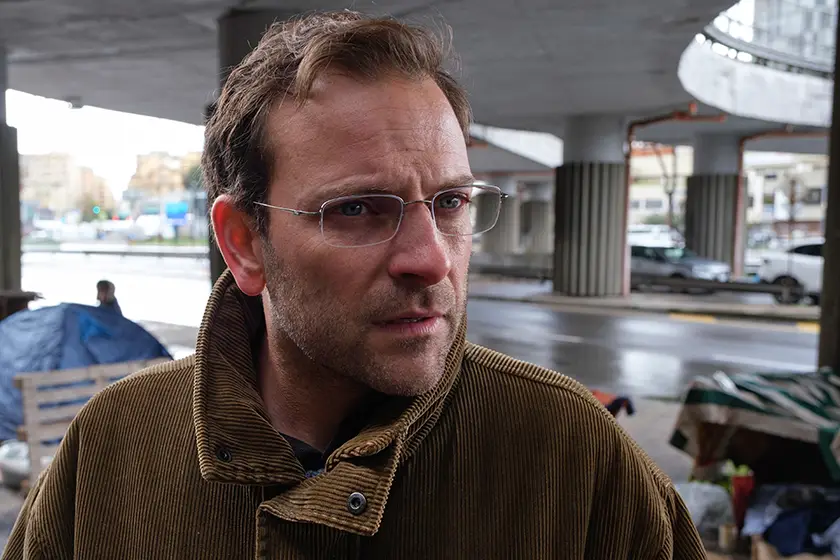
A bewildered Davide follows him there, where he finds an ally of sorts in morgue attendant Michele (Valerio Mastandrea) but soon finds himself even more entangled in the boy’s fate. To further complicate matters, he runs into a pregnant teenager named Aminah (Beïdja Yahiaoui), who’s just arrived from Algeria on a migrant boat and was refused shelter at the hospital for the night. Still in shock and with very little control over his own actions, Davide takes her in, which soon leads to his apartment being completely taken over by homeless people. Eventually, Davide begins to unravel, but even when his predicament is at its most unbearably surreal, he never becomes completely hostile.
Is he moved by generosity or crippled by guilt? That’s the question at the core of Nessun Dolore, where director Gianni Amelio uses an absurd premise to hold a mirror up to society and ask timely, complex questions about immigrants, and human beings as a whole. Alessandro Borghi is superb as a protagonist who’s overwhelmed by contrasting emotions, and though Valeria Golino has less screen time, her character, and her chemistry with Borghi, help give more layers to this story.
At the 2026 Venice Film Festival, we sat down for an interview with Gianni Amelio, Alessandro Borghi and Valeria Golino. Here’s what they told us about the film’s characters, Amelio’s filmmaking process, working with each other, immigration and political hopes, the importance of books, and more.
“There’s A Part of Me in Each Character” – Gianni Amelio on His Protagonists and How “Women Are Stronger Than Men”
Thank you for the film! Can you tell us more about your main characters?
Gianni Amelio: I would say that there’s a part of me in each of these three characters. I identify with Davide because I share his feelings. At the same time, I also understand Valeria’s character, Elsa, because I recognize in women a strength that perhaps we men don’t have: the perseverance to overcome both the mistakes and the pain that a woman encounters throughout her life. Women are stronger than men when it comes to overcoming things. I remember my mother, who, when she lost a two-year-old daughter, found the strength to carry on.
Valeria Golino: [to me] Imagine! He never told me that.
G.A.: Elsa is very important because she tells us about a somewhat reckless youth: she ran away with a professor who was older than her and broke up a family. In the film, she acknowledges that she made a mistake, but she makes up for it by devoting herself to caring for a man who is no longer able to live independently [we learn more about Elsa’s family situation at the end of the film, when we follow her to her house]. In this sense, she’s similar to Davide, but she’s also more grounded. She’s the one who asks Borghi, “What good are you doing by taking one person into your home, or two, or three, or four? There are millions who are still out there, and you’re only hurting the ones you take in.” I think women also have an extremely strong, practical sense of life.
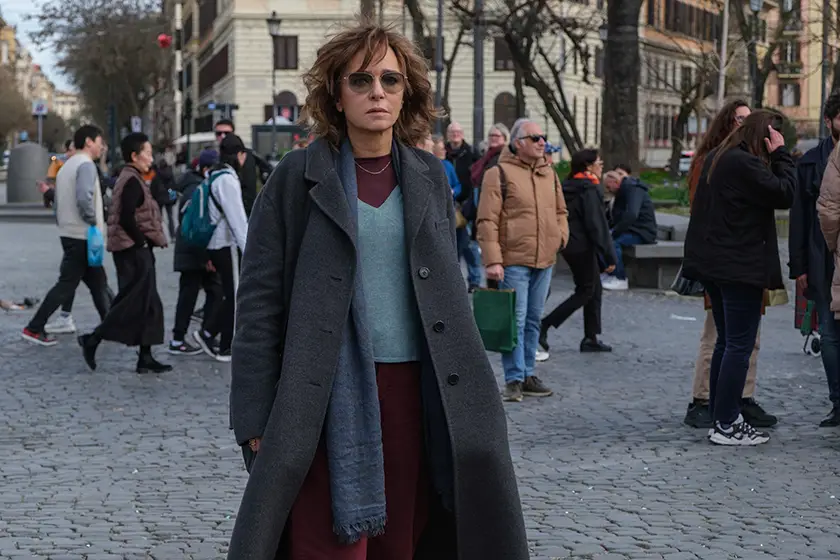
Then there’s the third character, Mastandrea’s. He’s a lonely man, but he finds strength in his children, and he can only understand Davide through his sense of fatherhood.
One thing I thought was very interesting in the film is that all your characters continue to speak their own language even when the person they’re talking to clearly doesn’t understand them.
G.A.: It’s a matter of intellectual honesty towards the characters, the subject matter of the film, and the reality I’m portraying. Obviously, today I couldn’t make cinema the old-fashioned way – a kind of cinema that doesn’t exist anymore, where, for example, Native Americans, the Sioux and the Cheyenne, spoke English, right? Everyone has to speak their own language because it’s part of their identity.
“This Motherf*cker!” – Valeria Golino and Alessandro Borghi on Gianni Amelio, Shooting a Key Scene, and Kissing Each Other
What was it like to work together? What’s the first memory from the set that comes to mind?
Valeria Golino: I did kiss Alessandro Borghi… Even if it’s not in the movie! [There’s a scene where Davide and Elsa take shelter from the rain in the bookstall, and the two characters grow closer.]
Alessandro Borghi: Hey, at least we did kiss! [Both laugh]
V.G.: Yes, we did. And of course we immediately had Gianni Amelio screaming, “WHAT ARE YOU DOING? It doesn’t look good! You look too cold!” We were like, “No, we’re not cold. We’re kissing! It’s lovely!” And he was going, “I don’t like it! I don’t like it!” [laughs] Eventually, he took the scene out, and we were kind of puzzled. But you know what? He was right!
He said, “Don’t kiss anymore; just look at each other.” And he left us looking at each other. How many minutes?
A.B.: Oh, I don’t know, 10 minutes?
V.G.: Probably, yeah. And I was hating him. I kept thinking, “How can I look more…?” And then when I saw it, I thought, “This motherf*cker!” It’s that great mind that Gianni has, because that tension is so much better than a kiss.
A.B.: The curious thing is that if we had kissed, and if it had made it into the movie, it would have been the first kiss in a Gianni Amelio movie, because there are none in his whole filmography.
How can that be?
V.G.: He never shot anyone kissing! And he kept saying to us, “Maybe this is the time it’s going to happen!” And then, he didn’t keep the scene! Hey, at least we did kiss, and that was memorable for me.
A.B.: For me as well.
We’ll see it on the DVD!
A.B.: [laughs] In the bloopers!
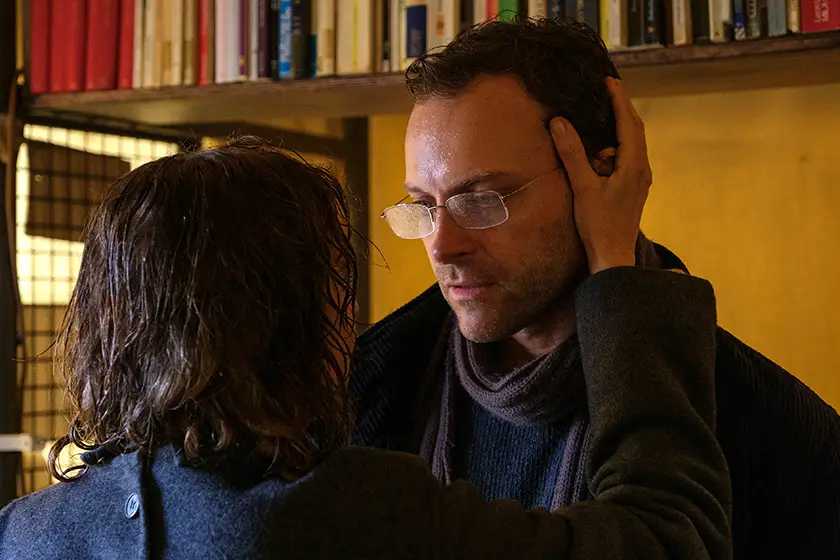
V.G.: I think Gianni burned the thing! [laughs]. But for me, many moments in the film were quite— They didn’t even have anything to do with me, but seeing Gianni and Alessandro work together was so memorable. It’s a very strange thing that happens when a director and an actor find their music.
You can see that there is something between them, whether they know it or not. I think Gianni knows it! He knows it, but he doesn’t care… But he likes it. As I’m also a director, I can see that when Alessandro, who is a fantastic actor, is with Gianni, something else happens to him. It’s like—I don’t wanna start naming names, but for example, take Scorsese with De Niro. De Niro is an incredible actor, but with Scorsese, he goes boom! Or Fellini with Mastroianni. And I think he’s—[looks at Alessandro] Sorry, I know I embarrass you [when I say these things]—I don’t care that the film wasn’t screened in competition: you’re my Best Actor Golden Lion.
***Spoilers from here***
Yes, I see what you mean! Alessandro, you’re so good in this movie! There’s a scene in particular, when the boy gets run over by a car as your character tells him to go away, where your performance is just incredible. You have such a physical response to it all.
A.B.: What you see in the movie wasn’t exactly in the script from the beginning. From the first time I read the script, I kept asking Gianni, “Do you have any idea of what we’re gonna do in that moment?” And he kept saying no. As in, “I don’t know, I have to think. I need the geography: I need to find the right street.” Which is true: you can have an idea in your head, and then maybe the space is completely different and you have to rethink it all.
So he chose the street, and then he told me: “All right. I want you to completely lose your breath, play with the cars, fall around… Let’s see what happens.” We had a lot of problems during the shooting—problems with traffic, or the extras looking elsewhere…—and with Gianni, if [even a minor thing is out of place], he’s going to go there and say something about it.
So I had to shoot that scene ten times.
Oh wow!
A.B.: Every time, it was like, “Ale, it was beautiful, but we have to redo that because there was one person standing 100 meters away from you.” I think the take that’s in the movie is like the fifth or sixth take, but I don’t remember the others because in that moment— It’s really a process. There’s no noise; there’s nothing. There’s just one person who’s going to get run over, and then you have to process everything.
***No more spoilers from here***
V.G.: And you have to invent your horror. That happens to actors very often.
And Gianni… He’s 80-something, but there’s a very disciplined recklessness in his filmmaking. It might look disordinato—out of order, you know, but it’s never really that. That’s why I find Nessun Dolore is a young movie. It’s full of contradictions, and it “puts itself in danger” all the time. It’s such an experience to see Gianni at work. It really is.
“You Have to be Prepared to Completely Change your Lines.” – Alessandro Borghi on Life, Acting, and the Rewritten Scenes in Nessun Dolore
For the whole movie, Davide is under so much stress, and for a lot of it, guilt also plays a big part. How did you approach this?
Alessandro Borghi: The thing that happened between between me and Gianni, I think, is really connected to life. It’s not about acting, or thinking about something, but about being something, you know? I have a lot of memorable moments from the set, but many of them are about how stressed I was about making the movie. Because I really felt that: I didn’t know exactly how to handle those kinds of emotions, the sense of guilt, the social responsibility and all that stuff.
At some point I said, “Okay, Gianni, we’ve got to figure out the best way to tell this line, to go through this process, to get to that point.” And 90% of the times he was like, “All right, we’re going to find it, and we’re going to rewrite the whole scene ten minutes before the shoot.”
And that’s what happened. Sometimes it was something big, you know? Maybe you’re supposed to shoot a scene where you’re having dinner with people and everyone is smiling, and ten minutes before, Gianni’d be like, “Okay, there’s no dinner anymore, you’re gonna mess up with everybody, and you’re gonna be disappointed.” Every time, you have to be prepared to completely change your lines. And the only way to feel comfortable in that situation is to stay focused on who your character is.
With every change you’re going to make, you have to be prepared to do that as the character. Sometimes life and acting are part of each other in some way, so it was complicated, dealing with that little boy. I have a little boy at home, who’s three years old. Every time, I was thinking about him and trying to escape to [more positive] thoughts, but it wasn’t possible for me.
Also, my house in the movie is the door next to my house.
Oh, interesting!
Yeah, it’s next door. At some point, I didn’t know where I was exactly, emotionally and physically. My fiancée was really the one who had to deal with that complication, because you don’t know what person is going to come out of one door and into the other.
I’m really happy to have been in this movie. After the screening in Venice, something different happened. It was my second screening, and I saw the film in a very different way. Maybe it’s because I’m always really emotional in Venice, or because it was with Valeria, Gianni, and all my friends, but it was different. I recognized something in the movie that was really connected to this sense of pain, and to the importance of being able to have a rebirth after hitting rock bottom.
There are a lot of themes that I really love in this film, and the only way to achieve that kind of [performance] in the best way possible is to lose yourself in the character and story completely. And you can do that only if there is something like Gianni in front of you.
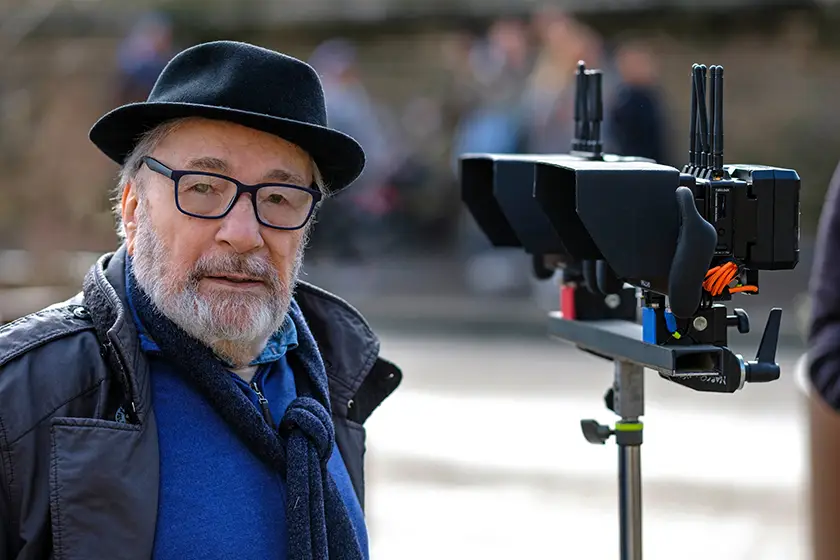
Gianni Amelio on Political Hopes and the Future of Books
That line Elsa says to Davide, “What good are you doing by taking one person into your home, or two, or three, or four?” – I feel it’s at the core of the film.
G.A.: I made this film to reflect not on the impossibility of changing things, but on the possibility of changing them. It’s true that, as an individual, I can welcome Aminah and invite her into my home if she needs it, but I can’t invite thousands of Aminahs.
Welcoming someone is a personal act that comes from our feelings. Integrating thousands or millions of people is a political matter. But in politics, we have to choose, and we should have the opportunity to make the best possible choice.
For now, I have some hope that something positive might come out of the midterm elections and reach Europe too. Fingers crossed, fingers crossed… [thinks] Fingers crossed! And I hope for one thing: that the Democrats in the United States wake up a little, just as I hope the left in Italy wakes up a little too.
Books are very important in your film. What do you think the future of books looks like?
G.A.: There’s something I read a few weeks ago about companies in the United States that are buying books so that their content can be transferred into the world of artificial intelligence, with the physical books then being destroyed.
This is a typically Nazi act. At least then, there was the clarity of burning books in public squares: you could immediately rebel against it because it was an act of utter vulgarity and evident contempt for humanity, right? But with this trick of transferring content, the gesture is even more insidious, even more dangerous, because we might even fall for it and say, “Okay, yes, we’ll have books in another form.”
No. A book exists in the form of a printed book, and there’s something beautiful about taking care of a book by touching it, too.
Alessandro Borghi and Valeria Golino on Books that Are Important to Them
A line I really like in the film is “I libri devono camminare” (“Books need to walk”), and books are actually being passed around throughout the whole movie, even in jail. Is there a book that someone gave you and that either means a lot to you or helped you in some way?
Valeria Golino: In our profession, we do pass books to each other a lot. Sometimes it’s because the stories are interesting enough to be made into a movie, and in that case, you devour them because you’re trying to assess if that book’s going to be useful to you in what we do. That’s what happens to me.
Sometimes, people give me books because they think I should read them: I could either direct an adaptation or act in it. Then there are other books that people give you, for example as birthday presents, saying, “This is the best book of the year.” And that’s lovely too, because then you leave them there for a couple of months, and one day you’re like, “Oh, let me check it out,” and you start reading.
My father has been giving me books ever since I was ten years old. He’d always give me books that were a little too difficult for my age. If I was twelve, he’d give me books that I’d eventually understand when I was fifteen, sixteen, seventeen, and so on. Every time, I’d say to him, “Papà, I don’t understand what this man is saying.” And he’d be like, “Don’t worry; books are like music. You have to get in tune with that author’s language, which seems strange to you right now, but if you listen to it a lot, it’ll become familiar.” That’s what happened to me. I eventually understood, and some of them even became my favorite books.
Alessandro Borghi: I have a problem, because the person I love the most on the whole planet is a professional reader. Every day, she tries to recommend books to me, and I have to say that I’m a professional disappointer, because I really need to read more. But if I have to think about a book that changed my life, it would be The Eight Mountains, because the movie [adaptation] we made is strictly connected to both the experience I had on the set and my idea of friendship as a whole. It was really important to me.
Thank you all so much for speaking with us!
This interview was edited for length and clarity.
Nessun Dolore had its World Premiere at the Venice Film Festival on September 3, 2026. The film was released in Italian cinemas on September 24.
Header credits: Poster for Nessun Dolore (Kavac Film, Our Films, Be Water Films) / Alessandro Borghi, Valeria Golino and Gianni Amelio at the Venice Film Festival premiere of the movie (Aleksander Kalka and Jacopo Salvi, Courtesy of Archivio Storico La Biennale di Venezia)