
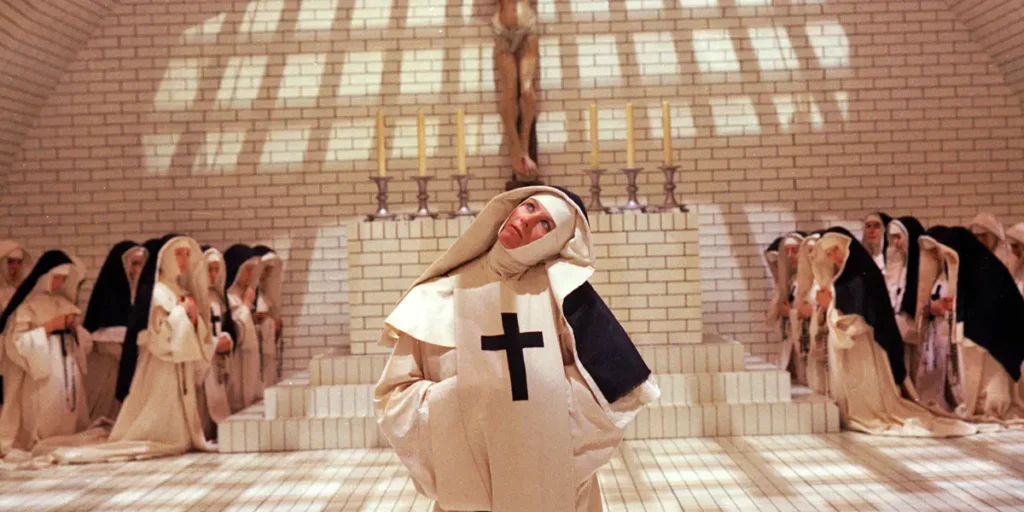
After five decades of infamy, Ken Russell’s masterwork The Devils is unveiled in its uncut, angry glory.
Director: Ken Russell
Genre: Dark Comedy, Psychological Drama
Run Time: 111′
Rated: NC-17
BFI London Film Festival Screening: October 9, 2026
Original Release: July 1971
U.S. Re-Release: October 16, 2026 in theaters
U.K. & Ireland Re-Release: October 30, 2026 in cinemas
Like many a poor soul that inhabits it, Ken Russell’s The Devils has been butchered, banned and blasphemed into infamy. Since its first screenings in 1971, the film has provoked outrage in many, admiration in others, and befuddlement in censorship boards and distribution houses the world over. After 55 years, the director’s cut finally sees the inside of a theater without fear of reproach from the censorious or the pearl clutchers. Its very point is to get you clutching your pearls in shock or offence, and it succeeds in this endeavour while also being far smarter and better made than other comparable films. Through sheer artistry and vision, it earns its right to offend.
The opening crawl declares that The Devils is ‘based upon historical fact’. The affair of the possessions of the Ursuline nuns at the convent of Loudun in 1634 is recorded, Russell’s vision is so incendiary and singular as to feel like the product of such an angry and driven mind as his. Among other things, The Devils reminds us that truth is sometimes stranger than fiction. It’s odd to think that a priest could be so mesmerisingly attractive as to drive women mad, but when you see him played by Oliver Reed in all his fiery glory, you believe it.
Reed plays Grandier, the priest of the town of Loudun. His impassioned sermons and swarthy looks keep his congregants (especially the womenfolk) rapt. His penchant for bedding the town’s women only adds to his reputation, but as The Devils goes on, it turns out that finding the love of God in the love of another person is the least of sins committed in Loudun. The town is losing its populace to the Plague, and its collective mind to fear. The tall town walls that keep adversaries out also keep its protectees in, stewing in their own panicked sweat. Those walls come courtesy of Derek Jarman’s astonishing production design. Walking a fine line between gothic snarls and domineering straight lines, the look of The Devils captures and imprisons characters and audiences alike.
Everyone here is caught behind walls, bars, fire and flesh, and it is bound to drive them all crazy. Among the craziest is the hunchbacked Sr. Jeanne de Agnes (Vanessa Redgrave), whose enclosed convent, desire for Grandier and jealousy of his new relationship with Madeleine (Gemma Jones) drive her to lustful visions. One of the film’s most memorable sequences sees Grandier descend from a cross to have his bloodied body embraced by Agnes. The body of Christ becomes the body of a man, and The Devils dares to show the pious to be as wretched as the rest of us. It helps that this wretchedness manifests in the brave performances throughout. From Reed and Redgrave through to the supports, there is no lack of physical and emotional nakedness.
Russell denied being a political filmmaker, but The Devils is the most notable of his screeds against the hypocrisy and self-preservation of religious fundamentalism. Church and state unite in an effort to take over the relative freedom of Loudun; they just need a reason. When Agnes jealously accuses Grandier of witchcraft, the authorities move in. As represented by the wonderfully hateable Dudley Sutton (as official Laubardemont) and Michael Gothard (as exorcist Barre), the powers that be revel in their putrid hypocrisies. In their need for manifestations of witchcraft, they encourage Agnes and her fellow nuns to display unfettered mania, leading to the film’s centrepiece.
As a barrage of naked nuns desecrate Loudun Cathedral, and the camerawork disorientates by joining in their mania, Russell forces his audience into difficult questions on the nature of outrage. Is a film that demonstrates heinous acts of blasphemy itself blasphemous? Russell knew the chin-strokers that would review the film would assume a moral high ground (Read contemporary reviews from the likes of Alexander Walker and Roger Ebert as proof), but The Devils never revels in the insane behaviour of its characters. We are drawn to Grandier because he’s the most normal person here, finding greater satisfaction in his duties to God and his wife while the town falls around him.
The Devils is wilfully provocative, but that doesn’t mean it’s indulgent. It is, in fact, a scream of humanity in the middle of a whirlwind of hypocrisy masquerading as fervour. The film has retained its relevance through decades of bans and recuts because its themes have never lost their potency. World leaders continue to wield their religion like a weapon against their enemies, and Russell sees through their act for the blood-hungry tyrants they are. In the end, the good are cast out, the innocents suffer and it’s up to those standing in the ruins to pick up the pieces. The Devils shows that it was always ever thus, and that the good fight has to carry on regardless.
Ken Russell’s The Devils: Movie Plot & Recap
Synopsis:
In 17th century France, a nun accuses a priest of witchcraft and heresy, and the resulting purge by Church and State forces threatens their whole town.
Pros:
- Daringly upfront writing and direction from Ken Russell. The film plunges you into its frenzied attack on religious hypocrisy
- Led by the fearless Reed and Redgrave, the whole cast exhibit bravery and honesty (and everything else)
- The production design is impeccable, bringing the period setting to life in unexpected ways
Cons:
- Not for the easily offended
The definitive 4K restoration of Ken Russell’s The Devils will be screened at the BFI London Film Festival on October 9-12, 2026. It will be released in U.S. theaters on October 16 and in U.K. and Irish cinemas on October 30.