
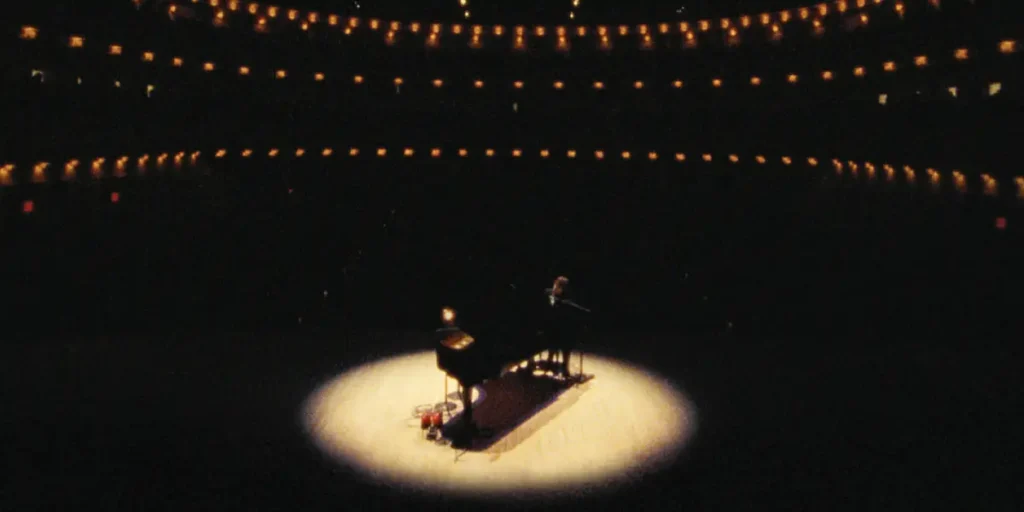
The beauty, intimacy and energy of Cameron Winter at Carnegie Hall confirm the generational skills of Winter and director Paul Thomas Anderson.
Director: Paul Thomas Anderson
Genre: Documentary, Music
Run Time: 75′
BFI London Film Festival Screening: October , 2026
U.S. Release: November 20, 2026 in select theaters
U.K. Release: Early 2027 in cinemas
In the middle of the awards buildup for One Battle After Another, Paul Thomas Anderson went to New York and filmed his second great film of 2025. Like his Oscar-hoovering opus, Cameron Winter at Carnegie Hall is a dazzling confluence of technique, talent and good timing. Shifting from a torn-from-the-headlines epic to the relative intimacy of one man and a piano, Anderson reaches the zenith of his worship of Jonathan Demme, and in doing so proves himself capable of almost anything behind a camera. In no uncertain terms, Cameron Winter at Carnegie Hall cements his status as America’s Greatest Living Filmmaker.
If One Battle After Another was prescient in its portrayal of a racially charged American police state, Anderson gets ahead of the curve again by filming Winter’s first solo show. This concert film sees the director and the musician he’s filming singing from the same hymnsheet; just as Anderson downsizes from the sprawl and anger of OBAA, Winter follows a months-long tour as frontman of post-punk rockers Geese with this one-man show. Both men take the opportunity to breathe a little more freely, at once focused and relaxed. The prologue sets the tone, with smiling punters arriving under the hazy lightbulbs and Christmas wreathing of the theater. This is a relatively small-scale endeavour for both Anderson and Winter, but it warrants excitement and anticipation.
That haze of the lights outside the theater follows the crowd indoors, thanks to Anderson’s decision to shoot the concert on film (He switches between 16mm and 35mm). What could be an overwhelming moment for most artists becomes controlled and personal in Anderson’s view. The grain of the film accentuates the mood Winter seeks in the lighting of the stage. The raised house lights are warm and inviting, while the slightest hint of dimming envelops artist and audience alike in a navy hush. The darkness swells the grief of opening song ‘It All Fell In The River’, and accentuates the regret of ‘Try As I May’ (“Try as I may / To love what fits in my hand / I don’t”).
The milieu of the music documentary is not new to Anderson, but Cameron Winter at Carnegie Hall presents new challenges. His filmography to date shows the director is at his best when presiding over large ensembles. 2015’s Junun juggled the input of several artists into one album, and he’s wrangled the likes of Haim and Radiohead into creative music videos.
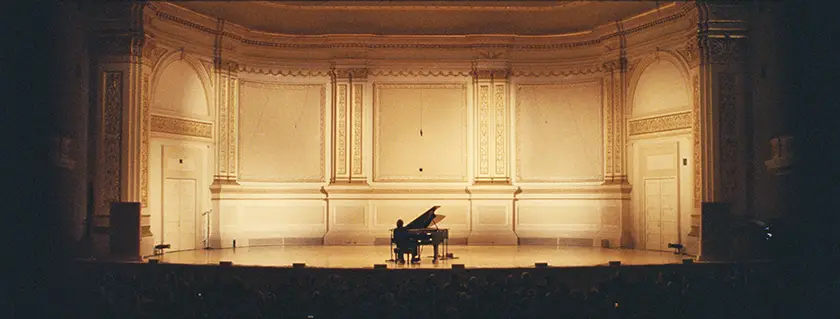
Cameron Winter at Carnegie Hall ultimately boils down to one man sitting at a piano for an hour plus change, but Anderson doesn’t baulk at this reduced canvas. It helps that the prodigiously talented Winter can hold the audience in the palm of his hand with his combination of Rufus Wainwright-esque voice, spiritually-inclined lyrics in the vein of Leonard Cohen, and a dazzling command of the muscular Steinway piano.
As a Demme acolyte, Anderson’s decision to make a concert film will earn it lazy comparisons to Stop Making Sense. However, where Demme and David Byrne’s artistic concerns merged in a marriage of the graphic and the theatrical, Anderson takes his lead from Winter. The minimalist stage setup leads him to seek out cinematic moments wherever possible. After a few minutes of holding rapt to Winter’s enviable skillset, Anderson will suddenly cut to a wide shot of the theater balconies, or to the backstage from where the camera will walk up to Winter, capturing his rhythm while never disturbing it.
The camera is energetic, but never restless, imbibing the mood even in its peculiarities. The film opens with an old-school iris transition, except it’s just the camera moving in from behind a circular piece of stage decor. During Winter’s performance of ‘Emperor XIII In Shades’, the shot briefly distorts in a blur. It could be an error, or it could be an eye filling with tears. Cameron Winter at Carnegie Hall astonishes with the breadth of the footage captured in the space of one evening. While there can be no doubt as to the rehearsal that was put into this staging, Anderson and his camera operators (including Benny Safdie) operate with a looseness and intimacy that ensure it never feels precious. Winter’s words are too heartfelt to be hidden behind pretension.
Cameron Winter took to the stage for one night only, but Anderson doesn’t just film the whole experience for a home audience. With his empathy and lightness of touch, he accentuates the feeling of being there, infusing his filmmaking with the emotional rhythms of the artist and his audience. It’s impossible to reduce Cameron Winter at Carnegie Hall to just a companion to the live album, or an experiment for its director. It is both those things and so much more; it’s a living, breathing moment of musical magic, and a reminder of what artists in tandem can achieve.
Cameron Winter At Carnegie Hall: Movie Plot & Recap
Synopsis:
Geese frontman Cameron Winter performs a sold-out solo show at New York’s Carnegie Hall, with Paul Thomas Anderson on hand to film the event.
Pros:
- Anderson shifts from his usual ensemble bigscreen milieu to an intimate concert setting with ease and skill.
- Winter’s beautiful songs are accentuated by the dazzling filmmaking.
Cons:
- It might be less accessible to anyone who doesn’t appreciate Winter’s style, or that of his inspirations.
Cameron Winter At Carnegie Hall will be screened at the BFI London Film Festival on October 7-8, 2026. The film will be released in select U.S. theaters on November 20, 2026 and in U.K. and Irish cinemas early 2027.