
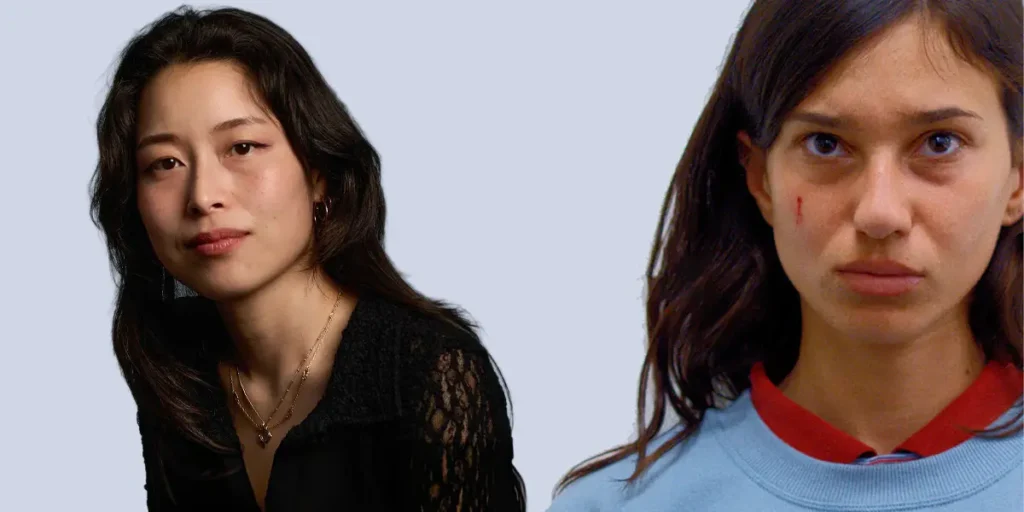
We interview director Hyun Lee about her debut feature French Girls, the fashion industry, working with non-actors, and the joys of making a micro-budget film.
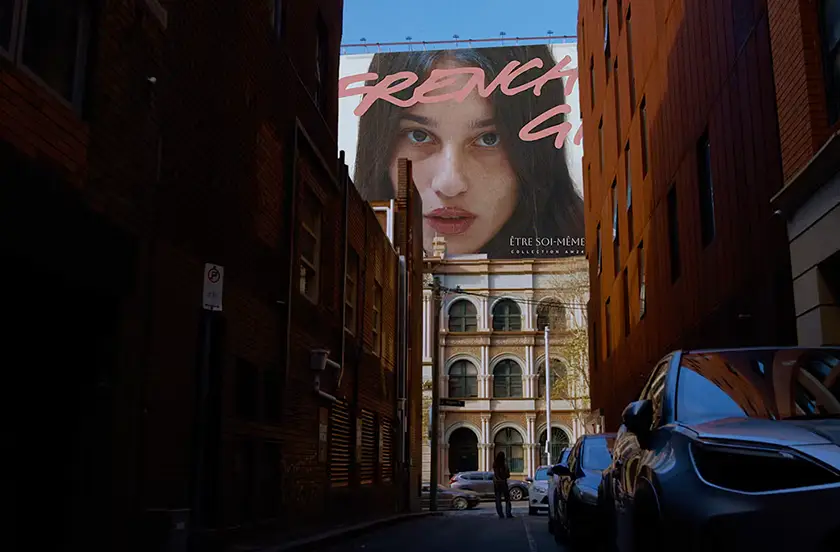
“Whenever I saw that billboard, I used to think, that girl isn’t even French!” says a voiceover at the start of Hyun Lee’s French Girls, perfectly introducing both the film’s themes and its protagonist. The latter, Mia (Mia Kudis), is working on a construction site when a model agent scouts her, convinced she belongs in front of the camera. “We’re an ethical agency,” she explains. “Basically, we just want you to be yourself.” Soon, Mia’s face is on a giant billboard that reads “French Girls, être soi-même” (“be yourself” in French), and her foray into the fashion world begins.
It doesn’t take Mia long to realize that there’s not much actual work involved in her new job, and we follow her and the other models as they do everything from trying on clothes to standing around for hours with nothing to do. But things soon take an increasingly absurd turn for Mia, who one day finds herself facing a detective, unable to explain how she ended up under arrest.
Adapting her own short film of the same name, writer-director Hyun Lee makes her feature debut with the Sydney-set French Girls, a fresh look at the fashion industry that explores a number of timely themes, from social dynamics and the ethics of capitalism to the strangeness of a world that’s so deeply embedded in our culture. At the BFI London Film Festival, Hyun Lee told us about the origins of French Girls, working with non-actors, shooting a micro-budget film, representation, fashion as a part of human culture, and more. Read the interview below!
“It’s a strange world.” — Hyun Lee on Modeling, Representation, and How French Girls Came to Be
I know that French Girls came from a short film you made in 2016. I’d love to ask you about how this film came to be.
Hyun Lee: The short film was made a really long time ago, and it’s set in the modelling world. I used to work as a photographer in fashion, so I made this short film based around a few ideas that I had at the time. I wasn’t exactly sure what it was about, back then: it was just a few images that I was really inspired by. And then, all these years later, I developed it into a story, and into a bigger piece.
French Girls comes from a lot of places. A lot of it is based on my observations of working in that world. I was quite young when I started: I was in high school when I began shooting models, and I was a really shy, quiet teenager, obsessed with photography. I got very nerdy about it, and I really liked taking portraits of people, so I started shooting for model agencies.
At the time, agencies would send me their new models, and they were often really young as well. So I would be shooting models who were just teenagers, and I was a teenager as well. They were very sweet high school girls, and the interactions I had with them were… Very awkward, because I was so young! I didn’t really know how to have a proper conversation with anyone. It’s kind of funny to look back: it was just such a fragile time to be a teenage girl.
When you see how the fashion world is shown in movies and TV, I sometimes find how models are represented frustrating, because the stereotype around fashion and the modelling industry is to show them as either victims of exploitation and abuse, or these nasty drama queens who deserve to be exploited and abused. It’s so different from what I experienced. For me, it was a professional world where people were just doing their jobs. I’m sure there’s drama and there’s a negative, gritty side to that world as well, but I just felt like in the mainstream media that we see set in that world, it tends to be quite harsh.
That’s so interesting and it definitely comes across in the film.
H.L.: I felt it was important to show the reality of what that world is. It’s just a feminine industry with lots of young women, and generally, it’s a strange world. There’s a lot of strangeness about it, which I hope comes across in the film. It’s an absurd occupation. There’s nothing like it in other industries, because modeling is a very passive job. Models don’t really have a lot of control over it: they can’t exactly work harder to become a more successful model, so in that way, it’s a unique job. For me, what models experience is a heightened version of what everyone experiences in a commercial capitalist society. We all experience a version of what they have: it’s not just models who are objectified; everyone is, in this world.
Oh, absolutely, and you show this very beautifully. One of the last lines of the film is that people still look at her, even when—
H.L.: Even when she’s wearing dirty clothes. [nods] It’s inspired by real girls, real women in my life, who are incredibly beautiful. They’re not interested in fashion or modelling, but they were just born a certain way, where they look really striking. It’s not in their control: when they walk down the street, people stop to look at them, and approach them. There’s something about women who look a certain way: they just attract attention, even if they aren’t doing anything [to stand out]. I think it’s a really unique and strange experience that’s often misrepresented in movies and TV.
“It’s so difficult to make ethical choices, even when you’re trying your best.” — Hyun Lee on Complex Dynamics in the Industry
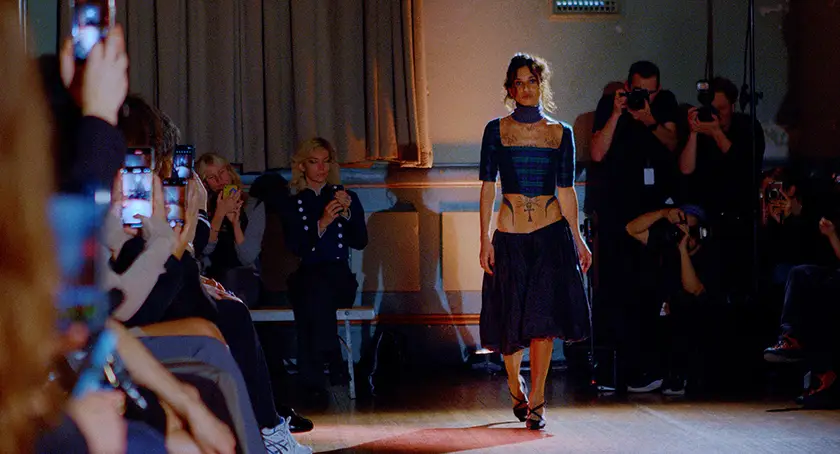
A scene that I thought was so effective is when a designer suddenly decides that “The model is the muse, and the muse is the artwork” and wants Mia to get rid of the clothes mid-runway even if it’s supposed to be a ‘fashion’ show.
That already works as a commentary on the fashion world so well, but the agent’s reaction is very interesting too: she tells Mia, “only say yes if you’re comfortable,” but would that be enough to safeguard her given how young she is? Was that something you wanted to comment on too?
Hyun Lee: I think it’s a really complex world, and I wanted to show that in the fashion industry there are lots of people who are very mindful and aware of ethics and looking after the young women. The model agent is supposed to represent a very progressive professional in the industry who’s trying her best to be ethical. But there are a lot of grey areas, and I wanted to show that even when you’re trying really hard to be ethical, it’s an inherently unethical environment.
Capitalism is inherently unethical. Even we, as consumers, can try to be ethical about our choices when we buy clothing, but we’re not in control of the manufacturing processes. We don’t know who made our clothing, and we don’t know if it was done ethically. I’m trying to show that in this commercial world that we live in, in a sort of Western capitalist society, it’s so difficult to make ethical choices, even when you’re trying your best.
I also wanted to show that it’s difficult for models and for young women, even outside of fashion, to advocate for themselves, even in environments where they’re being encouraged to do just that. It’s this idea that even when people are asking, “Are you sure you want to do this?”, it’s so hard for a woman to say no.
I agree. And it’s such a powerful scene; it really made me think a lot.
Hyun Lee on Casting Mia Kudis for French Girls
What is it about Mia Kudis that made you decide that she was going to be your protagonist?
Hyun Lee: I actually met Mia on a shoot. I wanted to shoot documentary-style footage for this project before we started even planning to shoot it, so I met a magazine editor in Australia for a publication called Rush Magazine. The editor was interested in my work and said, “You can come join us on a shoot while we do an editorial for the magazine.”
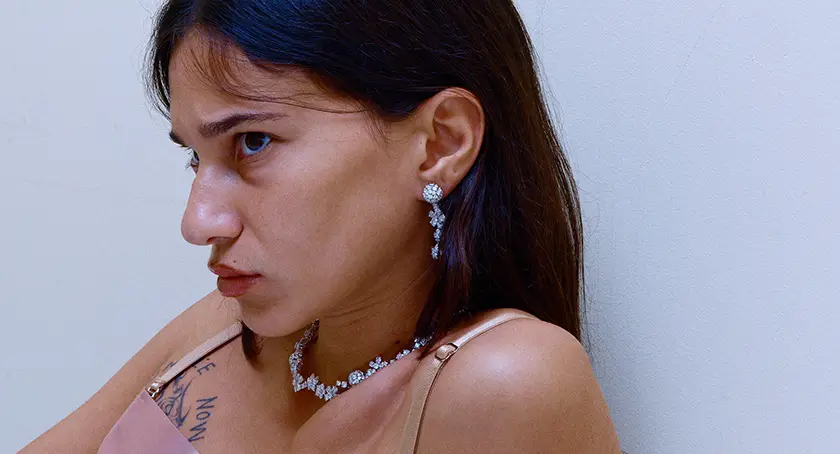
I brought my camera, and I was shooting this footage. Mia was a model that day, and from the footage that I shot, I was so struck by her face. Even when she’s not doing anything – even if she’s just staring off at a wall! – her face looks so expressive. You can see her thinking, having these deep, tumultuous feelings. She has such a powerful presence.
The footage that I shot with her from that day is actually in the film! You know that scene where she’s got the jewellery on her, and it’s that magazine editorial? That was the day that I met her!
Is that when, as she’s wearing the jewellery, the narrator is telling us how much it’s worth, and that there were security guards outside because of it?
H.L.: It was true! There really were four security guards, and the jewellery was worth several hundred thousand dollars. Everyone had to be wearing gloves to touch it. I was just there by myself with a camera, so I didn’t catch the security guards [and I wasn’t able to shoot them for the film].
That was how I met Mia. At the time, I was so struck by the footage that I got. I was like, “I have to track down this girl and ask if I can shoot maybe one or two more scenes with her. Maybe I can make a short film.” Then I tracked her down, and one thing led to another, and we shot the whole movie.
That’s amazing. And she’s fantastic in the film.
H.L.: She’s an incredible artist. By coincidence, she actually had the same name as the character that I wrote in the script, but I changed a lot of the script to mould it to Mia.
In the short film French Girls, your protagonist’s name was Anya, played by Kirsty McKenzie. As you were working with Mia Kudis for the feature film, did anything else change in the story?
H.L.: I really think when you’re working with non-actors, it’s good to mould the character to them as a person, because it’s a little more difficult for a non-actor to play a character that’s very different from themselves. Even though Mia in the film is separate and different from who she is in real life, I did bring her a bit closer [to the character] so that it would be easier for her to play that role.
“She’s the Voice of God, and God is a Woman.” — Hyun Lee on the Narrator, and Her Approach to Writing and Shooting
What’s your process like? When you’re writing a story or a film, how tied are you to the script? How much do you change?
Hyun Lee: Everything changes constantly. You have to with a micro-budget film, because locations and actors change at the last minute, and you constantly have to change things. With my process, I like to [approach the] structure first. From the start, I knew how the film would end, and it was just about figuring out how to get to the ending.
When we cast the actors, I could workshop the script with them to get the dialogue down to the specifics. I usually leave the dialogue and those sorts of details a bit open, but the structure is locked in place. As we lock in the actors, I workshop the script with them to get it closer to what they’re able to perform comfortably.
That’s so interesting. Did the actors have a script or did you just tell them what they were going to be doing on the day?
H.L.: It was kind of like that. In the first half of the film, it’s structured so that it feels a bit more like a documentary, and all the characters are just playing themselves. In the second half of the film, when the gun comes in and there’s this silly, stupid plot with the boyfriend, that’s when it becomes a movie, and there’s more acting there.
That side plot is great! I wasn’t expecting that twist at all. Did you always know you were going to have a narrator?
H.L.: In the short film, there’s a narrator as well, and it ends the same way. For me, the narrator has many purposes. I wanted there to be a feeling like you’re watching almost like a nature documentary, where there’s a narrator not just observing and saying facts about the world, but also [commenting on them,] like an essay film. I was thinking about the French New Wave and essayistic filmmaking, like Godard: the cliché French filmmakers. [smiles]
It definitely comes across as documentary-like, but there’s also a surreal element to it all. The first time she said “I” in the film really surprised me, because you’re not used to a narrator having an opinion.
H.L.: I think the narrator is quite a surreal figure because she does just kind of come and go. You don’t know who she is, and she seems to know everything, so maybe she’s sort of a god-like person: I like the idea of her being a creator, you know? Like God, the creator. And the actor who plays the narrator [Anya Beyersdorf] is actually a writer that I worked with. She works in film and TV. Sometimes her credit on productions is “creator,” because she’s created TV shows, so there’s something kind of nice about that. Maybe the audience wouldn’t know that, but for me it’s nice that she’s the voice of God, and God is a woman.
“People Come to You and They Just Want to Help.” — Hyun Lee on the Joyful experience of Making a Micro-Budget Film
French Girls was shot on a very low budget.
Hyun Lee: It was shot for $28,000 AUD, and it’s a nice segue because Anya Beyersdorf, who played the narrator, was the creator of a TV show that I worked on [called Fake], which aired on Paramount+. That was where I got the money to make this film.
The whole thing was extremely lucky, because I’m not that established as a TV writer: I had only worked on another TV show before that, a children’s series called Born to Spy which was about kids whose parents are spies. And it shouldn’t have happened, but I was brought onto Fake with quite a big budget. It did really well in Australia, and it was the most money I’ve ever made in my life, which came just at the right time to make this film.
We had started shooting the movie before I even knew where I was going to get the money from! For some reason, I just felt compelled to do it anyway. I’m a freelancer, so I don’t have a lot of savings, and I knew that I was going to run out of money after a few months. I was like, “I don’t know, we’ll figure it out.” The TV show just came out of nowhere, and that’s how I made the film.
Oh, I love this! How did you approach the people who ended up working with you?
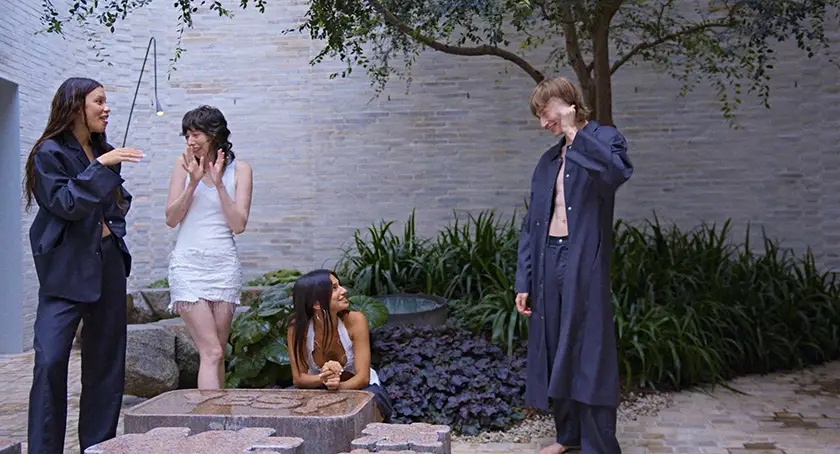
H.L.: I was quite upfront with everybody: I would tell them that I was just trying to make it for nothing. We would use actors who’d just wear their own clothes, and we’d try and shoot in locations that we already had access to. We shot in friends’ homes; we got a lot of favours.
It was basically just reaching out to your network of people, and friends of friends of friends. I think it’s important to talk about the film while you’re making it, because then you can spread the word about it. People just get excited and they want to help, because it’s a movie! [smiles] And people are so excited about a movie that they want to be a part of it.
Even for the construction site, I thought maybe we’d put some people in high-vis vests and find a truck, and just make them stand next to the truck. A friend of a friend used to work for a guy who owns a demolition business, so in the end, he came along with his 10-year-old daughter. He brought a truck full of rubble, a jackhammer, fences, and we didn’t have to pay for any of that.
When you’re making a film with nothing and you just have very excited energy, people come to you and they just want to help. I really encourage people to make micro-budget films, because I think it’s really such a joyful experience. The community wants to get involved, and it brings people together. You’d be surprised at how much you can do with very little.
Hyun Lee on Fashion as a Part of Human Culture
You were saying before that the fashion world isn’t often represented well in films. What are the kinds of films that impress you, in that regard?
Hyun Lee: I especially appreciate when people make films about the fashion world that show not just the stars, or the models, but also the behind-the-scenes, and the many professionals who work in this machine. The seamstresses, the factory workers… And not just the designers, but all of their assistants.
There’s a whole world in that industry that’s very collaborative. We take for granted that every piece of clothing you own, thousands of people have touched it in some way, from the designer to the people who make the fabric, the people who make the thread [and many more].
I think clothing is a part of human culture: I like to say this in introductions now. I look at fashion as a part of human culture, because when people think about fashion, they often think about the dramatic, glamorous side of it, like The Devil Wears Prada or The Neon Demon. I just want to shift everyone’s perspective to not look at it with that glamorous, judgemental perspective, but more with this humane perspective where fashion is a part of everyone’s lives.
We all wear clothing in the same way that everyone eats food. It’s a part of our daily life, and there’s something so human and beautiful about it. Having aesthetic preferences is universal; even babies show aesthetic preference. To be able to express that through what you wear is an opportunity for every single human being to express themselves. Even if they choose to just wear boring normal clothes, that’s fine, but that’s their aesthetic preference, and that’s them expressing it. I think of fashion in a very anthropological, sociological way — as a part of human culture that’s very universal.
The Australian-ness of French Girls, the London Film Festival Screening, and What’s Next for Hyun Lee
I was reading the reactions to French Girls, and I saw that a lot of people were recognising the locations and loving to see them represented, so it feels like you’re creating a bit of a community with the movie as well.
Hyun Lee: For some reason, there really aren’t very many films set in the urban centres of Australia. A lot of people will make films set in the rural areas, even though most people don’t live there. I’m not sure why that is, but even when they shoot in the urban centres, they’ll kind of hide the Australian-ness of it.
I wasn’t trying to make an Australian film. I wasn’t trying to be like, “Let’s make this Australian movie.” By accident, people are saying, “This is such a Sydney film.” I love Sydney, and I don’t think I was trying to hide it.
What was the London Film Festival screening like for you?
H.L.: It was interesting, because I sit in every screening that we have. We’ve done a few festivals now, so I’m always really interested to hear the audience and how they react. I thought that it was bombing because no one was laughing, but then someone told me, “No, no, no, it’s just that everyone’s British.” The humour is so different.
I was reading the Letterboxd reviews, and they were actually really positive, more positive than our past screenings. I was surprised! It feels really positive. The people in the audience who were coming up to me at the end of the screening were really, really lovely too. I feel like people got the film and appreciated it. I feel really lucky.
When it’s in your home city, you know people are going to come because they either know you or know people who were involved in the film. It’s amazing to me that we sold out our screenings in London and that people who have no connection to us came and enjoyed the film. It’s been really special to screen it here.
What’s next for you?
H.L.: I’ve been developing my second short film, Asian Girls, into a feature film. It’s very different: it’s a horror movie, with ghosts and so on! It’s a scary movie, but it also has ties to the fashion world. I’m also working on a TV series: lots of things going on.
Thank you for speaking with us!
This interview was edited for length and clarity.
French Girls was screened at the BFI London Film Festival on 12-13 October, 2026.
Header credits: Hyun Lee poses for a portrait session at the 2026 BFI London Film Festival (Tristan Fewings/Getty Images for BFI) / Poster for French Girls (Courtesy of the BFI London Film Festival)