
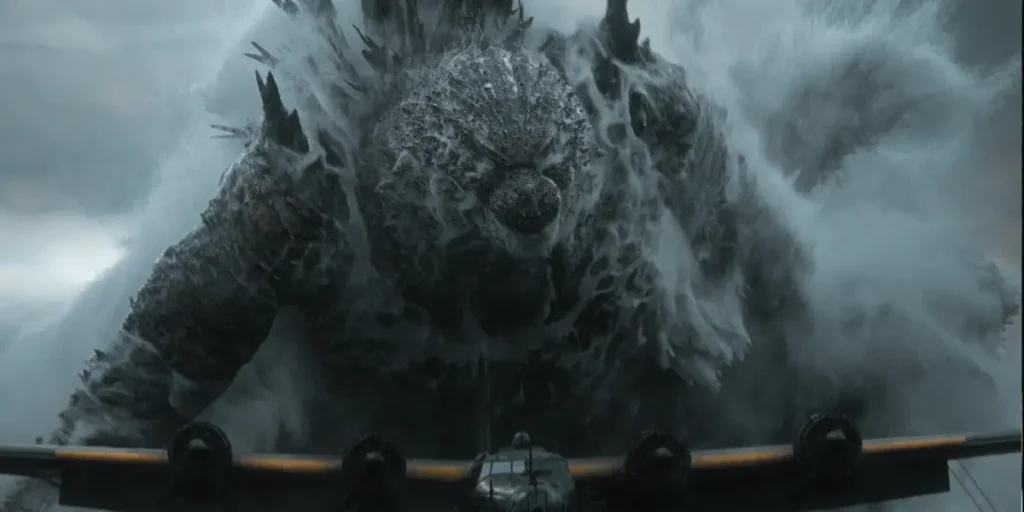
Godzilla Minus Zero is a triumphant follow-up to Minus One, building on its predecessor’s magnificent action, jaw-dropping visuals, and intelligent commentary on postwar Japan.
Director: Takashi Yamazaki
Genre: Action, Drama, Horror, Kaiju, Monster Horror
Run Time: 135′
Rated: R
BFI London Film Festival Screening: October 14, 2026
Release Date: November 6, 2026 in U.S. theaters, in U.K. and Irish cinemas, and globally in theatres
Godzilla Minus Zero begins in rip-roaring fashion. Naoki Satō’s (Godzilla Minus One) original score is the first thing we hear, a dramatic string-based flourish that repeats before panicked sounds of people accompany it. And then the chaos hits, as a new kaiju attacks Matsumoto, obliterating buildings and killing civilians. It’s a breathless opening that hints at two main things: one is that Satō’s score is going to be one of the best of the year; and two, that director/writer/visual effect maestro Takashi Yamazaki might just trump his efforts on 2023’s hugely successful Minus One.
The kaiju attacking Matsumoto is not Godzilla, who, two years after the events of Minus One, is still dormant at the bottom of Sagami Bay. Instead, this one is a dragon-like creature, with scientists led by Kanji Murakami (Min Tanaka, of Kokuho) naming it “Ghidorah”. This monster is a classic of the Godzilla franchise, first appearing in Ghidorah, the Three-Headed Monster (1964), but to the characters of Minus Zero, it is a new and terrifying threat. After this destructive opening, Yamazaki’s film takes on a quieter tone, as we reunite with many of the characters from Minus One whilst also meeting some new ones.
Core to that film were pilot Kōichi (Ryunosuke Kamiki, of Your Name), his wife Noriko (Minami Hamabe, of Anohana), and the director of the Large-Scale Disaster Response Bureau Kenji Noda (Hidetaka Yoshioka, of Always: Sunset on Third Street). The trio take centre stage again in Minus Zero, and even if they still remain relatively one-dimensional, it is impossible not to care for each and every one of them. A large reason for this is how well Yamazaki connects the appearance of Godzilla and Ghidorah to postwar Japan, much like Godzilla (1954) did with nuclear war and Shin Godzilla (2016) did with natural disasters. Each character is united by their shared trauma and their goal of survival.
The addition of Kanji is a particular masterstroke by Yamazaki. The elderly biologist is a survivor of the Hiroshima bombing, haunted by visions of the burnt bodies of his wife, daughter, and grandson. Yamazaki is unflinching in how he shows such memories, and Tanaka is the star of this ensemble as he portrays a man rocked by grief and spurred on by revenge. Minus Zero is very dark, as it should be when analysing how war affects societies and stays with people for the rest of their lives. As Noriko states at one point, all the citizens want is some peace.
That isn’t to say Minus Zero is a bleak affair. It very much knows that there is a silliness baked into the concept of two giant monsters running wild amidst various cityscapes, whilst its portrayal of US soldiers is amusing and righteously stinging. Americans are either faceless entities or arrogant a*holes who want the Japanese people to do the hard work and take the risks before sweeping in for glory. Yamazaki’s screenplay is mostly successful, although some overly melodramatic moments and an overextended middle section are notable flaws.
Ultimately, Minus Zero excels at what many people come to see: booming set-pieces with top-tier visual effects. In that regard, Minus Zero is a roaring success. The visuals are stunning. Bright, brilliant, and imaginative, they somehow seem gritty and grounded even when the two massive monsters enter the screen. They’re aided by excellent sound design (see this in the biggest and best cinema you can), whilst Satō’s score continually compliments and elevates everything happening on screen. Most pleasingly, there is clarity and cohesion amidst the chaos. Considering how hectic the action set-pieces are, they are very easy to follow. Minus Zero takes bigger, bolder swings than its predecessor, and it results in one of the most satisfying action films of 2026.
Godzilla Minus Zero (2026): Movie Plot & Recap
Synopsis:
In 1949, two years after Godzilla was defeated in postwar Japan, a new monstrous threat attacks the city of Matsumoto. Old and new faces unite against the kaiju Ghidorah, and eventually Godzilla as well, in a bid to save themselves and their struggling country.
Pros:
- Some of the best visual effects and creature design you’ll see in a film this year
- Great performances all round, most notably from Min Tanaka and Hidetaka Yoshioka
- Excellent reflections on war that reach a surprisingly deep level
- An unforgettable original score by Naoki Satō
Cons:
- Most of the melodrama in the screenplay is fine, but it sometimes becomes overbearing
- A weak middle section that takes too long to reach the superb finale
Godzilla Minus Zero will be screened at the BFI London Film Festival on October 14-16, 2026.