
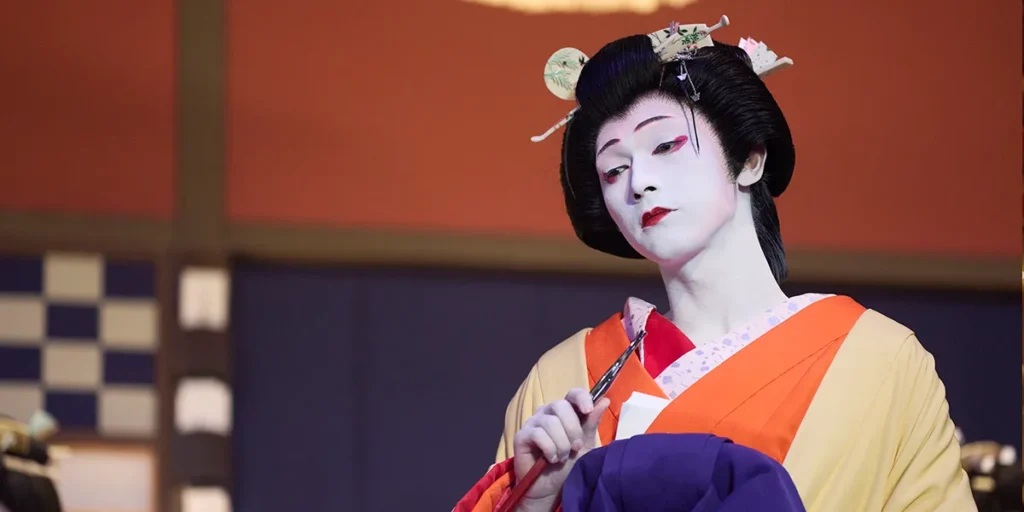
A familiar tale of artistic endeavour is given time to breathe in Japanese box office smash Kokuho, with sumptuous design and strong performances.
Director: Lee Sang-Il
Genre: Drama
Run Time: 175′
U.S. Release: February 20, 2026 in theaters
U.K. & Ireland Release: May 8, 2026 in cinemas
Kokuho arrives on European shores after a ridiculously successful theatrical run in its native Japan. It’s a rare home-produced live-action film that has raced into the top 10 films ever at the Japanese box office. It has spurred not just increased sales of Shuichi Yoshida’s source novel, but also a renewed interest in the distinctly Japanese art of kabuki theatre.
Kokuho proves that stories of artistic striving and sacrifice translate well. Creatives have to give up so much to become the best at their art, no matter where they come from.
Kokuho is a decent primer on kabuki, a ritualised form of theatre defined by stylised production and performances from all-male casts (Male actors playing women are known as onnagata. Women were forbidden from acting by the shogunates of old, for fear of moral degradation). The tradition of kabuki goes back over four centuries, but during the post-war period in which Kokuho is set, it shrugged off the disdain of occupation as a symbol of new national pride as the country sought to rebuild.
It’s no coincidence that the film opens in Nagasaki in 1964. It’s been 15 years since the nuclear bomb was dropped, but Japan is reclaiming herself. A traditional teahouse sees a debut performance from an aspiring kabuki performer, but the occasion is interrupted when his yakuza father is killed in a planned hit. Kokuho might be melodramatic, with its raw emotions and high production values but, besides fitting the heightened style of kabuki itself, it wants to avoid beige clichés of being another rags-to-riches romp geared towards awards. It’s too heartfelt for that.
Yoshida’s serialised novel and the resulting film tell a vast story, stretching across fifty years of artistry and pain. At its core are two adoptive brothers. Kikuo (Soya Kurokawa (one of the stars of Kore-Eda’s Monster) as a teen, and Ryo Yoshizawa as an adult) is the young man whose father gets gunned down, but is taken in by revered actor Hanjiro (Ken Watanabe, of Inception) to train as an apprentice alongside Hanjiro’s own son Shunsuke (Keitatsu Koshiyama as a teen, Ryusei Yokohama as an adult).
Under Hanjiro’s rigorous and excruciating training, the pair grow as siblings and actors. Their progress might have been charted via training montages, but Kokuho assumes sufficient foreknowledge on the audience’s part. Instead, screenwriter Satoko Okudera pivots the action on performances of some of the classic kabuki plays. Much as a music biopic relies on the actor playing the hits, Kokuho demonstrates the effort and talent required for kabuki in performances of ‘Love Suicide’ and ‘Temple Maiden’.
In between its sumptuously mounted kabuki performances, Kokuho jumps ahead years at a time, with Kikuo and Shunsuke growing in talent, and growing apart. Despite being the great Hanjiro’s son, Shunsuke is outshone by Kikuo, and opts to leave kabuki altogether. This is but one shattering event in these men’s lives, with relationships faltering, mentors passing, and illnesses forcing some tough decisions over the decades. This would be cliché in a biopic, but Kokuho’s narrative is derived from the experiences of many kabuki actors, and spreads its griefs across a generous timespan. The three hours rarely drag, with the drama interspersed with the kabuki performances to keep the audience rapt. Time is forever on Kokuho’s mind, showing its degenerative effects and the merciless speed with which it passes.
The script is thematically finessed, with little callbacks and echoes peppered throughout the narrative to tie its various strands together. Like a kabuki play, Kokuho trusts its audience to keep up, though it offers other delights even on a surface level. All this is held together by Korean-born director Sang-Il Lee, best known to Western audiences as the man who remade Eastwood’s Unforgiven. He knows how to keep the film light on its feet, without sacrificing dramatic heft. His images are dynamic, and the theatrical performances are bathed in colour. Cinematographer Sofian El Fani shows off the rich textures and fabrics in the production, particularly in Kumiko Ogawa’s beautiful Oscar-nominated costumes.
The term ‘Kokuho’ means ‘national treasure’, a status to which the greatest onnagata aspire. Naturally, one of our leading men is bound to get there, but the journey is a compelling one. Kokuho may take the long route, but the visual and emotional highs on the way are worth the time.
Kokuho (2026): Movie Plot & Recap
Synopsis:
Kokuho charts the rise of two adoptive brothers in the world of kabuki theatre, and the pains that come with it, over five decades.
Pros:
- A compelling story given room to breathe in a solid script
- Strong performances, particularly from the two adult leads
- Gorgeous production values
Cons:
- Some flab around its extended midsection
- Not without its melodramatic clichés
Kokuho will be released in cinemas in the U.K. and Ireland on 8 May, 2026. In the US, the film opened in theaters on February 20; the digital release is TBA.