

Casey Affleck’s Company takes some huge swings with its dense storytelling, but ultimately pays them off with an ambitious, rewarding finale.
Director: Casey Affleck
Genre: Drama, Mystery, Western, Comedy
Run Time: 92′
Venice World Premiere: September 8, 2026 (In Competition)
U.S. Release Date: TBA
U.K. Release Date: TBA
Most of the things that make humanity so special won’t survive the test of time; our tools will grow obsolete, our homes will erode over the years, and even our bodies will return to the earth eventually. For most of us, the only things that will survive are stories. The oral tradition has been around almost as long as humanity itself, and it will likely outlive us all. Casey Affleck’s gritty period drama Company understands the importance of stories better than most, weaving an intricate portrait of revenge, sacrifice, and independence through many different tales that culminate in a thrilling finale.
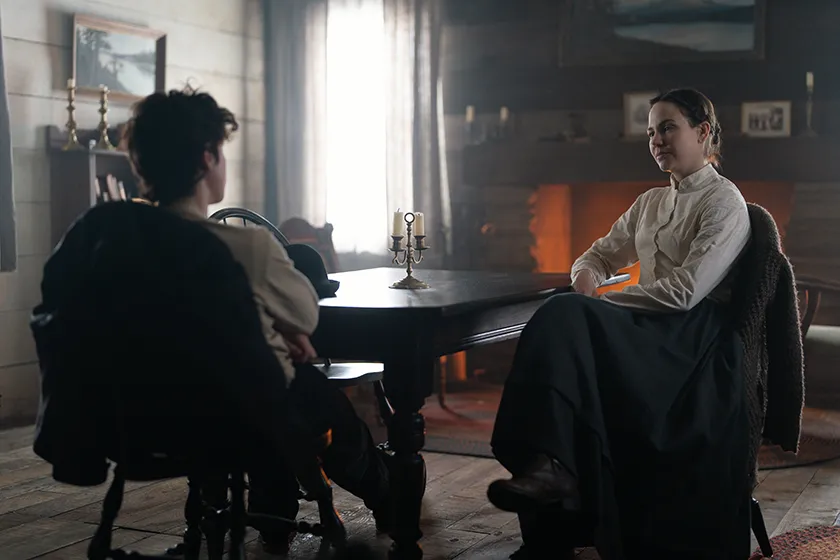
At the heart of Company are three different stories—but unlike a typical anthology, the movie weaves them together with a clear, coherent narrative that connects one to the other. On the film’s outer layer is Evelyn (Emily Alyn Lind), a young woman who arrives uninvited to a suburban Christmas party in 1975. Greeted with hot tea and lively conversation, she recounts a story that her grandmother once told her: that of a reclusive hermit named Tom (Nick Nolte) who once welcomed an injured actress into his solitary home. Once we’ve peeled back this layer of the narrative, Company offers us one more tale, recounted by the enigmatic actress: the story of her grandmother, whose frontier farmland was upended by the arrival of a mysterious young boy named Caleb (Atticus Affleck).
It’s this third narrative layer that Company pays most attention to, with the first two layers essentially just serving to set up (and later resolve) the primary focus. This ambitious storytelling is the first sign that Affleck’s film is more than just a regular period drama—there’s something mesmerising about the way everything unfolds with such purpose, with each story leading seamlessly into the next without feeling superficial. It’s easy for writers to use flashbacks to provide audiences with the information they need to know, but it’s less easy to write three stories, separated by decades, and somehow connect them thematically and stylistically.
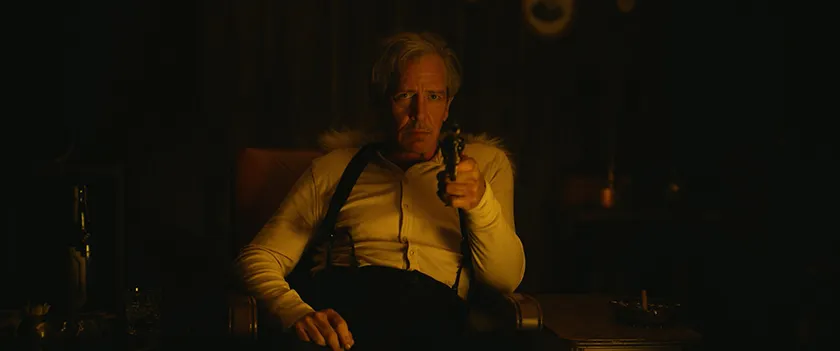
In fact, it would have been very easy for this bold writing approach to come across as a cheap gimmick, but Affleck ensures that’s never the case. Even with the frequent off-screen narration and flashbacks (which you’ll never see recommended in a screenwriting class), it’s clear that there’s a thematic vision to Company that makes the unconventional writing seem purposeful rather than lazy. We’re not just watching people tell stories because it’s ‘easier’ for the writer to let the narrative play out that way, but rather because storytelling is a central theme in the film through which we understand these characters on a deeper level.
Company is an extremely dense and thematic film, most of which plays out through extensive monologues and profound conversations between the characters. There’s very little action (until the final act), creating a very slow, methodical pace that may admittedly deter some viewers. But those who stick with the film, allow themselves to get lost in the vivid imagery, and approach the film’s poignant ideas critically will definitely get something out of it. This story (namely, the deepest multi-narrative layer) is brimming with fascinating discussions about the ethics of revenge, the nature of time and legacy, and how our lives can be defined by instinctual reactions that we make in seemingly mundane moments.
That being said, Affleck and Hansen’s screenplay does admittedly feel a little impenetrable at times, as certain scenes are heavily overwritten with dialogue that feels more literary than natural. It almost reads like a classic American novel with its poetic prose, but this kind of stilted dialogue doesn’t always translate well for the screen. There’s also an unfortunate elephant in the room with Atticus Affleck’s performance, which doesn’t feel quite in tune with the rest of the film’s cast, and subsequently makes it difficult to relate to his character in any meaningful way.
The film’s most impressive accomplishment, beyond the ambitious writing and gorgeous winter aesthetics, is its ability to seamlessly pull off an otherwise shocking and abrupt twist in its third act that completely rewrites everything that precedes it. Not only does this major revelation shift the entire focus of the story, but it also justifies the three-layer storytelling on a deeper level by shedding light on a new connection between the characters.
Ultimately, Company is an admirable film that succeeds at weaving together an intricate story with countless bold ideas, but often fails at presenting them in a way that feels natural. The dialogue and performances feel quite self-serious and overworked at times, which doesn’t always blend with the talestory that Company is trying to tell. Thankfully, its richly atmospheric visuals and engaging structure make it worthwhile in spite of its flaws.
Company (2026): Movie Plot & Recap
Synopsis:
On a winter night in 1975, a mysterious woman named Evelyn arrives uninvited at a holiday gathering and tells the story of Tom, an ageing hermit who rescues a stranded actress during a Colorado blizzard in 1953. To pass the night, the actress recounts an older tale of a farming couple who take in a troubled young drifter as a series of grisly murders spreads fear across the frontier. As the stories intertwine across generations, Company becomes a meditation on grief, vengeance, forgiveness and the quiet acts of compassion that can heal even the deepest wounds.
Pros:
- An engaging, multi-layered narrative that feels genuinely earned thanks to the film’s critical assessment of storytelling as a method of human connection.
- Luscious, poetic dialogue that engages with some fascinating ideas about purpose, forgiveness, and identity.
- Immersive visuals that bring some gorgeous locations to life in a very aesthetic way.
Cons:
- Some moments feel very overwritten and elongated in a way that doesn’t always blend with the rest of the film’s tone.
- Certain performances let the film down, causing the audience to struggle to relate with the central characters.
Company had its World Premiere at the 2026 Venice Film Festival on September 8, 2026. Read our review of Light of My Life!