
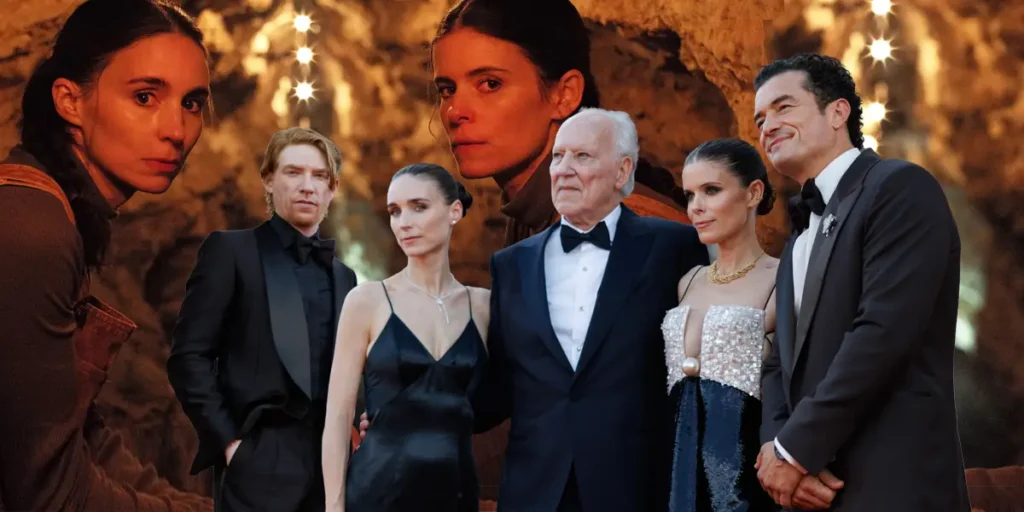
We interview Kate & Rooney Mara, Domhnall Gleeson, Orlando Bloom and Werner Herzog on Bucking Fastard, Herzog’s latest singular and fantastical feature.
With Bucking Fastard, legendary German auteur Werner Herzog has taken his most ambitious creative leap yet. While his movie might be the avenue for filmmaking innovation, its stars, and real-life sisters, Kate and Rooney Mara, elevate the film into an entirely new league. What materializes on screen from Herzog’s absurd and fantastical concept about two sisters who are so close they speak in unison with one another is a delightful melody of strangeness, underscoring the deeper importance of humanity.
Bucking Fastard follows the anomaly that is the Holbrooke sisters. Jean (Kate Mara) and Joan (Rooney Mara) are entirely intertwined in one another’s identity; they wear the same clothes, talk at the same time and love the same man. When their love affair with their neighbor Gareth (Orlando Bloom) goes south, the girls find themselves trying to start over.
This turns out to be a common occurrence for the Holbrooke sisters, as no one truly knows how to interact with them as a unit nor distinguish them as individuals. The outside world either views them as a duo to protect or a spectacle to exploit. Through it all, the girls know in their very core that their purpose in life is love. When they see the outside world is undeserving of a love as pure as the one they have to offer, they search for a land that love can not only exist, but flourish.
While Herzog is known for taking wild swings that push the bounds of filmmaking, Bucking Fastard lies outside the realm of any film he’s crafted before. Prior to the film’s world premiere at the Venice Film Festival, we sat down for an interview with the film’s writer and director Werner Herzog as well as stars Kate and Rooney Mara, Orlando Bloom and Domhnall Gleeson to analyze the world of Bucking Fastard, talk through the logistics of synchronized line deliveries and discuss working on set run by Herzog himself.
How Kate & Rooney Mara, Domhnall Gleeson, and Orlando Bloom got involved with Bucking Fastard
What was it about the script and the ambition of this project that drew you to it?
Orlando Bloom: I think, for all of us, Werner Herzog is the big draw. He’s such a passionate, artistic creator whose work you’ve never really seen anything like before. When I got the script, I thought I had never read anything like this, and you almost can’t believe it’s going to actually be made because you then think, “No one is ever going to have seen anything like this before,” and that’s something really wonderful to get to be a part of.
Werner is such a historic and legendary director. What was the experience of working on one of his sets like?
O.B.: He’s one of the all-time greats. His vision, his passion, his dedication create something that is a rare bird and really a dream. On set, he creates this wonderful moment, like it’s a sacred thing we’re doing there and I do think that’s the goal for the creative process.
As the world is moving at such a rapid pace, it’s something that’s forgotten and lost, but that’s something that he’s held onto for dear life and that’s really the gift of getting to work with him.
Domhnall Gleeson: I feel the same way. I went to film and broadcasting in college and he really loomed large there. He was a part of a lot of the conversations we had, which has continued for the 20 years since I went to college and suddenly I found myself on one of his totally unique sets and a part of this world, which I never thought was going to happen. For myself, and I can say for all the other Irish actors in the film as well, I feel like we all got lucky to be on his set.
Kate Mara: When we got the letter from Werner asking us to read the script and be a part of the film, I kind of couldn’t believe it. It felt too good to be true being sent a movie to work on, not just alone with Werner, but with my sister; it felt surreal.
It still feels very surreal because the film is very surreal, in a lot of ways. It’s a beautiful poem and the whole experience was something you couldn’t even dream of.
Kate and Rooney, the two of you specifically wanted to meet Werner the first time individually instead of together. Why was that?
Rooney Mara: I feel like because Kate and I have a lifetime of history, I wanted to come in with my own energy and not have it affected in any way. There’s a lot of inter- and codependence between sisters, and I knew we were going to be so intertwined that I thought it was better to start by having my own experience with him.
K.M.: Also to build our own relationship with Werner from the beginning of the project as well.
Werner Herzog: I think it was a healthy attitude.
The logistics behind Kate & Rooney Mara’s one-of-one performances
A performance like this has never been done before and watching it is a remarkable feat. Did it require a lot of rehearsal, or was it very natural for you two to be so in sync during the scene?
Kate Mara: It was a lot of exploration. Rooney and I spent a lot of time together before working with Werner, just talking about the sisters and finding our way with these characters before we ever spoke the words.
That aspect was certainly the most daunting and the scariest before we really got it on its feet, but once we did, it really made sense. We kind of found our own language and our own rhythm with it and after day one working with Werner, there was a real ease there for us.
To call the film ambitious would be an understatement, even for you, Werner.
Werner Herzog: It was always clear this was unique not only in the worldview of my other films. It’s unique in film history in a way, and I say that without pride; it’s just a fact. It’s unique that two sisters are playing as one and the reason we are in Venice is for the two sisters.
You see, I don’t need to be in competition; I have been in competition. I’m not out for awards; I have gotten awards. People thought that Cannes had overlooked the film, but that is not true. Cannes invited the film into the official selection, but not in competition and I said no; there has to be a platform for the two sisters to compete for best actress, but as one entry only. The jury has to know you cannot give an award to Kate or to Rooney separately; it has to be as one. So that’s a novelty we will let others struggle with.
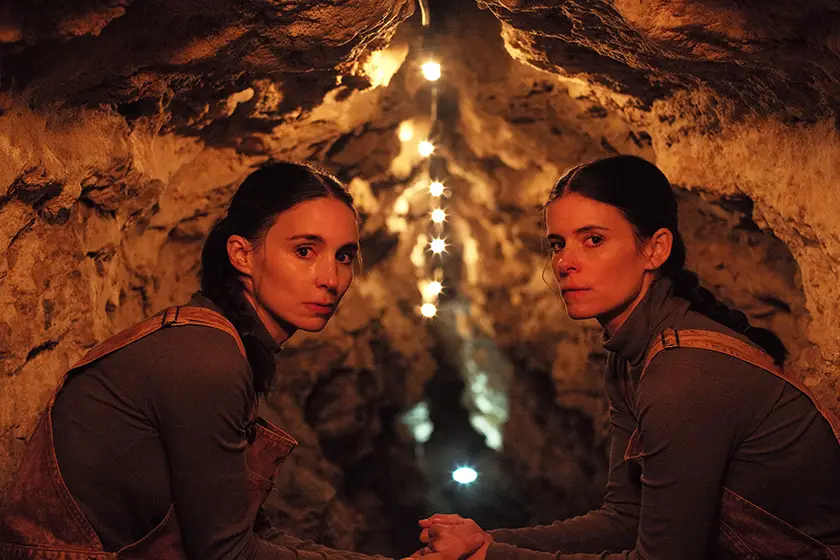
Perfecting these synchronized performances feels like you’ve discovered an entirely new way of acting. How did you practice and build the joint speech throughout the film?
Rooney Mara: We had Werner’s incredible script as the guidebook for everything. Before we even started, Kate and I said to Werner, “I think maybe we should separate some of the lines more”; we were fighting it. But as soon as we came into rehearsals, it became very clear what Werner responded to and what was working within this dynamic.
Then when we got to set and we actually had lines that were separated, it was like nails on a chalkboard. Hearing my own voice without Kate’s was very uncomfortable.
K.M.: It felt very unnatural at that point.
Werner, did shooting the synchronized performances pose a challenge as compared to, say, what a typical shooting day would?
W.H.: We had only one camera and we were shooting sometimes only one take, others only two or three. It was very, very quick and all of the takes were good, so we moved on quickly. My shooting days were very short and nobody could believe it. We stayed under schedule and under budget. But that’s because I am very organized.
While your performances are so in sync, your line deliveries are uniquely distinct in a way that reveals nuances to the personhood of Jean and Joan separately, but also adds color to them as a unit. Did you two prepare for your roles together, or did you allow each other space before filming to find particular individualities in the sisters?
R.M.: I don’t think we really had to work to find those because we are two different humans, so that easily and naturally came across. In fact, there were some times where we were doing different things and Werner didn’t want us to.
W.H.: Because I’m the director.
R.M.: Haha, that you are!
K.M.: If we were ever looking in different locations or making eye contact with say, Orlando at different times, it would be distracting, so some of that stuff took some practice. It would be little things that we would find during the first take where, after I’d say something like “Oh, you’re looking at him on that line so we’ll both do that together,” or “That’s not working so let’s both try this,” and that’s how it became very fluid on set.
W.H.: It became that if we had a second take, it was for that higher precision between them.
The real challenge was not in the motor of speaking in unison, but in the rhythm. Something deeper inside than mouthing in sync.
This is why I always do the slate. I want to be the last one between the actors on the side of the camera and the technical crew on the other because I see everything is all good. I see the lights are good and I listen to the breathing of the actors and I know we could roll, but we shouldn’t because we’re not completely there yet.
When I see they are ready, I do the slate and am the last one to move out to stay the closest one to the camera and the closest one to the actors to facilitate that sync. That’s what makes it all work.
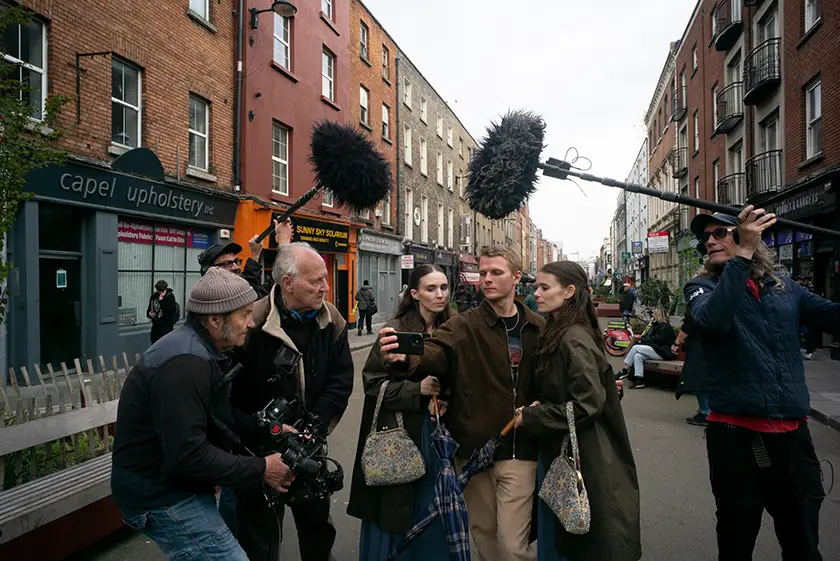
Domhnall and Orlando, I wonder if you could speak on the experience of acting opposite Kate and Rooney’s powerhouse synchronized performance and how it was different from acting opposite other performances you’ve supported in the past.
Domhnall Gleeson: We’re saying earlier on, it’s like that weird feeling of when you talk to one person, but you look between their eyes because you can’t look at both of them at the same time. It felt like that, but instead with two different people.
I love in the film the times when they slightly move apart a little bit, and their individuality creeps in even more. I just thought they did an amazing job in the film and I found their performance really gorgeous. They’re so empathetic; they just make you feel for them so much for the sisters. It was a privilege to stand opposite them.
Orlando Bloom: They were amazingly prepared, and you just felt a little bit in awe watching them. Their performance really infused a sense of awe among the set, and it spread to the characters and everyone in front of them.
The themes and lessons of Bucking Fastard
Bucking Fastard is really a movie about love.
Werner Herzog: Love and the search for love are the central force in the film. Of course it’s a search for the inner landscape, an ideal country like Atlantis or the Orkneys, that exists in our fantasies, but is very human in its search for love.
The world reacts to and interacts with the Holbrooke sisters in incredibly divisive ways. Orlando and Domhnall, you both play two really pivotal characters in how the outside world views them. I was hoping you could speak to the different ways in which your characters see the sisters and how you think it speaks, on a larger scale, to how the world reacts to things they maybe don’t understand?
Domhnall Gleeson: I think it’s the same as how you deal with anyone, right? You can look to take from somebody, you can look to give to somebody, and the best relationships are when you are both giving and taking from each other.
I think they experienced a lot of people in the film who they feel have taken something from them, and my character is just there to give and try to help and try to understand. It felt good to bring his empathy to them, which really is what I felt like Timothy’s job was in the film.
Orlando Bloom: I think Gareth is just very simple. There’s a real truth and purity to how Werner makes movies and the characters that he creates. Gareth was a really simple idea of a man with a very transactional nature, but then there’s a love that he feels for them.
I think he can’t help but recognize the purity of the sister’s love and the beauty of their innocence and vulnerability, which turns into a passion that is really out of his depth. He doesn’t know what to do, so he hands it over to the authorities because he can’t handle it.
It’s interesting how we see the vulnerability and beauty of these girls influence the whole story and the ways that people react to them in both good and bad ways.
Bucking Fastard is layered with so many nuanced themes of loneliness and love and connection and identity. Were there any particular themes that stuck out to you while you were reading the script or shooting the film? Has that answer changed at all since seeing the project?
D.G.: I kept thinking about the co-dependency between them. It’s really hard to know if it’s good for them or not good for them. Reading the script, I was sort of unsure; then when we finished the film I was even less sure.
I think it’s a really cool question to be asking about: at what point is dependence a good thing, and at what point can it stop you from fulfilling your own dreams? I liked how that idea lived sort of in the middle of the film, and I thought it was really interesting.
O.B.: Spot on.
Is there one message in particular you hope audiences walk away contemplating or that you hope the film delivers?
O.B.: That love is a dream. It’s something worth dreaming for and about.
D.G.: The things that can seem unusual about somebody are not the things to be feared. Understanding the unknown, or trying to understand things that are different from you, people that are different from you, is incredibly important and the most human way to live your life.
How Bucking Fastard changed Kate and Rooney Mara’s real-life relationship
When you are in this business and when you have a sister who looks a lot like you, you must have intentionally spent some time trying to create some distance and avoid all the inevitable comparisons. In this film, you have to do the opposite and embrace your similarities to work in tandem with one another. It’s also notably your first time working with one another.
Was it intentional to have your first joint project be one where you really have to embrace one another in a completely unique way?
Rooney Mara: It felt very divine. It was a very confronting task. You do spend your life individuating from your siblings and your family, so there is a real kind of ego death that has to happen when you have to rely so much on another person in one moving performance. I think that was really daunting at first, but then it was really very liberating. It was an incredible experience to be able to do that together.
Kate Mara: Once there would be one similarity, all of these other ones began to present themselves. We already knew we were similar in very specific ways, but then we found all these other secret ways that we are similar as well while making the film.
You’ve both said you are huge fans of Werner’s; what did you learn from your time on this project?
R.M.: I think the thing I would like to take from Werner most is his ability to tunnel vision into doing things his way and drown out anything on the outside. He is so true to himself and such an individual and a poet.
K.M.: And he’s demonstrated such a real pride and caring about the film you’re making. I really find that so inspiring to watch, someone who cares so deeply about the art. I think sometimes there’s a shame in that and there is no shame in the way Werner makes his film and how he goes about getting what he needs.
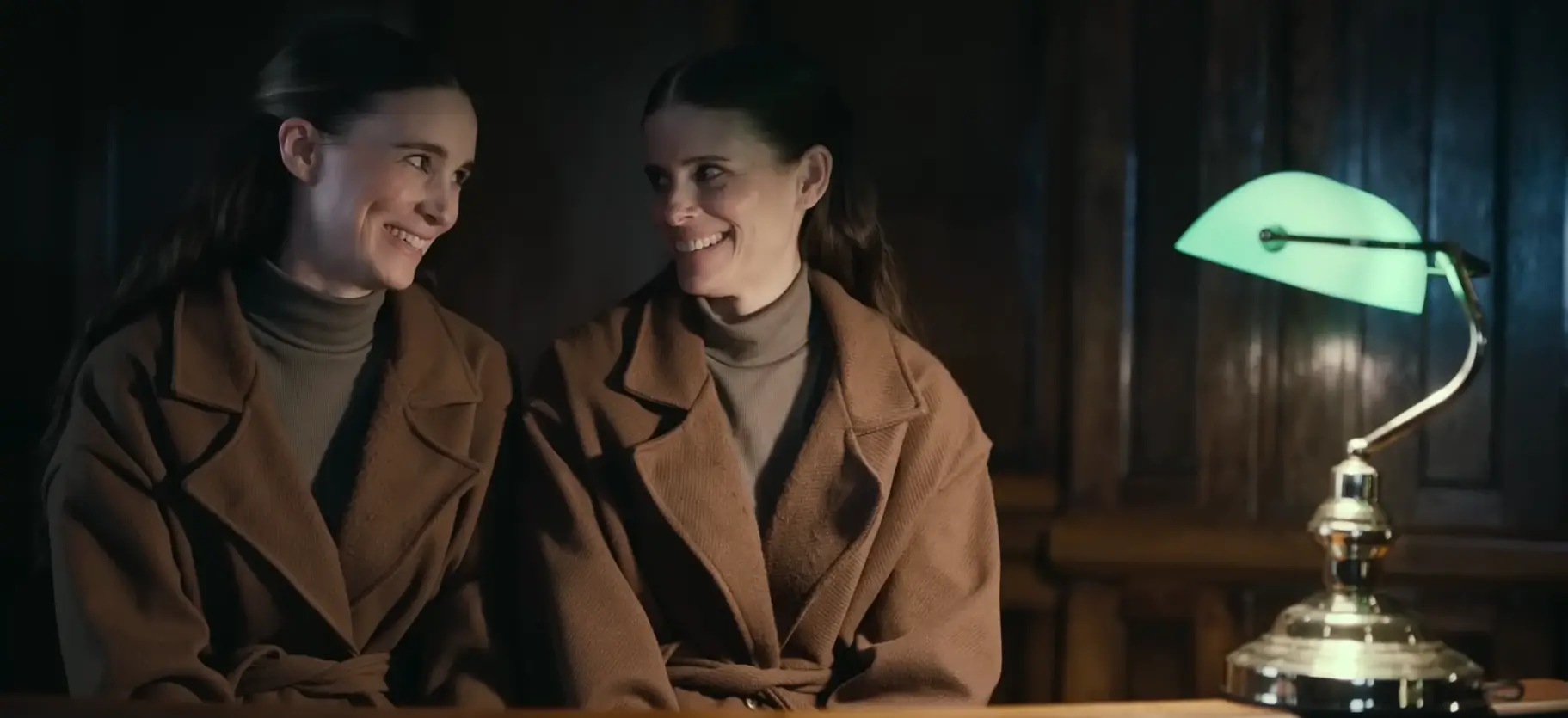
How did working on this film together impact your relationship, if it did at all?
K.M.: It reignited a lot of childhood energy in us, which was really special. Acting is really just playing, right? And as children, that’s what we did best. For years we’d always have some sort of argument about who would play the mom or the baby in a scene or who would have to play the dad-
R.M.: I was always having to be the dad.
K.M.: I did always cast her as the dad.
But to be able to play again as adults and create this world together felt right and really effortless. It felt like coming home together.
Since you already know each other so well, was there anything surprising that you learned about each other through finally having the chance to work together?
K.M.: Yes, but most of the things I won’t share. It’s similar to being friends with another actor or director and then when you work with them it’s a very different experience than just regular life with them.
We had never had that experience on set. I’ve seen all of Rooney’s work; she is my favorite actress, so being able to be on set together made me love her even more.
This interview was edited for length and clarity.
Bucking Fastard had its World Premiere at the 2026 Venice Film Festival on September 3, 2026.
Header credits: Kate and Rooney Mara in Bucking Fastard (Gateway to Orkney LLC, HanWay Films) / Kate & Rooney Mara, Domhnall Gleeson, Orlando Bloom and Werner Herzog at the 2026 Venice Film Festival red carpet for the film (Jacopo Salvi, Archivio Storico La Biennale di Venezia)