
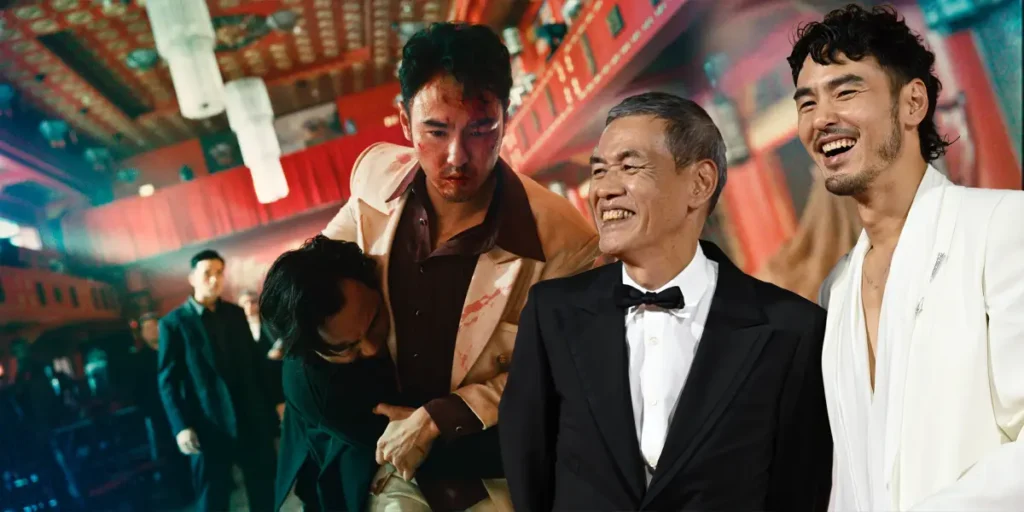
We interview writer/director Sabu and lead actor Ethan Juan about their new film Arrested Memory, which premiered at the 2026 Venice Film Festival.
The characteristics of a traditional action hero have evolved massively throughout the decades, from the stoic lawmen of Hollywood Westerns to the brutal, dishonorable gunslingers of ‘80s blockbusters. Sabu’s latest action movie Arrested Memory imagines a new kind of action hero: one who’s plagued by guilt and shame over an incident in his recent past, and is beginning to lose every memory of who he even is.
Sabu’s film is a high-octane thriller that follows Lee, a superstar detective who is transferred to a rural police station following the deaths of his entire crew during a raid gone wrong. When he’s assigned to retrieve the kidnapped child of a wealthy Japanese investor, Lee quickly realizes that he’s passing his prime—and the echoes of his trauma are coming back to haunt him.
At this year’s Venice Film Festival, we had the opportunity to speak with writer/director Sabu and star Ethan Juan about Arrested Memory. They opened up about the cinematic inspirations behind the film, the challenges that came with this complicated and weighted story, and their experience working together on-set. Read the interview below!
Ethan Juan on Bringing His Arrested Memory Character to Life
Congratulations on this film!
Ethan, it’s difficult enough to play a fictional character, but it’s presumably even more difficult to play a character who doesn’t even remember who they are. Was that an added challenge?
Ethan Juan: Actors remember the script; we remember the words, and that’s really simple. But when I read this script, I just tried to forget it and let things happen. During the shooting process, I was a little bit stressed—but Sabu told me to hold onto that stress and nervousness, because that’s how the character should be.
And how did Sabu’s approach to filmmaking compare to other directors you’ve worked with in the past?
EJ: I’ve worked for so long. [Laughs] Many directors have very different methods, so for me, the most important thing was to get to know Sabu and have conversations with him about the film. I remember once, before shooting began, I drove him to the beach, and we just talked—even with our different languages. I needed to do that because once I knew him, I could understand what he needed from me.
Sabu on Arrested Memory’s Key Themes and Stylistic Influences
One of this film’s biggest themes is the association between guilt and memory. Could you talk about the research that went into that?
Sabu: I actually didn’t research it too much because I didn’t want this to be a movie solely about amnesia. It’s an important theme, but not the main focus. That would totally change the tone of the movie. I was more interested in how Lee’s memory loss affected his life, rather than the condition itself. It’s more important to me to question how natural and instinctual Lee becomes once he’s lost that basic sense of who he is. You become something pure. For example, Lee doesn’t know which people are his enemies and which are his friends, so he simply treats them in return as they treat him. A person’s identity is never based on themselves, it’s always a reflection of how others act towards them.
The action in Arrested Memory feels very reminiscent of older action films. While filming, are you considering how the action genre has evolved throughout the years? Are you adapting your style to fit with that?
Sabu: I felt that judo was the best fit for this film because police officers are simply trained to protect people, so I didn’t want any of that fancy ‘wire action’. I wanted to get down to the basics using judo, just body-to-body. I first wrote this script over 20 years ago, so it will inevitably be similar to those ‘70s or ‘80s action movies. As time progressed, I wanted to maintain that while incorporating something new at the same time. I was trying to blend an old-school style with something new.
Arrested Memory has plenty of funny scenes despite being a very serious thriller. How do you balance these two styles, both as a filmmaker and an actor?
Sabu: That’s always been my style. I’ve never aimed for something especially comical; I always start out seriously, but as the story progresses, something funny will just happen. Following a very serious scene with something more lighthearted can be funny simply due to the contrast. I would actually apologise to Ethan, because jumping between those styles isn’t easy to do. [Laughs]
EJ: It’s not easy for me at all. It’s down to the director to command the film’s tone, I just need to keep my performance grounded and realistic. That’s all.
What have you learned from the other talented directors you’ve worked alongside throughout your career?
Sabu: My work has been impacted by a lot of great directors. I’ve always tried to learn something from the greats; that’s just a part of the journey. Personally, I’ve always loved ‘70s action movies—and if you want to watch something, the best way is to make it yourself.
This interview was edited for length and clarity.
Arrested Memory had its World Premiere at the 2026 Venice Film Festival on September 7, 2026 and was screened at TIFF on September 10.
Header Credits: Ethan Juan in Arrested Memory (Courtesy of the Venice Film Festival) / Sabu and Ethan Juan walk the red carpet for the film (Aleksander Kalka, Courtesy Archivio Storico La Biennale di Venezia)