
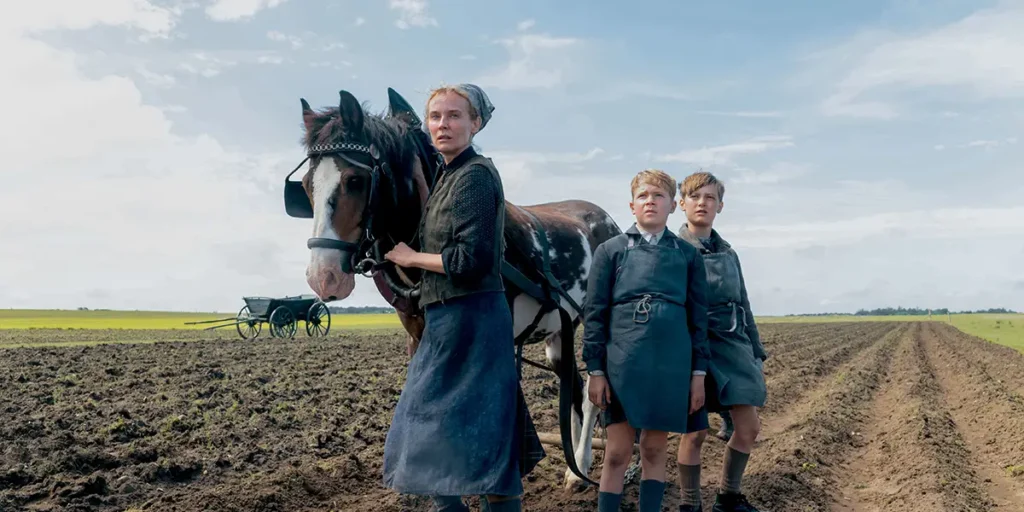
A secluded island is the stage for Fatih Akin and Hark Bohm’s coming-of-age tale Amrum, set during the fall of Nazi Germany.
Directors: Fatih Akin and Hark Bohm
Genre: War, Drama, Coming of Age
Run Time: 93′
U.S. Release: April 17, 2026 (New York); April 24, 2026 (Los Angeles)
U.K. Release: TBA
Where to Watch: In select U.S. theaters
Like The Boy in the Striped Pyjamas, Jojo Rabbit and The Zone of Interest before it, Amrum turns the camera’s gaze away from the frontlines of the Second World War and towards the inner lives of the families of Nazi officials. Fatih Akin’s film, based on the childhood memories of co-screenwriter Hark Bohm, sits somewhere between these three monoliths of 21st century cinema on Nazism – less formally daring than Jonathan Glazer’s work, but with a touch of Taika Waititi’s wry humour and a far more effective and ethical portrayal of lost innocence than Mark Herman’s 2008 film.
Twelve-year-old Hamburg native Nanning (Jasper Billerbeck) lives a bucolic lifestyle on the titular island in the North Sea with his pregnant mother Hille (Laura Tonke), younger brother Hermann (Kian Köppke) and aunt Ena (Lisa Hagmeister, of System Crasher), while his father serves in the SS on the mainland. He is a member of the Nazi Youth, though one gets the impression that only recently has he started to understand what that really means. It’s 1945 and word has it that the war in Europe may soon be over, a thought Nanning’s staunch Hitlerite mother will not entertain. And so this humble pastoral life continues uninterrupted, even if the cracks have begun to show.
The distancing effect of Nanning’s island residence is twofold. Most obviously, it shields him from the truth of what is taking place across the water, but his status as a city boy in a rural setting, unused to the local dialect, creates another sense of isolation, this time from his neighbours. In an early scene he publicly insults his new classmates, German refugees from Soviet-occupied territories, in search of the approval from the local kids that never comes, and finds himself suddenly alone on the school playground. Things quickly change with the death of the Führer and the birth of Nanning’s new baby sister; in a prize example of the dark humour that occasionally arises throughout the film, we are led to believe that Hille’s screams of pain are a reaction to the announcement of Hitler’s demise, when in fact she has just gone into labour.
Suffering from depression in the aftermath of these two seismic events, Hille tells Nanning of her yearning for some bread with honey – quite the rarity on a small isle in times of rationing. Offering a sense of purpose, Nanning’s new mission sees him brave this alien environment and begin a journey of self-awareness and maturity. He visits various figures who not only help him to bring his mother’s desire to fruition, but open his eyes to both the difficulties of rural living and the horrors of the war from which he has thus far been protected, and in which his family is complicit.
The implied parallels between the laws of nature and human conflict, messy though they are, set a classical tone that is reflected in the film’s myth-like narrative structure – our hero’s resolve is persistently tested, by unhelpful adults, run-ins with other youths, and the island’s trepidatious tide, in a tale whose rhythm recalls the Labours of Hercules and the Odyssey as much as any other wartime fiction.
Billerbeck appears in almost every scene, with DP Karl Walter Lindenlaub’s camera often held at his height, so we truly see the world open itself up from his protagonist’s point of view. He is extremely endearing as the dogged Nanning, whose discovery of the truths of life are impactful but secondary to his love for his mother and desire to see her well again. Billerbeck’s interactions with his young peers are particularly compelling, not least in the film’s final sequence, a refreshingly hopeful note that celebrates what Hannah Arendt called ‘the coming of the new and young’.
After The Zone of Interest depicted the cognitive dissonance of Nazi families in the form of avant-garde slow cinema bordering on psychological horror, something as tame and conventional as Amrum was always doomed to feel somewhat flat by comparison. The simple, linear narrative is not supported by especially well-developed characters, and there’s little to remark upon in terms of Akin’s visual approach to telling this story – though granted, he makes good use of the beautiful natural surroundings.
Bohm, who since the premiere has sadly passed away, was originally set to direct Amrum but handed it over to his longtime collaborator Akin due to his declining health. The lack of artistic flair could therefore be put down to a wish to fulfil Bohm’s vision as faithfully as possible – it is described onscreen as ‘A Hark Bohm film by Fatih Akin’. This is a noble aim, and the film is indeed a very accomplished tribute to the man whose life it is based on, but Akin’s reverence for his mentor impedes him in achieving true greatness. This is a safe, competent effort in an ever more crowded field of World War II cinema.
Amrum (2026): Movie Plot & Recap
Synopsis:
On the quiet island of Amrum, twelve-year-old Nanning sets off on a mission to make bread and honey for his mother, a staunch Nazi reeling from the death of Adolf Hitler. On his journey, he is forced to deal with setbacks, discover the harsh realities of rural life, and face up to the truth of the horrors in which his family is complicit.
Pros:
- A coming-of-age story with a classical, myth-like narrative structure
- A strong lead performance from a charming young lead
- The cinematography makes great use of use of natural landscapes and tells the story from the child protagonist’s point of view
Cons:
- Conventional storytelling feels flat compared to more daring recent WWII films
Amrum was released in New York at the Quad Cinema on April 17, 2026 and will be out at the Laemmle Royal in Los Angeles on April 24.