
Joshua Bailey’s Stolen Kingdom turns Disney World’s theft economy into a funny, jaw-dropping true-crime caper with a slippery suspect.
Director: Joshua Bailey
Genre: Documentary
Run Time: 74′
U.S. Release: May 20, 2026 (Letterboxd); May 21, 2026 (theatrical); June 16, 2026 (VOD)
U.K. Release: TBA
Disney has spent a century convincing us that the seams don’t exist. The paint stays fresh, the cast members never break character, and the trash gets collected before you even notice it dropping. The whole engineering miracle is built on a promise that there is no behind-the-scenes worth investigating, only the magic out front.
Which is, of course, exactly the kind of premise that’s catnip to a specific kind of obsessive. Stolen Kingdom, the remarkably confident documentary debut from director Joshua Bailey, is about the people who decided to crawl behind the curtain and see what was back there. Some of them did it for the thrill. Some did it for the photos. A few of them did it for the cash.
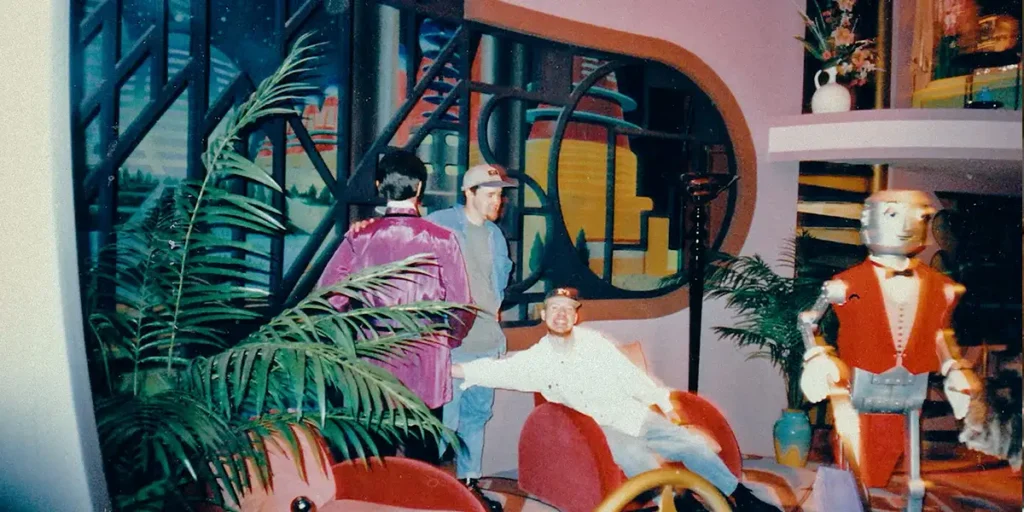
Bailey structures the film around a single mystery: in 2018, an animatronic named Buzzy went missing from a long-shuttered Epcot attraction called Cranium Command. He was a quirky character beloved mostly by Disney nerds who’d been visiting since the late eighties. Once he disappeared, he turned into a coveted piece of stolen park memorabilia. Stolen Kingdom asks who took him, but that answer becomes the least interesting question. The more compelling one is why this whole subterranean economy exists in the first place, and what kind of person ends up inside it.
The film explores that ecosystem in layers. At the wide end, you have urban explorers like Adam the Woo and Dan Bell, YouTubers who built audiences sneaking onto Discovery Island, the abandoned Bay Lake nature preserve that’s been overgrown into a Florida Jurassic Park since 1999. Their footage is genuinely cool, all foam rocks and rotting signage, and there’s a real spy-movie kick to watching grown men duck behind manicured topiaries.
Then Bailey zooms in closer, focusing on people like Matt Sonswa. His 2017 video of the abandoned Cranium Command served as a shopping guide for the next tier of bad actors. We zoom in even tighter until we land on Patrick Spikes, a former Disney cast member whose name keeps coming up in connection with Buzzy, and who carries himself through the film like a man who has rehearsed his denials in a mirror.
What makes Stolen Kingdom so watchable across its 74 minutes is the absurd disconnect between the gravity of the crimes and the contents of the appropriated items. We’re talking about felony-level burglaries of, frequently, raggedy hats and decades-old animatronic shirts. One interviewee calls the Buzzy job “the Ocean’s 11 of Disney World” with a totally straight face. The deadpan never falters, and Bailey understands how to let that contradiction speak for itself without emphasizing it.
He’s also smart about Spikes, who is clearly the film’s antagonist and seems to know it, even relishes it. There’s a swagger to the way he plays into his own notoriety, right up until law enforcement enters the picture and the swagger drops out of his voice like someone pulled the plug. Bailey doesn’t add commentary; he simply keeps filming as Spikes digs a hole for himself. The film has a Jinx-adjacent moment of self-incrimination that I won’t spoil, except to say that it earns the comparison.
Technically, this is a tidy piece of work. Brandon Pickering’s cinematography skillfully manages both grainy archival YouTube footage and crisp interview lighting. Brendan Canty (of Fugazi, no less) provides a score that blends caper-movie coolness with a more somber tone, hitting the exact emotional mark the film aims for. The editing team (Nathan Bracher, Matthew Kosinski, Willi Patton, and Matthew Serrano) sprinkles tiny visual clues throughout the film. These can appear as either hints or coincidences, depending on how closely you look. Observant viewers might develop their own theories before Bailey reveals the truth.
My main complaint is that I wanted more. At 74 minutes, the runtime feels almost too disciplined. I would have gladly watched another twenty minutes of background on these guys, their families, what their parents make of all this, what made Patrick Spikes into Patrick Spikes. As a Disney lifer myself, I’d be lying if I said I’m not the exact target audience for this thing. Still, Bailey has created something that resonates whether you know the Magic Kingdom intimately or you can’t identify Mickey Mouse in a lineup. That’s a hard bridge to build, and he builds it without flinching. Parts of the kingdom may have been taken, but the movie is a real steal.
Stolen Kingdom (2026): Movie Plot & Recap
Synopsis:
A documentary investigation into the underground community of Walt Disney World urban explorers, thieves, and obsessives, anchored by the 2018 disappearance of a beloved Epcot animatronic named Buzzy.
Pros:
- A fascinating, fully accessed look at a genuine subculture
- Patrick Spikes is one of the year’s most compelling on-camera figures
- The American Vandal / Jinx tonal blend pays off beautifully
Cons:
- At 74 minutes, leaves you wanting more backstory on the subjects
- Some viewers may need a quick Disney-park primer to catch every detail
Stolen Kingdom is now available to watch on the Letterboxd video store and in select U.S. theaters, and will be released on digital platforms on June 16, 2026.