
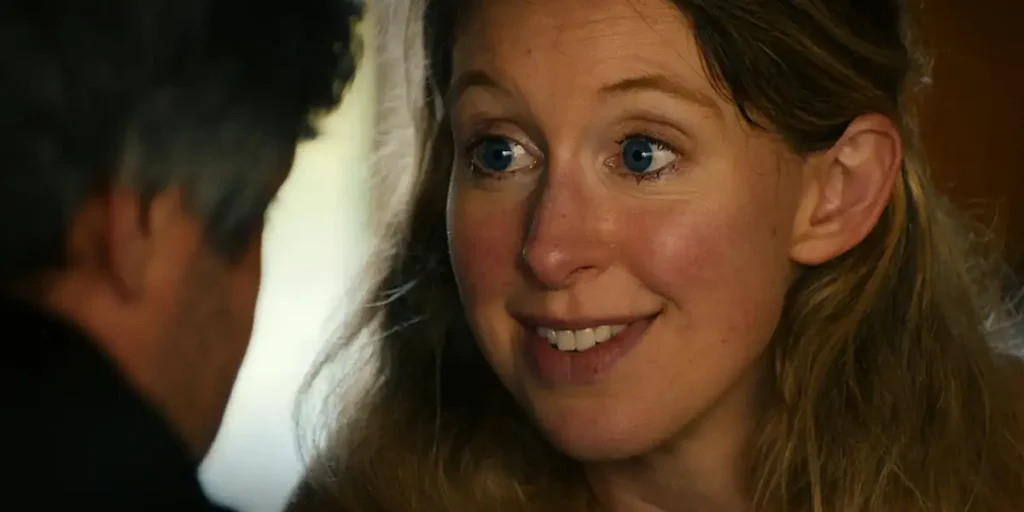
Nathan Fielder and Lance Oppenheim’s You Can See Everything turns documentary filmmaking on its head to create the best film of the year.
Directors: Nathan Fielder, Lance Oppenheim
Genre: Biographical, Documentary
Run Time: 174′
Rated: R
U.S. Release: October 16, 2026 in theaters
U.K. & Ireland Release: November 20, 2026 in cinemas
When word emerged that comedian Nathan Fielder (The Rehearsal), notorious for his deadpan humor and elaborate scheming in the name of comedy, was visiting Theranos founder Elizabeth Holmes in prison, the world could never have prepared for what this project would yield. While Fielder’s longstanding history of absurd solutions to some of the most minuscule and/or load-bearing issues you can think of is what has solidified him as a master storyteller, with You Can See Everything he crosses the threshold from comedic brilliance to filmmaking genius.
Not only does the film allow you to see Fielder in an entirely new light; it sophisticatedly implores audiences to form a solid opinion on a subject that is either the world’s greatest master manipulator or most misunderstood victim.
In 2003, at Stanford University, 19-year-old Elizabeth Holmes founded the company Theranos. The company, whose name is a combination of therapy and diagnoses, was predicated on the development of a technology that, with one drop of blood, would be able to run hundreds of comprehensive lab tests. The implementation of this technology would have changed the medical field as we knew it and provided accessible healthcare to many who could not otherwise afford it.
While Holmes was able to raise hundreds of millions of capital for Theranos and became the youngest female self-made billionaire at the peak of the company in 2014, her rise quickly plummeted when it was revealed the technology simply did not work as promised. Through an exposé in The Wall Street Journal, it became public that the machines could not operate as advertised, false positives and negatives had been sent to real-life patients and it was alleged that the top figures in the company were aware of this and deceived patients and investors regardless.
This case, and the subsequent fictional Hulu show it inspired (The Dropout), had everyone weighing in on the motivations of Elizabeth Holmes. Was she a cold-hearted sociopath on a journey to become successful regardless of her technology’s actual functionality? Or was she a victim of manipulation from Ramesh “Sunny” Balwani, Theranos’s Chief Operating Officer, with whom she secretly had a toxic romantic relationship? Did she genuinely not know her technology did not work, or get in over her head and act out of desperation trying to save her reputation?
When You Can See Everything begins, we meet Holmes and her husband, Billy Evans, in a rental home they are living in, located in San Diego. Just thirty-four days before she is set to serve her eleven-year sentence for wire fraud and conspiracy related to defrauding investors, Holmes has invited a camera crew led by Nathan Fielder and Lance Oppenheim into her home to document her days leading up to her imprisonment. She repeatedly tells Fielder, who appears on camera throughout the entirety of the documentary, that he and his crew have full access to everything she and her family say or do. In a clarifying text, she explicitly says “you can see everything” to Fielder.
However, her partner Billy seems to feel much more on edge about this constant surveillance they have both agreed to. While Fielder masterfully tries to get to the crux of the questions everyone who knows of Holmes is dying to find out, he is dealing with the roadblock that is Billy, who is constantly requesting breaks in filming, saying the crew needs to get out of the family’s way and trying to straight up cut off the camera from accessing anything he deems unfit for the narrative they are trying to build.
While Fielder is initially extremely skeptical about Holmes and her proclaimed innocence, he begins to understand the way in which she operates, but is unable to dive as deeply into her motivations as he wants to because of Billy’s bizarre and controlling antics. As time begins to run out, Fielder ends up physically moving into their guest home to try and find the answers he is seeking before Holmes must go serve her time.
When their time eventually runs out, Nathan’s goodbye to Holmes feels charged with the understanding he sees her in a completely new light, but also is not any closer to the answers he sought to find. When she goes to prison, Fielder’s access to her becomes limited; Billy serves as his only channel to speak with Holmes while she is in jail. It’s through this restricted access to her that You Can See Everything morphs into an entirely different project and the documentary quickly and completely flies off the rails.

You Can See Everything is the definitive film of the year. Fielder and Lance Oppenheim’s direction of this movie is nothing short of revolutionary, transcending the bounds of what documentary filmmaking can look like. It constantly references and questions Fielder and Oppenheim’s ability to look at Holmes and the documentary through a subjective versus objective lens and, in seeing Fielder’s intense struggle with forming a solid opinion on his film’s subject, demonstrates to audiences just how nuanced the web of Elizabeth Holmes and the questions surrounding her is.
Each turn of the film takes audiences down a wildly unexpected road in this mind-bending labyrinth of a documentary that is unlike anything you’ve ever seen before. Fielder has a unique ability to both stay in control of the story and allow it to venture into unknown territory for the sake of its evolution. We get to see him in an entirely new light as a storyteller as he feels an allegiance to telling Holmes’s story correctly, regardless of the fact that he isn’t sure he can really trust her.
It’s fascinating in that both Fielder and Oppenheim make it abundantly clear they do not trust Holmes at the beginning of the project; however, even they are unable to escape the spell she can cast on people. While everything you may have read or heard about Holmes may have you thinking one way about her, she is a surprisingly disarming person, and the film playfully implores audiences to grapple with her multitudes. The documentary wants to dive deeper than asking the question “Is she a scammer?” and rather understand how in the world she can stay so steadfast in her declaration of innocence and strangely enough lure people into her web of constant contradictions.
By the end of You Can See Everything, I don’t think you will by any means have a clearer understanding of who Elizabeth Holmes is or how much of her crimes she genuinely understands she committed. Is she a sociopath? Is she a victim? I don’t know that anyone is able to truly answer those questions, much less the people who have spent the three-year journey this film has taken this documentary crew on. However, I think you will walk away with something richer and more fulfilling than a cut-and-dried answer, which is the gift of dissecting the nuances of a real-life character as fascinating and contradictory as her.
You Can See Everything (2026): Movie Plot & Recap
Synopsis:
Thirty-four days before she is sent to prison for her crime of federal fraud, infamous Theranos founder Elizabeth Holmes invites a documentary camera crew into her home in an attempt to have a say in the retelling of her life story.
Pros:
- Filmmaking beyond the scope of anything audiences have ever witnessed before.
- Nathan Fielder and Lance Oppenheim’s direction is genius.
- Every turn the film takes brings audiences down a wildly unexpected road in this mind-bending labyrinth of a documentary.
Cons:
- None to name.
You Can See Everything was released in US theaters on October 16, 2026. The film will open in UK & Irish cinemas on November 20.