
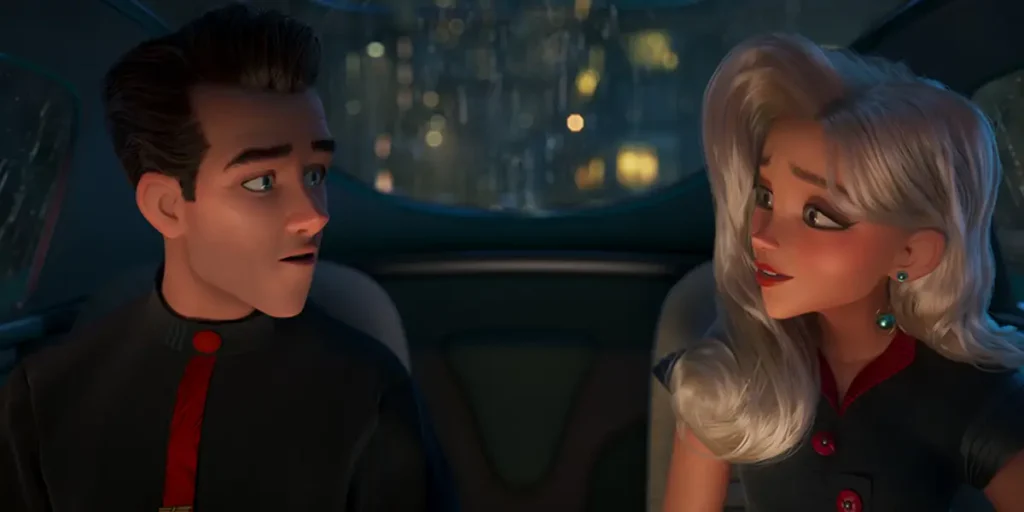
Brad Bird reminds the world why he’s the greatest animation filmmaker working today with the jaw-dropping Ray Gunn.
Director: Ray Gunn
Genre: Animation,
Run Time: 119′
Theatrical Release: December 4, 2026 in select U.S. theaters
Digital Release Date: December 18, 2026 globally on Netflix
“Welcome to the Future” is the first line you hear in Brad Bird’s incredible Ray Gunn. It serves not only as an introduction to the retro-futuristic world of Metropia, a landscape that has been gestating in Bird’s imagination for more than thirty years, but also as a signal of the filmmaker’s latest stage in his reinvention of animation as the purest and most artful medium cinema can achieve.
While it may not reach the apex of his ultimate masterpiece, Incredibles 2, Bird’s latest genre-blender serves as a potent reminder of why he’s in a league ahead of literally everyone else doing animated films for Hollywood studios, fundamentally understanding how images can evoke awe and wonder at almost every turn.
What starts out as a quasi-riff on the mechanics of The Incredibles turns into something else entirely as Bird and co-screenwriter Matthew Robbins further develop the world of Metropia through the figure of the film’s titular character (voiced by Sam Rockwell), a private detective who, in a world proliferated by technology, still believes old-fashioned methods are the best way to solve a case. He has help from his alien partner and friend, Eye-ra Kadok (Tom Waits), but Gunn refuses most of the advances this society has blindly accepted. That’s why Arnold Dom (Bobby Cannavale), owner of the Moon Room and husband of popular singer Venus Nova (Scarlett Johansson), seeks him out: he knows his discretion and reliance on ancient methods will ensure she never suspects a detective is watching her every move.
Already, one can sense a potent anti-AI (and the evils of corporate overlords, though doesn’t it feel strange that David Ellison produced this?) message before Bird pushes it forward even more, but the one thing you need to know is, as with every good noir, the case isn’t as clear-cut as it sounds. Arnold suspects Venus is having an affair. Ray is to catch them in the act, but when he does, it almost feels like he’s being deceived, and the truth about who Arnold is partnering with is hidden. When he finds out that alien mob boss Francis “Slugsy” Xavier (Matt Berry) is heavily involved in an operation to scandalize Venus so much that her career will be destroyed, the film’s entire narrative landscape shifts.
But it does so through a series of impeccably mounted, bracingly kinetic action sequences that constantly showcase the filmmaker’s endless imagination. Of course, he repeats himself slightly by having Michael Giacchino punctuate early fistfights and futuristic weapon confrontations with a jazz-inspired musical score, but that repetition is necessary for the movie to open up into unpredictable territory. Sometimes, you have to acclimate audiences to how your world works, how aliens and humans coexist, how the action will differ from a film like The Incredibles, and then you surprise and dazzle them when introducing audiences to the shape-shifting KHAL A-113 Particle Blaster, a weapon that will have a major role in the movie’s best sequence much later down the line.
Each element Bird introduces through his imaginative, detailed tableaux naturally builds toward a grandiose conclusion that continues to prove the director’s adoration for film, even as he is about to blow out seventy candles next year. Bird hasn’t necessarily made many movies in his lifetime, but his filmography is one of the most treasured in contemporary Hollywood history because he always pushes the medium forward and finds something new, drawing characters and a universe that feels as three-dimensional and textured as our reality. You fully believe in Metropia, in its opulence and sense of beauty, but also in its corrupted nature when Bird begins to delve into the criminal underworld. The level of detail is also astonishing, and it wouldn’t surprise anyone if I said that Ray Gunn is Skydance Animation’s most excitingly realized animated world.
Lord knows if this division of Ellison’s large media conglomerate will survive in the wake of the Warner Bros. merger (or if it will be integrated into Paramount and Warner Bros. Animation), but it’s no secret they haven’t found a real winner in the films they’ve released. Most of them were forgettable streaming fare that recycled screenplays we’ve already seen before, in far better movies, despite the obvious craft that went into them. After stepping down from Pixar in disgrace, it felt as if John Lasseter was simply reheating the nachos he found much success with in his heyday, but without any of the creativity and thought-provoking emotional storytelling of his greatest achievements.
Ray Gunn is an actual winner, because Bird’s sense of scale and emotion is simply unmatched. He deftly blends hilarious (read: laugh-out-loud) physical comedy through intricate action scenes with real weight and urgency. He’s not simply doing action for action’s sake. There’s emotional intent in almost every sequence, even when the aforementioned particle blaster malfunctions and distorts Ray’s form, leading to a series of unexpected situations that culminate in a shocking (yet morbidly funny) punchline.
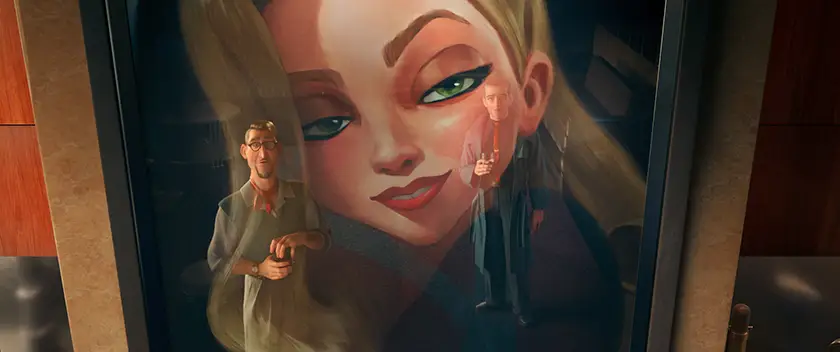
Maybe that’s what sets Bird apart from everyone else. He isn’t afraid to enthrall both kids and adults, and he always gives his animation a certain edge that mainstream animated films don’t have. The edge is only slight, so you won’t realize just how mature his movies are until you grow old and see that a movie like The Iron Giant or Ratatouille appeals to you in a much different (but still emotional) way than it did when you were a child. Kids will probably perceive Ray Gunn differently than their parents, but a second viewing as they mature will yield a different response. That’s perhaps Bird’s greatest asset, and he continues to refine it with each passing movie, whether through animation or by incorporating the techniques he developed for his live-action works.
In any event, both Rockwell and Johansson portray characters who feel so alive in the hands of Bird’s writing and expressive animation that it’s not hard to fall in love with what its detailed images are showing. Bird always fills our periphery with such intense attention to detail that each figure we meet, whether a human or alien, seem completely developed, even if we don’t spend much time with them. That’s how good he is, but it also helps that he surrounds himself with incredible talent to lend their voices to the film’s wide array of colorful figures. Beyond the leads, Waits, Cannavale and Berry all impress with their sense of comedic timing, which undoubtedly responds to Bird’s own, and give Ray Gunn the support it needs to elevate its arresting and unbelievable animation.
It’s the stuff that only dreams seem to be made of, but Bird loves to dream in real-time and bring us back to when times were so simple. Every time I watch one of his movies, life’s incredible again (to make a reference to Giacchino’s greatest-ever composition). You feel renewed at the prospect that cinema can still move and excite you, even if it feels like such a rare commodity nowadays, in a world filled with AI slop that snake oil salesmen are trying to peddle as the future of filmmaking.
An algorithm couldn’t conceive such hand-crafted wonders like Ray Gunn, and its narrative imperfections in the film’s last half act more as a feature than a bug, especially as Bird will always try to think what cinema can – and should – achieve, as he will likely be plotting what to do next after attempting to conceive this world for more than thirty years. Human-made art will always prevail, and reign supreme, no matter what anti-art individuals will try to sell you. There isn’t anything quite like Ray Gunn, and Brad Bird likely won’t make the same thing again. Welcome to the Future.
Ray Gunn: Movie Plot & Recap
Synopsis:
In the retro-futuristic world of Metropia, private detective Ray Gunn and his partner Eye-ra Kadok investigate a series of murders tied to the inner circle of popular singer Venus Nova.
Pros:
- The animation work is frequently jaw-dropping and dazzlingly realized.
- The world of Metropia is detailed and lived-in.
- The action sequences feature Bird’s signature kineticism, integrating live-action filmmaking techniques through fully realized (and colorful) animated frames.
- Sam Rockwell, Tom Waits, and Scarlett Johansson all give fantastic vocal performances.
- The supporting cast brings serious levity to a movie that never takes itself too seriously, but has a slight edge for adult viewers to enjoy.
- Michael Giacchino unsurprisingly gives another generational musical collaboration with Brad Bird.
Cons:
- Some later narrative developments are slightly head-scratching, but never to the full detriment of the picture.
Ray Gunn will be released in select U.S. theaters on December 4, 2026 and will be available to stream globally on Netflix on December 18.