
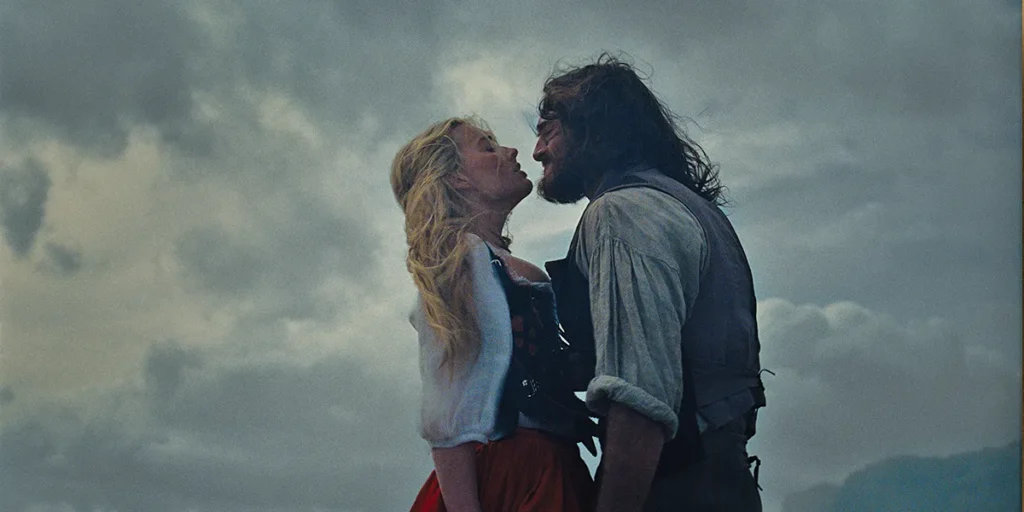
Emerald Fennell’s Wuthering Heights (2026) is lush, erotic, and exhausting, an intoxicating but overlong take on obsession and class.
Director: Emerald Fennell
Genre: Period Drama, Romance, Drama
Run Time: 136′
Rated: R
Release Date: February 13, 2026
Where to Watch:
Emerald Fennell has never been particularly interested in restraint, and her adaptation of Wuthering Heights makes that clear within its opening minutes. The film begins with a startling, almost perverse image: sounds that initially suggest sexual pleasure slowly reveal themselves to be the labored breaths of a public hanging.
It’s a blunt thesis statement, immediately binding desire and suffering together, insisting that in this version of Wuthering Heights, love is inseparable from cruelty, and pleasure cannot exist without pain. It’s excessive and very provocative, which also neatly describes the film that follows.
Loosely based on Emily Brontë’s novel, Fennell’s Wuthering Heights has little interest in being faithful beyond broad narrative strokes. This is not a reverent literary adaptation; instead, it’s a heightened, erotic, emotionally overheated reimagining that treats the story as a fever dream about obsession, class resentment, and self-destruction. Whether that approach feels invigorating or exhausting will likely determine how audiences respond to it.
The film traces the familiar arc of Cathy Earnshaw (Margot Robbie, of Barbie) and Heathcliff (Jacob Elordi, of Frankenstein), beginning with their childhood at Wuthering Heights. As children, they cling to each other out of necessity. Heathcliff, poor and abused, endures violence simply to remain close to Cathy, and she becomes both his refuge and his reason for surviving. Fennell emphasizes how their bond forms not out of innocence, but out of shared isolation and cruelty inflicted from the outside. Even early on, there’s something unhealthy about how tightly they hold on to each other, as if the world has taught them that love must be possessed before it’s taken away.
As they grow older, that childhood intimacy curdles into something darker. Margot Robbie’s Cathy becomes increasingly aware of class, comfort, and the limits imposed on her as a woman. Loving Heathcliff may feel natural, even inevitable, but it would also mean choosing poverty, instability, and social exile. Robbie plays Cathy as this mix of radiant and reckless, but never naïve. Her eventual decision to marry Edgar Linton (Shazad Latif), a man who offers wealth and security rather than passion, isn’t framed as betrayal so much as brutal pragmatism. It’s a choice that keeps her physically safe while emotionally hollowing her out.
Jacob Elordi’s Heathcliff is the film’s center of gravity. Fennell’s casting choice alone signals how little she cares about tradition even if it may bring along some expected controversy, but Elordi makes it work through sheer presence. His Heathcliff is this wounded man who is obsessive and simmering with resentment, a man whose entire identity has been shaped by rejection and humiliation. When Heathcliff disappears and later returns wealthier and more dangerous, the film treats his transformation l as corrosion. He hasn’t healed; he’s sharpened himself into a weapon.
The chemistry between Elordi and Robbie is intense and steamy and even a tad uncomfortable, which feels entirely intentional. Their scenes together pulse with desire and mutual destruction. This is a film that is unapologetically horny, but not in a way that ever feels playful or liberating. Sex here is compulsive, desperate, and entangled with power. Fennell refuses to romanticize Cathy and Heathcliff’s bond, even as she presents it as inescapable. They don’t complete each other. They ruin each other.
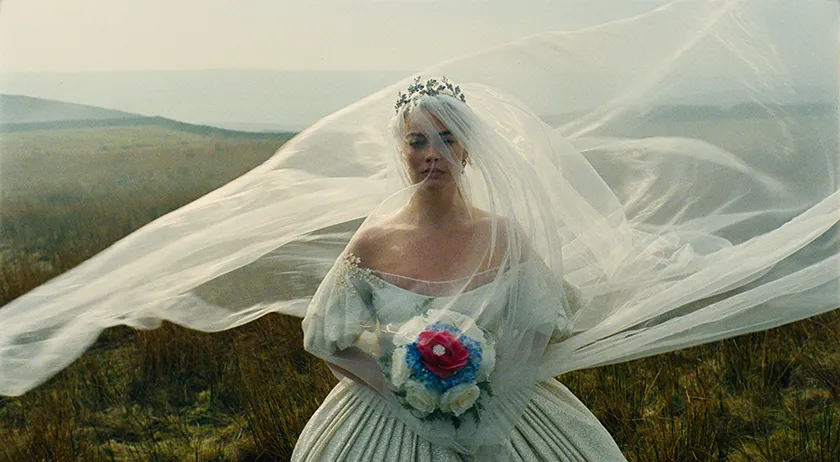
Visually, the film is often extraordinary and gives the eyes a real feast. Linus Sandgren’s cinematography leans into rich, saturated colors that heighten the emotional extremity of every scene. The Yorkshire moors feel vast and oppressive, both freeing and isolating. The production design and costumes are meticulously considered, often reflecting the characters’ internal states. Cathy’s wardrobe, in particular, becomes increasingly ornate and restrictive as her sense of entrapment deepens. There’s craft on display here; every frame feels designed.
And yet, the film’s excess is also its greatest weakness. At nearly every turn, Fennell opts for volume over nuance. There is little room for subtext or ambiguity. Every character practically tells the audience how they feel and the pacing suffers as a result, with scenes stretching past their natural endpoint, bludgeoning the audience with the same ideas long after they’ve landed. The film feels overlong, as if Fennell didn’t trust the material or the audience to sit with implication alone.
This lack of subtlety extends to the film’s thematic work. Class violence, repression, and trauma are all present, but they’re delivered with such insistence that they begin to feel flattened. Fennell is so committed to her interpretation that alternative readings are effectively shut out. You’re never allowed to forget what the film is about, even when it might benefit from silence.
Still, there’s something intoxicating about Wuthering Heights. Its atmosphere is thick with longing and despair, and its commitment to emotional extremity is almost admirable. Fennell doesn’t soften the story or search for redemption where none exists. Cathy and Heathcliff are portrayed as toxic, destructive people who devastate themselves and everyone around them and yet, in this vision, they remain cosmically bound. Not meant to be together in any healthy sense, but unable to exist apart.
That contradiction is where the film is most compelling. Wuthering Heights isn’t a love story so much as a portrait of desire turned poisonous, of trauma mistaken for destiny. It’s messy, excessive, often frustrating, and frequently beautiful. Audiences will likely either embrace its maximalism or recoil from it entirely. I found myself caught in between admiring the ambition, exhilarated by individual moments, but worn down by the relentlessness of it all.
Emerald Fennell’s Wuthering Heights may not be subtle, faithful, or restrained, but it is unmistakably hers. For better and worse, it’s a film that refuses moderation, daring the audience to either surrender to its intensity or reject it outright.
Wuthering Heights (2026): Movie Plot & Recap
Synopsis:
The film follows Catherine Earnshaw and Heathcliff from their turbulent childhood at Wuthering Heights through a lifetime of desire, class resentment, and emotional destruction.
Pros:
- Jacob Elordi delivers a magnetic, wounded performance that anchors the film
- Intense chemistry between Elordi and Margot Robbie
- Lush, striking cinematography from Linus Sandgren
- Detailed production design and costuming that reflect psychological entrapment
- Bold, unapologetically maximalist vision from Emerald Fennell
- An intoxicating atmosphere steeped in longing and despair
Cons:
- Overlong runtime with noticeably uneven pacing
- Heavy-handed themes with little room for subtext
- Emotional beats often overstated rather than earned
- Excess occasionally dulls the story’s impact
Wuthering Heights (2026) is out now globally in theaters. Read our reviews of Saltburn and Promising Young Woman, and our article on Saltburn’s ending explained.