
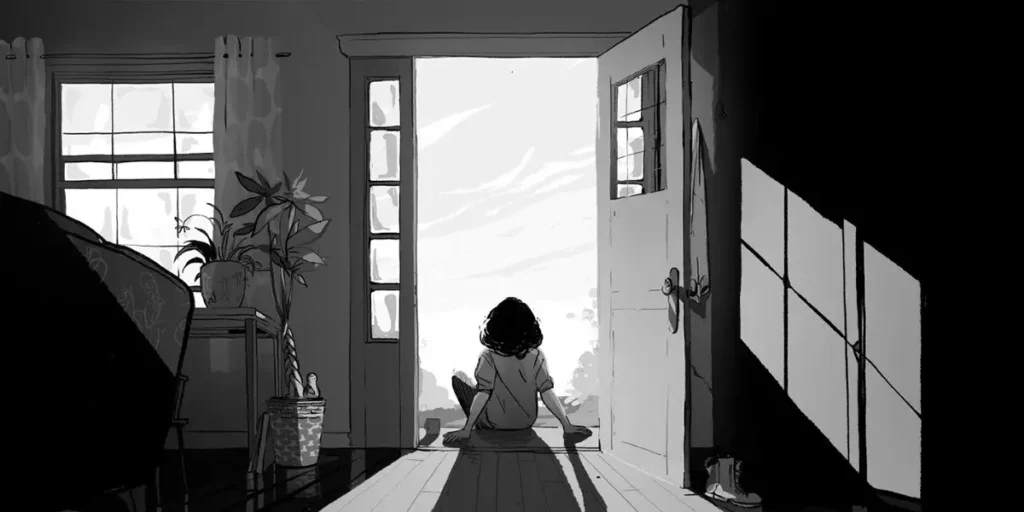
With emotion in spades and a clever analysis of its own viewpoint, Tangles is a moving look at how a family responds to a terminal diagnosis.
Director: Leah Nelson
Genre: Animated, Drama, Family
Run Time: 102′
Cannes Premiere: May 14, 2026 (Special Screening, First Film)
U.S. Release Date: TBA
U.K. Release Date: TBA
When graphic artist Sarah Leavitt’s mother Midge began suffering from what would be revealed to be Alzheimer’s Disease in 1999, Sarah’s life was turned upside down. Forced to travel between her Maine hometown and her new life in California, while trying to keep both her family and her west coast life going, Sarah endured heartbreak upon heartbreak, before turning her pain into an acclaimed graphic novel.
“Tangles: A Story About Alzheimer’s, My Mother, and Me” was published in 2010, and hailed as a remarkable empathetic look at degenerative disease from the point of view of those caring for the afflicted. Directed by Leah Nelson, the animated film adaptation of Tangles is faithful to Leavitt’s work and worldview, even if that faithfulness leaves it feeling less like a film on its own merit, and more like the book’s panels set to music.
Losing a family member to degenerative disease is universally painful, and anyone who has gone through it will find something in Nelson’s film that rings true. However, an early intertitle underlines the film’s inherent subjectivity. In Leavitt’s own words, some of her family will remember the events that follow differently, but “[T]his is just how I remember it”.
Tangles is about loss, but it’s particularly concerned with how we view and process that loss. Everyone’s subjective experience informs how we interpret, process and react to such events, and Nelson’s film is unapologetically from one woman’s viewpoint. Leavitt’s experience of her mother’s illness is framed through her work, life and relationships. Living in San Francisco in her 20s, Leavitt (voiced by Abbi Jacobson) worked as an artist for a queer interest magazine, living a happy life as a young lesbian, and still maintaining a healthy relationship with her family. As for anyone, all these things exist in a delicate balance, and tragedy arises when this balance shifts.
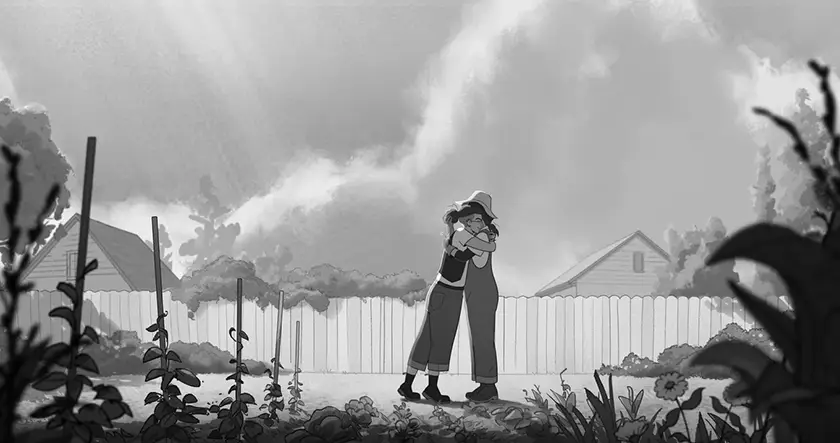
For the heaviness of its material, Tangles is a remarkably playful film. It has to be in order to investigate the limits of objectivity. Of course this isn’t a documentary, but Tangles seeks to understand the point at which facts are laid down, and when ‘truth’ (in the subjective sense e.g. my truth) takes over. The reality of Sarah’s familial situation is factually difficult, but the truth of the matter lies in how her interpretation of this fact is shaped.
The animation may be black and white, yet the ideas being examined are anything but. Sarah feels no antipathy towards her family, though her existing priorities of work and a burgeoning relationship with Donimo (Samira Wiley) will be inextricably damaged by the need to be present at home. Tangles may be a handsome animation, but it’s certainly not for children. Sarah’s work and relationships find joy in their queerness, and it is refreshing that there is no pushback against that from Leavitt’s family or anyone else in her life. The film doesn’t need that drama; there’s more than enough waiting at home when Sarah visits again.
Sarah arrives back in Maine to find her mother Midge (Julia Louis-Dreyfus, of The Sheep Detectives) gardening, despite having left the iron on, and very quick to temper. Sarah’s sister (Beanie Feldstein, of Lady Bird) and father (Bryan Cranston, of The Phoenician Scheme) are trying to take her encroaching illness in their stride, though their approach is too hands-off for Sarah to tolerate. It’s a sad fact that responses to a life-changing diagnosis will differ from person to person, and when those manifest within the family, Tangles makes sure to show them, no matter how selfish or cold any one party may be.
These tensions bleed into Sarah’s art, causing her commissions for her job to become darker in tone. When a heated moment reaches a crescendo, Nelson plunges into Sarah’s psyche by animating her nightmares. Where once she drew tasteful erotica, her mind is now haunted by skeletal imagery, as she dreams of her mother losing herself piece by piece. These flights of animated fright are the highlight of Tangles, their energy allowing the material to transcend its printed origins.
Tangles is necessarily moving; dementia has only one prognosis, which differs only in timescale. Spending this time in Sarah’s mind invests us in her and her mother’s pain. Even as her mother slips away, we get to know both women in ways that edify and reassure. It’s also a clever film in its analysis of its own genesis, standpoint and what it is meant to do as a piece of storytelling. However, while the black and white animation is stark, it also pins the art to the page, rarely able to breathe cinematically outside of those dark moments of imagination. Factor in some unnecessary stars in the voice cast (Seth Rogen only ever sounds like Seth Rogen), and the film threatens to undermine its very worthwhile efforts. Even so, Tangles has the capacity to connect beyond its potential pigeonholes by showing that illness and inevitability don’t care about categorisation.
Tangles (Cannes 2026): Movie Plot & Recap
Synopsis:
The animated tale of Sarah Leavitt’s attempts to help her family cope with her mother’s Alzheimer’s diagnosis.
Pros:
- A very smart script analyzes how we interpret grief and sudden disruptions through subjective lenses.
- The core story is a simple and heartfelt one, and very touching.
Cons:
- The animation is handsome, but not particularly memorable on its own terms.
- Some big-name voice performances distract
Tangles premiered at the Cannes Film Festival on May 14, 2026.