
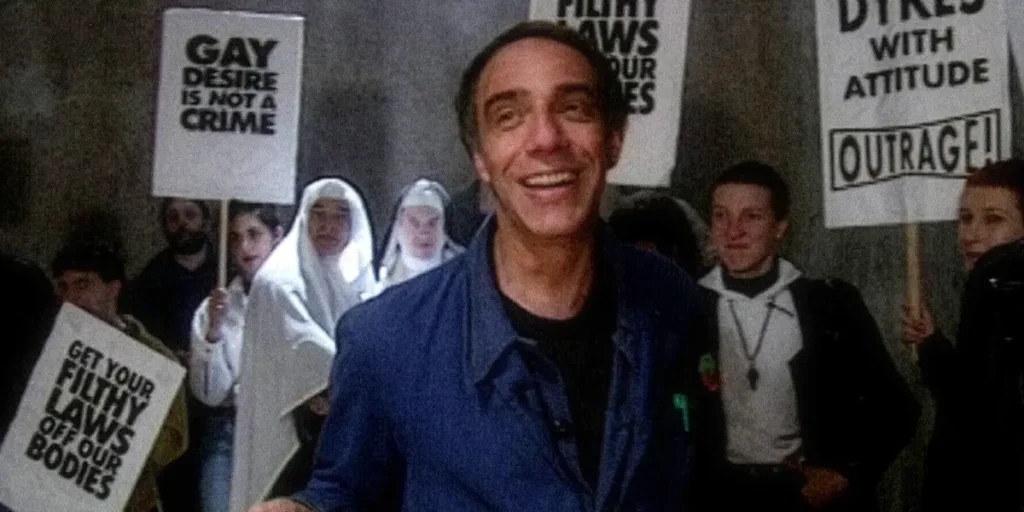
Queer Edward II is a remarkable archival documentary about Derek Jarman, who made his protest film version of Edward II whilst dealing with HIV/AIDS.
Director: Theo Rollason
Genre: Documentary
Run Time: 97′
BFI London Film Festival Screening: October 11, 2026
U.S. Release Date: TBA
U.K. Release Date: TBA
Watching the remarkable Queer Edward II, you are struck by how Derek Jarman was really a singular filmmaking presence. He had initially trained as a painter before working as the production designer on Ken Russell’s The Devils. That led to his work as a director, beginning with Sebastiane in 1976. His films were openly queer, reimagined past figures (Saint Sebastian, Elizabeth I in Jubilee) and often courted controversy as frequently as Jarman made films.
Not even an HIV/AIDS diagnosis in 1986 stopped his work ethic or, as this debut documentary from Theo Rollason makes abundantly clear, his active involvement in the British gay rights movement.
But what made Jarman’s films even more important was the fact he operated in a political climate of homophobia. In Britain, the worldwide stigma over AIDS was coupled with a series of anti-LGBTQ+ legislation passed by Conservative governments. Section 28 banned the ‘promotion of homosexuality’. The proposed Clause 25 of the 1991 Criminal Justice Bill would have criminalised consensual sex acts between gay men in public with the same sentence as rape. There were unequal age of consent laws too (21 compared to 16 for heterosexual acts).
It was in this context in 1991 that Jarman adapted Christopher Marlowe’s play “Edward II”, about the eponymous medieval King of England, his love affair with Piers Gaveston and his betrayal at the hands of his senior figures. Jarman wanted to update it as a protest film that, as a title card for Queer Edward II says, spoke “to the homophobia of the moment.” And during the film’s production, he gave Seamus McGarvey, camera assistant on some of his previous films and future DP of Atonement, free rein to shoot wherever he wanted for a possible behind-the-scenes film. That Betacam footage then sat in a cupboard for decades until Rollason saw it.
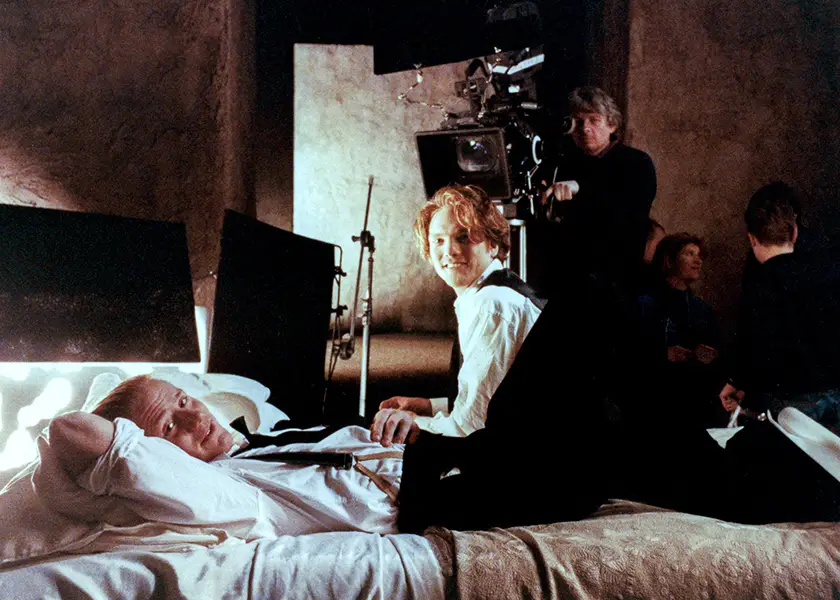
To put it simply, Queer Edward II is immaculately pieced together. Over 30 hours of McGarvey’s footage has been combed through by Rollason and co-editor Nicole Hálová. They both help to illustrate Jarman’s personality (a mix of relaxedness and effervescence), his anachronistic creative vision (as seen in Sandy Powell’s costumes, both historical and contemporary) and his political intentions. We also see the joyous camaraderie across the set and production offices and even some of Jarman’s key collaborators, from Powell and Tilda Swinton (who played Queen Isabella) to Annie Lennox, who sings a cover of Cole Porter’s ‘Ev’ry Time We Say Goodbye’.
There are problems encountered on set. The production was one of the first films funded publicly by the BBC, which wanted no nudity. Jarman doesn’t mind their low budget, though it does mean they are limited in film stock and stretched when the extras demand more money. Meanwhile, when Jarman brings in LGBTQ+ protest group OutRage! for a key scene, they storm into the stages next door, trying to ‘out’ the singer Cliff Richard. That results in a tabloid firestorm that the production has to navigate. For the record, Jarman is vaguely supportive of ‘outing’, the practice of disclosing someone’s sexuality without their consent, here, and it is the only thing that might not age well with some viewers.
Still, with McGarvey’s footage so attentive and rich in detail, Queer Edward II can put a spotlight on it and still be highly absorbing. It doesn’t need to be comprehensive about Jarman’s life, though Rollason adds other archival materials that contextualise Jarman and showcase his activism, whether he is at protests or on TV speaking out against Clause 25. Then there is the HIV diagnosis that he made public (making him one of the first famous figures to do so). The condition hangs over Jarman as he recounts how he has lost so many friends to AIDS, or as he talks of his uncertainty of the future, or as McGarvey pays attention to the medication he needs to take. It makes both his resilience in creativity and his adamance in speaking out against the British government even more powerful.
Jarman’s presence is just one of many delights to be found in Queer Edward II, an amusing, in-the-moment ‘making of’ documentary about a dedicated artist. Rollason uses the archive footage here to find parallels between the collective processes of filmmaking and the activism Jarman played a part in. He manages to pin down what Jarman’s work represents: art as protest, as an inherently political medium. And crucially, as we see with what happened with a vote to change the age of consent law (two days after Jarman’s death in 1994), and with what has happened with LGBTQ+ rights since, the film highlights how necessary the director’s outspokenness is today. It is a must-watch.
Queer Edward II: Movie Plot & Recap
Synopsis:
In 1991, Derek Jarman shoots his adaptation of Christopher Marlowe’s Edward II, which updated its themes of homophobia for the contemporaneous political climate, whilst dealing with his AIDS diagnosis.
Pros:
- 30 hours of archive footage from the set of Edward II, pieced together by Theo Rollason and Nicole Hálová for a remarkable documentary.
- Manages to illustrate Jarman’s boundless creativity, personality and political activism.
Cons:
- Nothing, aside from some outdated views on ‘outing’
Queer Edward II was screened at the BFI London Film Festival on October 11-13, 2026.